Acne in Germanic Healing Knowledge (GHK)
The Biological Purpose
According to GHK, acne is not viewed as a skin malfunction but as the healing phase of a biological program involving the sebaceous glands of the corium skin.
The associated biological conflict is:
- Attack conflict
- Feeling soiled or contaminated conflict
The inflammation, redness, swelling, and pus appear during the healing phase as bacteria assist in breaking down the extra tissue formed during the conflict-active phase. (learninggnm.com)
The Core Emotional Conflicts
1. Feeling Soiled
This can be experienced literally or symbolically.
Examples include:
- Feeling dirty after an unwanted touch.
- Feeling contaminated after sexual abuse.
- Feeling “unclean” after a humiliating experience.
- Feeling emotionally stained by gossip.
- Feeling ashamed after a mistake.
- Feeling that one’s reputation has been “dirtied.”
The psyche interprets these experiences as being “soiled.”
2. Attack Conflict
The person experiences an attack on their integrity.
Examples:
- Harsh criticism.
- Public humiliation.
- Verbal abuse.
- Character assassination.
- Being insulted.
- Feeling emotionally attacked.
- Physical assault.
- Medical procedures perceived as invasive.
The body responds by strengthening the affected area during the conflict-active phase.
3. Disfigurement Conflict
Especially with facial acne.
The cycle often becomes:
A few pimples appear
↓
“I look ugly.”
↓
“I don’t want anyone to see me.”
↓
“I feel ashamed of my face.”
↓
A new attack or soiled conflict begins.
↓
More acne develops.
The appearance of acne itself frequently delays completion of the healing process because it creates another “feeling soiled” conflict. (learninggnm.com)
Why Teenagers Commonly Develop Acne
According to LearningGNM, adolescence is a period when individuals become highly sensitive about:
- Physical appearance
- Acceptance
- Attractiveness
- Peer opinion
- Romantic interest
- Criticism from parents and teachers
Facial acne is therefore common because adolescents may experience repeated feelings of being attacked, embarrassed, or “not good-looking.” (learninggnm.com)
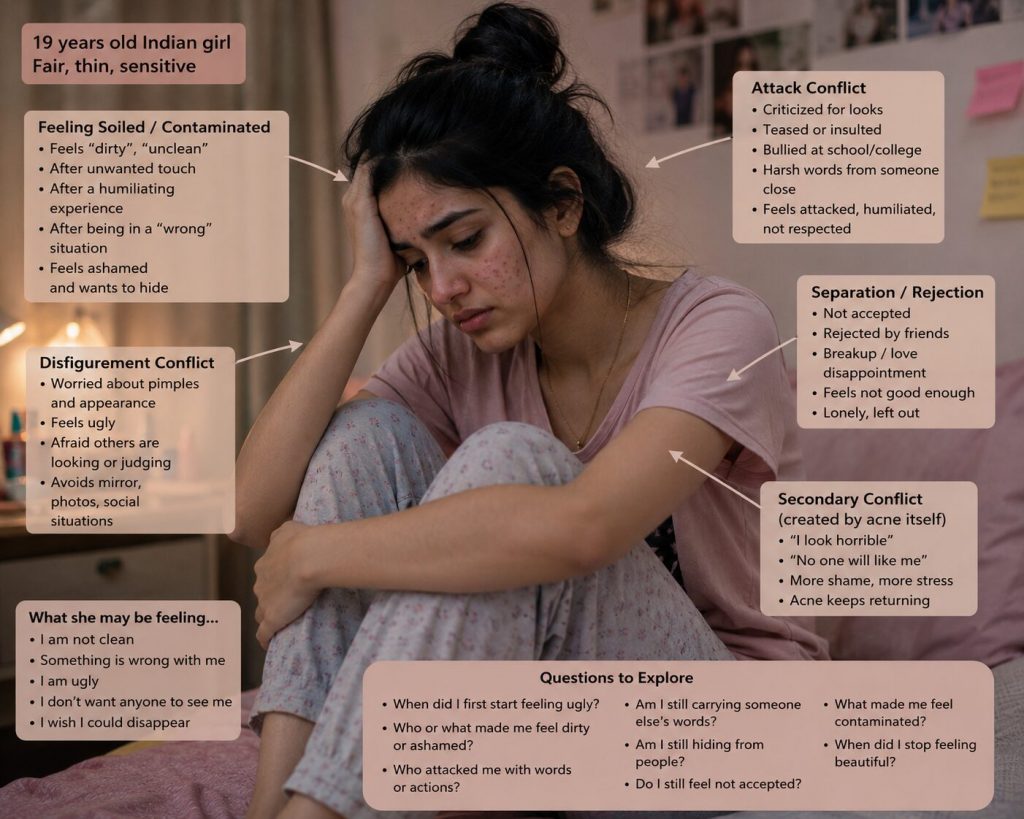
Questions to Explore
Instead of asking only:
“Who separated from me?”
Explore questions such as:
- When did I first begin feeling ugly?
- Who insulted my appearance?
- Did someone make me feel dirty or contaminated?
- Was I verbally attacked?
- Was I publicly embarrassed?
- Do I still feel ashamed about my appearance?
- Did gossip or criticism make me feel stained?
- When did I first start hiding my face?
Case Story 1 – “A Verbal Slap in the Face”
LearningGNM shares the experience of a 61-year-old teaching assistant who developed a large boil-like pimple on her right cheek after a colleague publicly humiliated her during a seminar by angrily cancelling appointments with her in front of respected peers.
She described the incident as feeling like “a slap in the face” and an attack on her integrity. She remained distressed for four days before deciding to let it go. The very next day, the pimple appeared on the right cheek. She interpreted this timing as the healing phase beginning after the emotional conflict was resolved. (learninggnm.com)
Case Story 2 – The Teenage Acne Cycle
LearningGNM describes a common pattern:
A teenager develops a few pimples following conflicts involving criticism, appearance, or social attacks.
Instead of the healing completing, the teenager begins thinking:
- “Everyone is staring at me.”
- “I’m ugly.”
- “Nobody will like me.”
The acne itself becomes a new “feeling soiled” or disfigurement conflict, leading to repeated conflict relapses and chronic acne. (learninggnm.com)
Case Story 3 – Feeling “Dirty”
The LearningGNM skin material also gives examples of conflicts involving literal or symbolic contamination:
- Feeling “unclean” after a sexual insult or unwanted sexual experience.
- Feeling contaminated by “dirty” words or malicious gossip.
- Feeling disgust after contact with something perceived as filthy.
In the GHK framework, these experiences can activate the same biological program affecting the corium skin and sebaceous glands. (learninggnm.com)
How to Complete the Biological Program
According to GHK, healing involves resolving not only the original event but also the emotional meaning attached to it.
Helpful reflection questions include:
- Who or what made me feel attacked?
- What made me feel dirty, ashamed, or contaminated?
- Am I still carrying someone else’s words?
- Am I repeatedly attacking myself every time I look in the mirror?
- Can I see myself as whole despite what happened?
- Is my acne itself becoming the source of a new conflict?
Key Insight
One of the most important observations in LearningGNM is that many chronic acne cases continue not because of the original conflict, but because the individual begins experiencing every new pimple as further evidence of being unattractive, ashamed, or “soiled.” This repeated emotional reaction is thought to reactivate the same biological program, delaying its completion. (learninggnm.com)
For many people, resolving both the original attack/feeling-soiled conflict and the secondary conflict about their appearance is considered central to allowing the biological program to complete within the GHK framework.