Hypertension — GHK Perspective
What is hypertension?
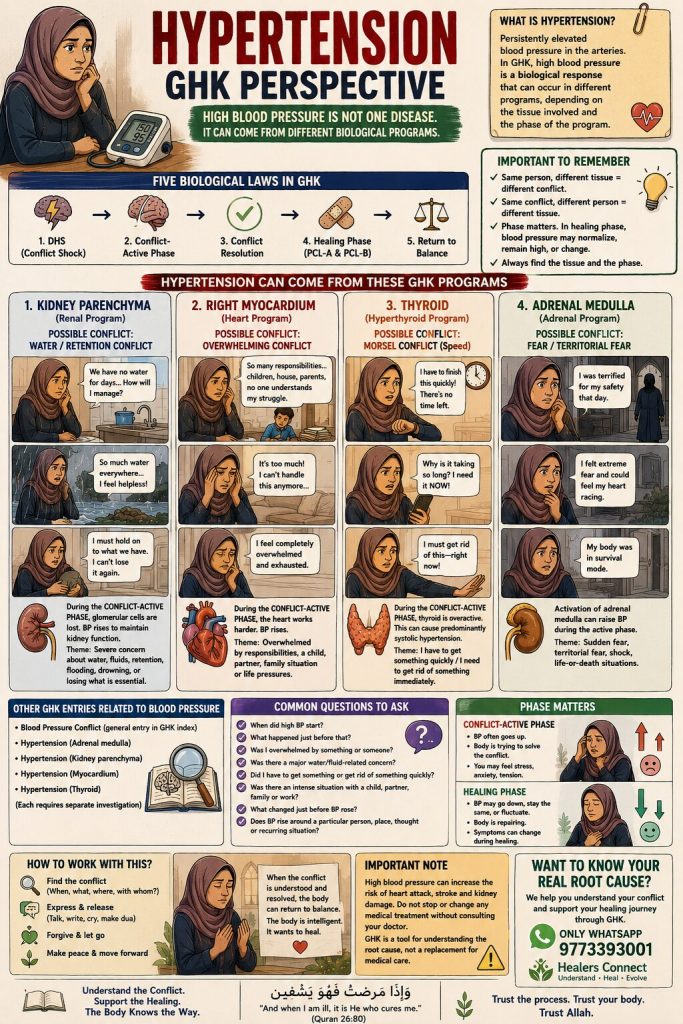
Medically, hypertension means persistently elevated arterial blood pressure. In GHK, elevated blood pressure is interpreted as a biological response that can occur in several different SBS programs, so the organ/tissue involved and the phase of the program matter.
1. Kidney parenchyma — renal conflict
LearningGNM describes hypertension during the conflict-active phase of a kidney parenchyma program. It associates this with a water/retention-related conflict and says that loss of glomerular tissue is accompanied by increased blood pressure, interpreted within GHK as a compensatory mechanism for maintaining kidney function.
Possible themes to investigate:
- Severe concern about water/fluid
- Feeling unable to retain or access something essential
- A situation involving bodily fluids
- Experiences involving flooding, drowning or fear related to water
The exact conflict should be established from the person’s individual DHS rather than imposed beforehand.
2. Right myocardium — overwhelming conflict
Germanic Healing Knowledge also describes hypertension associated with the right myocardium. Its case material gives an example in which hypertension and palpitations were interpreted as an overwhelming negative stress related to mother/child or partner, depending on laterality. ([Learning GNM][3])
So the exploration can include:
“What situation became too much for me to handle?”
Possible areas:
- Feeling overwhelmed by responsibility
- An intense situation involving a child
- An overwhelming relationship situation
- Feeling unable to cope with what was happening
The exact relationship theme depends on handedness, sex and hormonal status in the GHK model.
3. Thyroid — hyperthyroid program
Germanic Healing Knowledge states that an overactive thyroid can produce predominantly systolic hypertension. It associates the underlying thyroid program with a morsel conflict—a biological theme around wanting to obtain something quickly or wanting to get rid of something unwanted.
Questions might therefore include:
- “I have to get this quickly.”
- “I am too slow.”
- “I need to get rid of this immediately.”
- “I can’t get what I need quickly enough.”
4. Adrenal medulla
LearningGNM’s index separately identifies “Hypertension (Adrenal medulla)”, so this should not simply be lumped together with kidney or heart hypertension.
So, what conflicts can lead to hypertension?
In a GHK case investigation, I would therefore not start with “What is the hypertension conflict?”
I would start with:
Where is the biological program?
| GHK pathway | Conflict theme described in GHK |
|---|---|
| Kidney parenchyma | Water/fluid-related conflict |
| Right myocardium | Overwhelming conflict |
| Thyroid | Morsel conflict involving speed/obtaining or eliminating |
| Adrenal medulla | Requires separate adrenal-medulla mapping |
| General Blood Pressure Conflict | Listed separately in the GHK index and requires its own assessment |
GHK also emphasizes that an SBS has a conflict-active phase and, after resolution, a healing phase, so the same person’s blood pressure may change depending on where they are in the biological program.
The most useful questions for a real case
- When did the blood pressure first become elevated?
- What happened immediately before that?
- Was there an overwhelming situation?
- Was there a major concern involving water or fluid?
- Was there a situation where something had to happen faster?
- Was there an intense situation involving child, partner or family?
- What changed immediately before the BP rose?
- Does the BP rise around a particular person, place, thought or recurring situation?
That timeline is much more useful in GHK than assigning a generic emotional label to everyone with hypertension.