Understanding Myasthenia Gravis Through Germanic Healing Knowledge
In Germanic Healing Knowledge (GHK), Myasthenia Gravis is not viewed as an autoimmune disease in which the body attacks itself. Instead, it is understood as a Meaningful Biological Special Program (SBS) involving the striated skeletal muscles and the motor cortex of the brain.
According to this perspective, muscle weakness reflects a biological adaptation associated with a specific motor conflict.
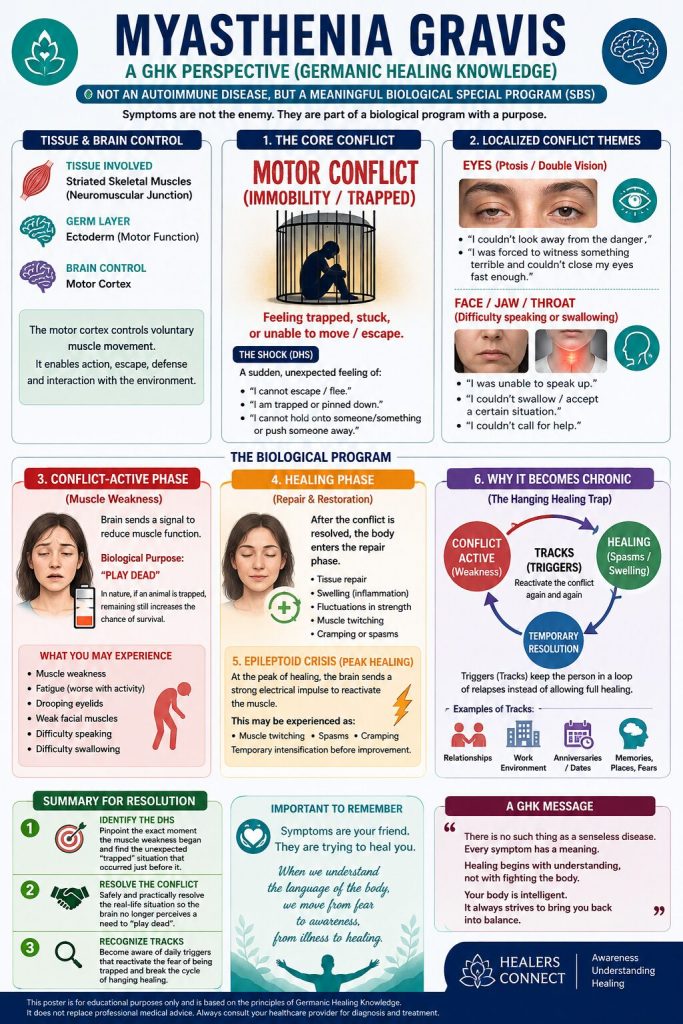
Tissue Involved
Striated Skeletal Muscles
- Germ Layer: Ectoderm (motor function)
- Brain Control: Motor Cortex
The skeletal muscles enable movement, protection, escape, and interaction with the environment.
Primary Biological Conflict
Motor Conflict – “I Cannot Move”
The central conflict theme is:
“I am trapped.”
“I cannot escape.”
“I cannot defend myself.”
“I cannot hold on.”
“I cannot push away.”
This conflict is typically experienced as an unexpected and emotionally overwhelming event (DHS), where the individual feels physically or emotionally immobilized.
Localized Conflict Themes
The location of symptoms may provide additional clues.
Eyes (Ptosis / Double Vision)
Possible themes include:
- “I couldn’t look away.”
- “I was forced to witness something distressing.”
- “I wished I hadn’t seen it.”
- “I couldn’t close my eyes to what was happening.”
Face, Jaw & Throat
Possible themes include:
- “I couldn’t speak up.”
- “I couldn’t express myself.”
- “I couldn’t swallow or accept what happened.”
- “I couldn’t call for help.”
Conflict-Active Phase
During the conflict-active phase, the motor conflict remains unresolved.
According to GHK, the biological adaptation is a functional reduction of muscle activity, resulting in:
- Muscle weakness
- Fatigue with repeated movement
- Drooping eyelids
- Weak facial muscles
- Difficulty speaking
- Difficulty swallowing
The intensity of symptoms is believed to correspond to the intensity and duration of the unresolved conflict.
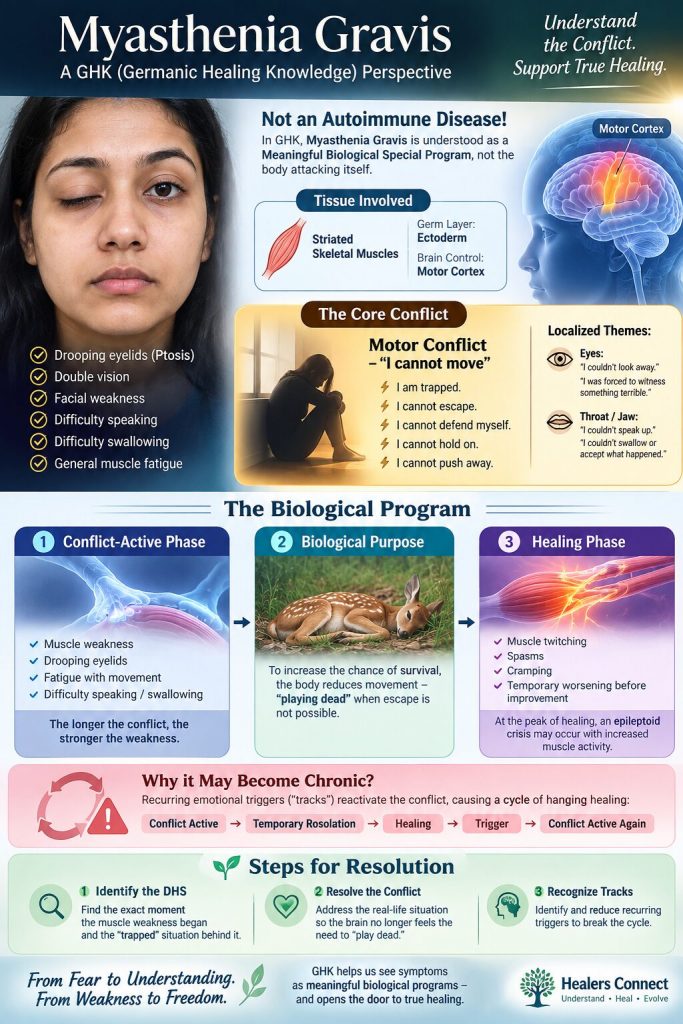
Biological Purpose
Within the GHK framework, the temporary reduction in muscle function is interpreted as a survival adaptation.
In nature, when escape is impossible, remaining motionless (“playing dead”) may increase the chances of survival.
From this perspective, the body temporarily reduces movement until the perceived danger has passed.
Healing Phase
When the motor conflict is resolved, the body enters the repair phase.
Possible features include:
- Muscle twitching
- Muscle spasms
- Cramping
- Temporary fluctuations in strength
The Epileptoid Crisis
At the peak of the healing phase, GHK describes an epileptoid crisis.
This represents a brief period during which the nervous system temporarily increases activity before healing continues.
Depending on the tissues involved, this may be experienced as:
- Muscle spasms
- Twitching
- Increased muscle activity
- Temporary worsening before improvement
Why Symptoms May Become Chronic
According to GHK, persistent symptoms may occur because of tracks (triggers).
Tracks are reminders of the original conflict that repeatedly reactivate the biological program.
Examples include:
- Returning to the same stressful environment
- Seeing a particular person
- Certain places or situations
- Emotional memories
- Fear of the symptoms themselves
Repeated activation may lead to a cycle of:
Conflict Active → Temporary Resolution → Healing → Trigger → Conflict Active Again
This recurring pattern is described as a hanging healing state.
Questions to Explore
A GHK practitioner may ask:
- When did the first muscle weakness appear?
- What unexpected event occurred just beforehand?
- Where did you feel trapped or unable to act?
- Was there someone you wanted to push away or hold onto but couldn’t?
- Were you unable to express yourself?
- What situations continue to trigger these feelings today?
Supporting Resolution
Within the GHK framework, the focus is on understanding and resolving the underlying conflict.
This may include:
1. Identifying the DHS
Explore the unexpected event that preceded the onset of symptoms.
2. Resolving the Conflict
Address the real-life situation so that the brain no longer perceives the need for the biological adaptation.
3. Recognizing Tracks
Identify recurring emotional triggers that reactivate the conflict and work toward reducing their impact.
Healers Connect Summary
GHK Perspective: Myasthenia Gravis is understood as a biological program involving the motor cortex and skeletal muscles, triggered by a motor conflict related to feeling trapped, unable to move, defend, or express oneself. Muscle weakness is interpreted as occurring during the conflict-active phase, while muscle twitching or spasms may occur during the healing phase. Long-term or fluctuating symptoms are understood within GHK as repeated conflict relapses caused by unresolved emotional triggers (“tracks”). Understanding the conflict timeline, resolving the original conflict, and recognizing recurring triggers are central to the GHK approach.