Understanding Kidney Stones
Kidney stones are hard mineral deposits that form within the kidneys or urinary tract. Symptoms may include:
- Severe flank pain
- Lower back pain
- Painful urination
- Blood in the urine
- Nausea and vomiting
- Urinary urgency
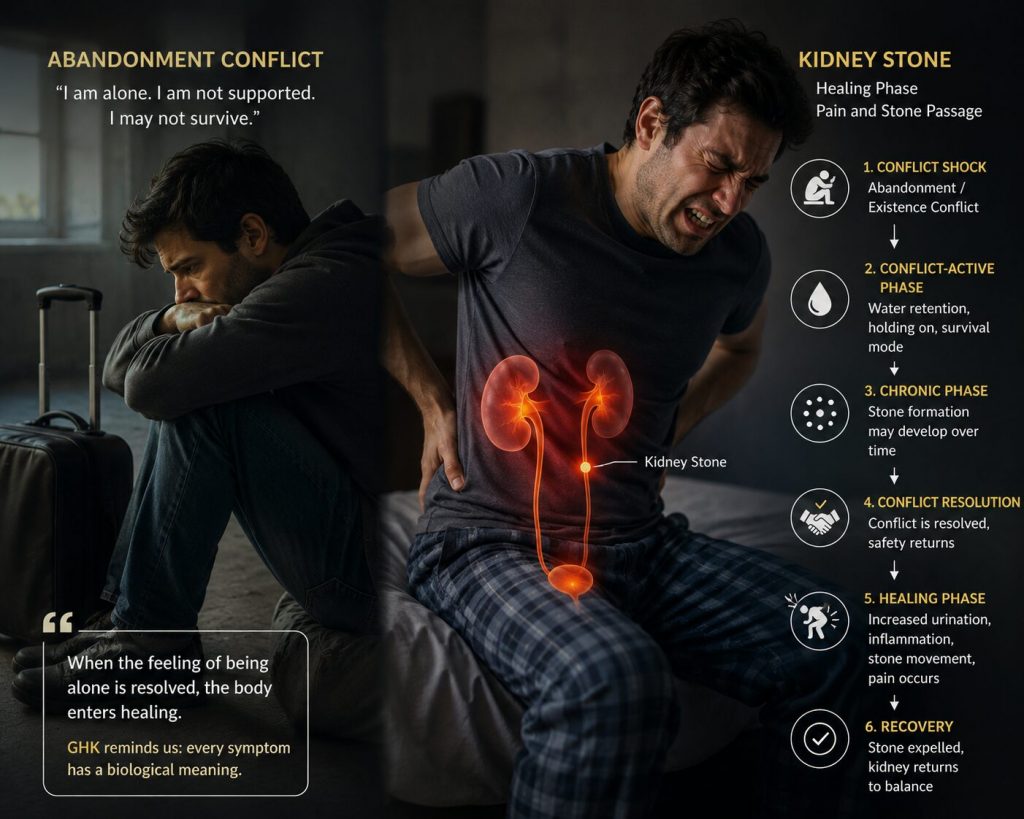
Within Germanic Healing Knowledge, kidney stones are not viewed primarily as a mineral imbalance. The focus is on the biological programs affecting the kidneys, renal pelvis, ureters, and kidney collecting tubules and the emotional conflicts associated with these tissues.
Biological Conflict Themes
1. Abandonment / Existence Conflict
The kidney collecting tubules are associated with:
- Feeling abandoned
- Feeling left alone
- Fear for survival
- Refugee conflict
- Feeling uprooted
- Loss of home or security
This is often described as a “fish out of water” conflict.
Examples:
- Divorce
- Death of a loved one
- Financial collapse
- Leaving home
- Immigration
- Hospitalization
- Feeling unsupported during illness
2. Territorial Marking Conflict
The renal pelvis and ureters are associated with:
- Boundary violations
- Territorial intrusion
- Personal space conflicts
- Feeling someone is invading your territory
Pain frequently appears during the healing phase after resolution of these conflicts.
Brain Relay and Germ Layer
| Component | Relationship |
|---|---|
| Biological Conflict | Abandonment / Existence Conflict |
| Brain Relay | Brainstem |
| Germ Layer | Endoderm |
| Organ | Kidney Collecting Tubules |
| Conflict-Active Phase | Water Retention |
| Healing Phase | Increased Urination |
| Component | Relationship |
|---|---|
| Biological Conflict | Territorial Marking Conflict |
| Brain Relay | Cerebral Cortex |
| Germ Layer | Ectoderm |
| Organ | Renal Pelvis & Ureters |
| Conflict-Active Phase | Ulceration |
| Healing Phase | Pain, Inflammation, Stone Passage |
How Kidney Stones Are Viewed in GHK
GHK discussions often associate recurring kidney stones with recurring kidney programs and unresolved conflict tracks.
The typical sequence described is:
Conflict Shock
↓
Water Retention / Kidney Program
↓
Conflict Resolution
↓
Healing Phase
↓
Pain, inflammation, stone movement, urinary symptoms
↓
Recovery
Case Study: Rainer the Boxer Dog
One of the most widely cited kidney-related cases in LearningGNM involves a boxer dog named Rainer.
Presenting Symptoms
After being separated from his young owner, Pablo, Rainer developed:
- Severe water retention
- Disorientation
- Minimal urination
- Weakness
- Symptoms resembling kidney failure
The separation occurred after the boy traveled away from home for several weeks.
Biological Conflict
Abandonment Conflict
Rainer experienced:
“I have been left alone.”
The separation from his companion triggered an intense abandonment conflict.
Symptoms
- Retained approximately 5 kg of water
- Produced very little urine
- Appeared confused and disoriented
- Developed signs that conventional medicine might interpret as acute kidney failure
Resolution
The dog was returned to the care of his mother.
Within a short period:
- He began urinating normally
- Eliminated large amounts of retained fluid
- Regained orientation
- Returned to near-normal functioning
The presence of safety, familiarity, and connection resolved the abandonment conflict.
GHK Summary
Conflict
Abandonment
↓
Brain Relay
Brainstem
↓
Organ
Kidney Collecting Tubules
↓
Conflict-Active Phase
Water Retention
↓
Resolution
Reunion and Safety
↓
Healing Phase
Profuse Urination
↓
Recovery
Normal Function Restored
Questions Often Explored
- When did I first feel abandoned?
- Did symptoms begin after a move or separation?
- Was there a financial survival crisis?
- Did I feel unsupported during illness?
- Was there a loss of home, partner, family, or security?
Supporting Resources
📖 LearningGNM – Kidneys and Bladder
📖 LearningGNM – Kidneys: Abandonment Conflict
LearningGNM Kidney Testimonial (Rainer)
📖 LearningGNM – The Syndrome
Key Insight
Many kidney-related GHK cases revolve around a surprisingly simple emotional theme:
“I am alone.”
Whether experienced through separation, loss, exile, relocation, divorce, financial insecurity, or feeling unsupported, the kidney programs are often explored through the lens of survival, belonging, and connection.