Understanding Thrombocytopenia
Thrombocytopenia refers to a low platelet count in the blood. Platelets are involved in blood clotting and wound repair. People with thrombocytopenia may experience:
- Easy bruising
- Bleeding gums
- Nosebleeds
- Small red or purple skin spots (petechiae)
- Prolonged bleeding after injury
- Fatigue
From a Germanic Healing Knowledge perspective, thrombocytopenia is not viewed as an isolated blood disorder. Instead, it is explored in relation to the biological programs involving the bone marrow, which is responsible for blood-cell production.
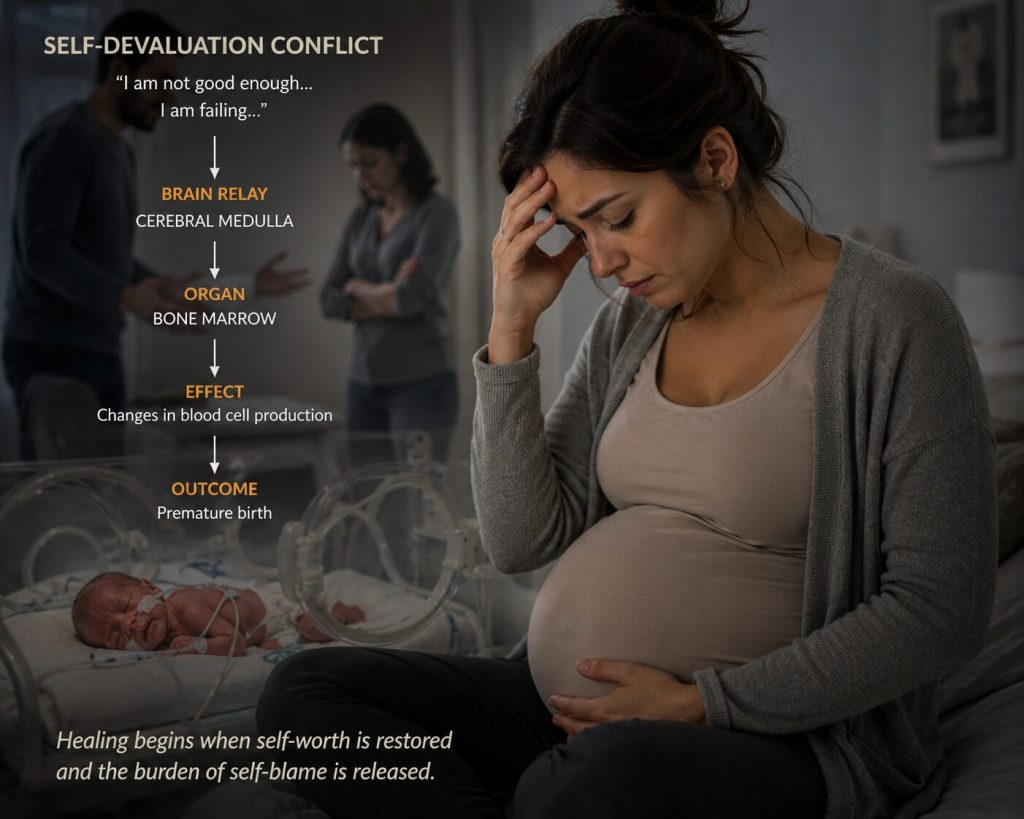
The Biological Conflict
Within GHK, the bone marrow is associated with a self-devaluation conflict.
This may involve experiences such as:
- Feeling inadequate
- Feeling like a failure
- Loss of status or respect
- Being criticized or rejected
- Feeling unable to perform a role
- Not feeling good enough
The specific nature of the self-devaluation often reflects the area of life where the conflict occurred.
Brain Relay and Germ Layer
| Component | Relationship |
|---|---|
| Biological Conflict | Self-Devaluation Conflict |
| Brain Relay | Cerebral Medulla |
| Germ Layer | New Mesoderm |
| Organ | Bone Marrow |
| Conflict-Active Phase | Reduced marrow function |
| Healing Phase | Bone marrow restoration |
Conflict-Active Phase
During the conflict-active phase:
- The person remains preoccupied with the self-worth conflict.
- Bone marrow activity may decrease.
- Blood-cell production can be affected.
- Symptoms may remain unnoticed initially.
Emotionally, the individual often feels defeated, incapable, or diminished.
Healing Phase
Once the self-devaluation conflict is resolved:
- Bone marrow begins rebuilding.
- Blood production is restored.
- Significant changes in blood counts may occur during the healing process.
GHK often discusses platelet counts in the broader context of bone marrow healing and regeneration.
The intensity of the healing phase is believed to correspond to the intensity and duration of the original conflict.
Common Life Situations
Examples that may be explored include:
- Losing a job or career position
- Academic failure
- Feeling like a poor parent
- Athletic defeat
- Public embarrassment
- Loss of physical ability
- Feeling unable to support loved ones
The key question is often:
“When did I begin feeling less valuable, less capable, or not good enough?”
Questions for Self-Inquiry
- What challenged my self-worth before the symptoms appeared?
- Did I experience criticism, rejection, or humiliation?
- Was there a situation where I felt I had failed?
- Did symptoms begin after the situation improved or resolved?
- What role or identity felt threatened?
GHK Summary
Conflict Shock
Self-Devaluation
↓
Brain Relay
Cerebral Medulla
↓
Organ
Bone Marrow
↓
Conflict-Active Phase
Reduced marrow activity
↓
Conflict Resolution
Self-worth restored
↓
Healing Phase
Bone marrow regeneration and changes in blood counts
Final Thoughts
From a GHK perspective, thrombocytopenia invites exploration of self-worth and self-devaluation themes. The bone marrow is viewed as responding to experiences that challenge a person’s sense of value, competence, or identity.
Understanding the emotional experiences that preceded the symptoms may offer insight into the biological program and its healing process.