In Germanic Healing Knowledge (GHK / GNM), Religious OCD (Scrupulosity)—characterized by intrusive thoughts of sin, fear of divine punishment, blasphemous doubts, and compulsive religious rituals or prayers—is not viewed as a psychiatric defect or a moral/spiritual failure.
Instead, it is understood as a Schizophrenic Biological Constellation involving specific cortical and subcortical brain relays.
1. What Is a Biological Constellation in GHK?
In GHK, obsessive-compulsive behaviors occur when an individual experiences two or more active biological conflict shocks (Dirk Hamer Syndromes / DHS) simultaneously affecting opposite hemispheres of the brain.
- The Biological Purpose (Sinn): When the brain enters a constellation, the accumulation of physical conflict mass is largely halted. This protects the physical organs from severe tissue breakdown or fatal organ overload.
- Psychological Shift: The conflict energy is redirected into the mind, creating hyper-vigilance, compulsive rituals, or persistent mental looping to keep the individual “on guard” against a perceived threat.
2. The Conflict Themes Behind Religious OCD
Religious OCD typically arises from a combination of specific biological conflict shocks:
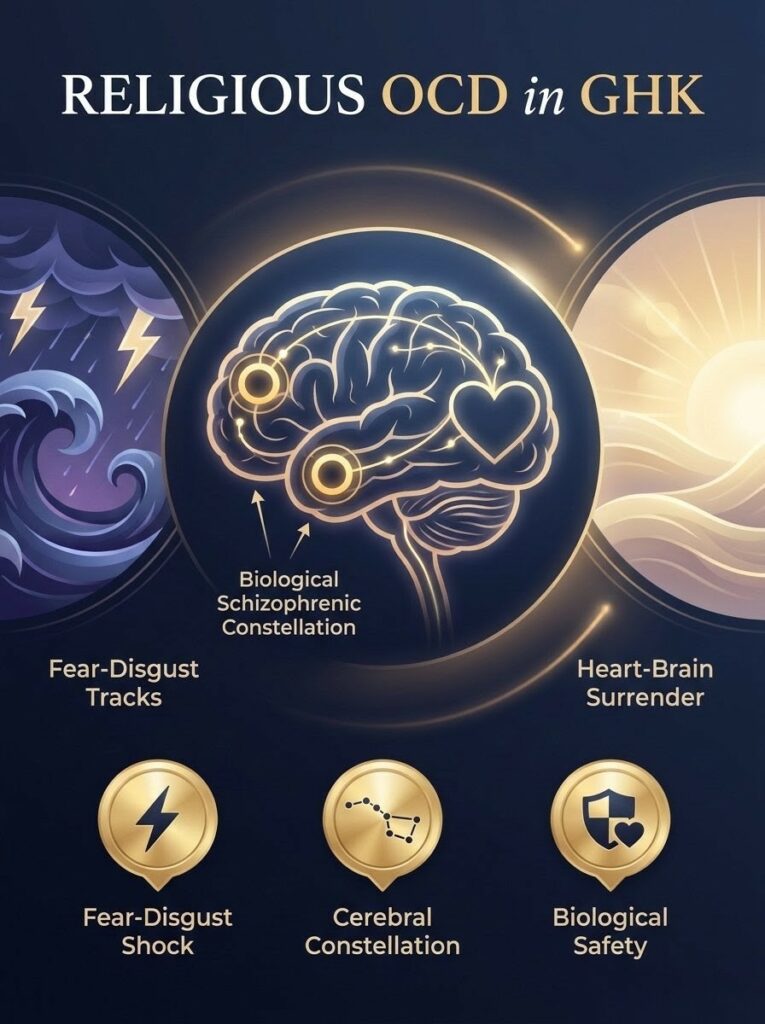
- Fear-Disgust Conflict (Angst-Ekel-Konflikt):
- Core Feeling: Experiencing a situation perceived as deeply repulsive, dirty, morally corrupting, or spiritually defiling (“I am unclean,” “This is a sin,” “I have been corrupted”).
- Brain Level: Controlled in part by the diencephalon / alpha-islet cell relays.
- Frontal-Fear Conflict (Frontalangst-Konflikt) & Powerlessness:
- Core Feeling: Acute fear of what lies ahead—specifically imagining the worst-case scenario (such as divine retribution, hell, eternal damnation, or unforgivable mistakes).
- Brain Level: Controlled by the frontal lobe cortex relays.
- Separation & Postmortem / Afterlife Relays:
- Core Feeling: Fear of being severed or cast out from the spiritual community, family, or God.
- Postmortem Accentuation: When a severe territorial or separation shock occurs, the mind often tilts toward the Postmortem Constellation, causing an intense, hyper-focused obsession with death, the afterlife, sin, and religious rituals.
3. Why Compulsions and Rituals Form
- The “Undo” Safety Mechanism: Compulsive actions—such as repeating prayers until they feel “perfect,” constant confession, washings, or checking for bad thoughts—are subconscious attempts to neutralize the fear-disgust shock and prevent the imagined future disaster.
- Subconscious Tracks (Schienen): Religious words, sacred spaces, moral doubts, or specific thoughts act as subconscious triggers (tracks). Every time a track is touched, it briefly reactivates the conflict relays, triggering a fresh wave of panic and driving the urge to perform the compulsive ritual.
4. GHK Self-Facilitation & Resolution Approach
- Dismantle the Panic & Guilt:
- Recognize that intrusive thoughts and compulsions are a biological brain response to unresolved fright/disgust shocks—not proof that one is a “bad person” or rejected by God.
- Removing the secondary fear of “Why am I having these terrible thoughts?” lowers overall stress innervation (sympathicotonia).
- Uncover the Root Conflict Shocks:
- Trace back to when the scrupulosity first began: Was there a traumatic childhood experience of severe religious shaming, fear of hell, an unexpected loss, or a situation where one felt spiritually “defiled” or powerless?
- Shift from Fear-Based Control to Genuine Faith & Surrender:
- GHK reference texts emphasize that true spiritual connection, prayer, and meditation should ground the individual in safety, peace, and surrender rather than rigid panic or fear of punishment.
- Surrendering the burden of trying to control every outcome signals to the brain central computer that the danger has passed, allowing the constellation to naturally dissolve.