
Presenting Diagnosis
David was initially diagnosed with melanoma on his right cheek in 2005.
Following several surgeries, a CT scan in May 2006 revealed multiple lesions in the lungs, which were interpreted as metastatic cancer. He was subsequently classified as Stage IV.
The First Conflict Shock
Several months before the melanoma diagnosis, David became unexpectedly involved in a business lawsuit involving a close friend.
He described feeling:
- Deeply upset
- Humiliated
- Personally attacked
- His integrity was questioned
Within GHK, this corresponds to an attack conflict affecting the corium skin. David experienced the event as an attack against his person and reputation.
Conflict-Active Phase (Melanoma Program)
Psyche
“I was attacked.”
Brain
Cerebellum relay associated with the corium skin.
Organ
Corium skin of the face.
Biological Purpose
The body responds by producing additional tissue at the perceived attack site.
The lesion appeared on the cheek, the area symbolically associated with the attack.
Conflict Resolution
After the conflict was resolved, healing began.
Within GHK, healing of a corium skin conflict involves decomposition of the additional tissue, inflammation, bleeding, and changes in appearance.
This healing stage is often when melanoma is considered more concerning medically because tissue changes become visible.
Second Conflict Shock
The melanoma diagnosis itself created a new conflict.
David describes receiving a diagnosis of malignant melanoma and later Stage IV cancer.
This produced intense fear regarding survival and death.
Death-Fright Conflict
Psyche
“I might die.”
Brain
Brainstem relay associated with lung alveoli.
Organ
Lung alveoli.
Biological Purpose
In GHK, a death-fright conflict activates the lung alveoli program.
Additional alveolar tissue is produced to increase oxygen uptake, symbolically improving survival capacity during a life-threatening situation.
Evidence of Resolution
Between May and July 2006, four significant events occurred:
- He learned about German New Medicine.
- He received the Sacrament of the Anointing of the Sick.
- He entered a treatment program.
- He began counseling specifically to address his fear of death.
The counseling and spiritual support helped him process and resolve the death-fright conflict.
Healing Phase
A subsequent CT scan showed that the lung lesions had stopped growing.
Further scans showed:
- Reduction in lesion size
- Continued reduction over several months
- Eventual disappearance of most abnormalities
- Three consecutive clear scans by August 2007
Within GHK, this would be interpreted as the healing phase following resolution of the death-fright conflict.
Emotional Turning Point
The key turning point was not the appearance of the lesions.
The turning point was David’s shift from:
“I am under a death sentence”
to
“I am no longer living in fear of death.”
He specifically credits counseling and spiritual support for helping him reach this point.
GHK Summary
Program 1
Attack Conflict
→ Corium Skin
→ Melanoma
Program 2
Death-Fright Conflict
→ Lung Alveoli
→ Lung Lesions
Resolution
- Emotional understanding
- Counseling
- Spiritual support
- Reduction of fear
Outcome
Progressive reduction of lung lesions and multiple clear CT scans.
Key Insight
This case illustrates a common GHK pattern:
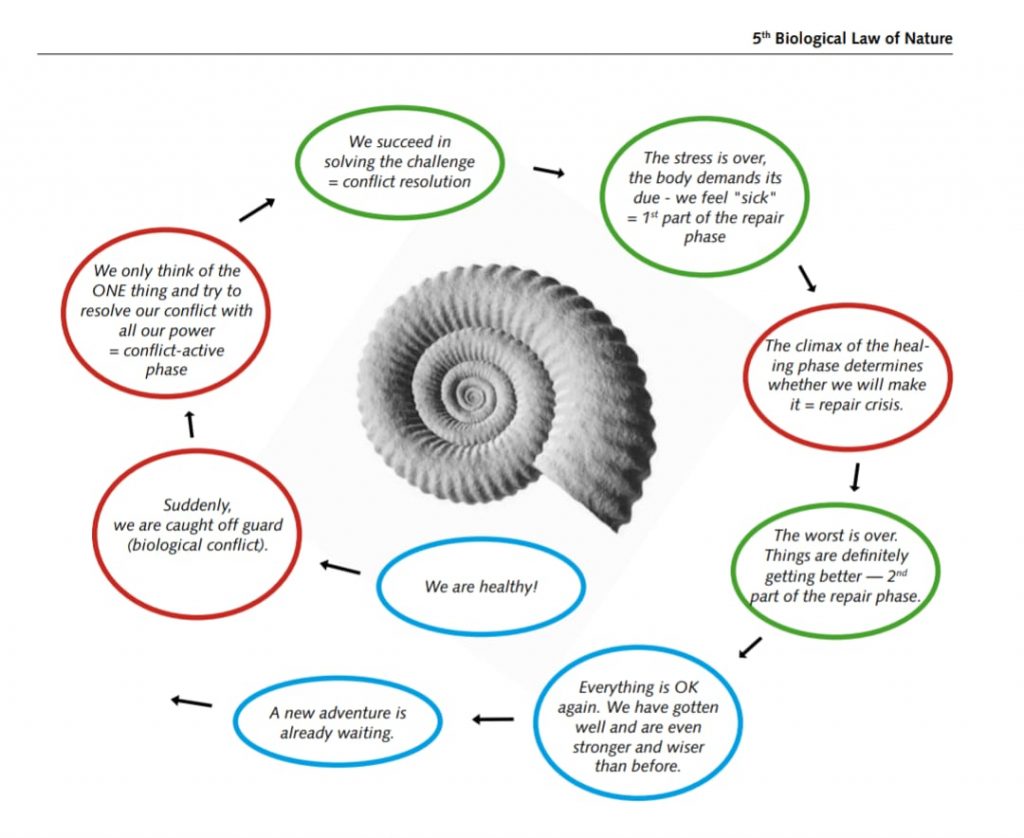
Unexpected conflict shock → biological adaptation → diagnosis shock → secondary conflict → resolution → healing.
The testimonial emphasizes how the emotional meaning of events changed over time and how addressing fear became a central part of David’s healing journey.
Download Source File
note : Image used for reference purpose