Is Melasma Only a Pigmentation Problem
or Can the Skin Reflect a Deeper Biological Conflict?
Melasma is commonly described as an acquired pigmentation condition, particularly affecting the face. From the GHK/GNM framework, however, pigmentation is explored through the biological meaning attributed to the skin and the person’s experience around the time the pigmentation appeared.
LearningGNM explains that the corium (dermis) contains melanocytes, which produce melanin, and associates this skin layer in its model with “attack” and “feeling soiled” conflicts. It also describes a separate conflict pattern for the epidermis involving separation. (Learning GNM)
The GHK question is therefore not simply: “Why is the pigment increasing?” It is: “What was happening in my life when my skin changed?”
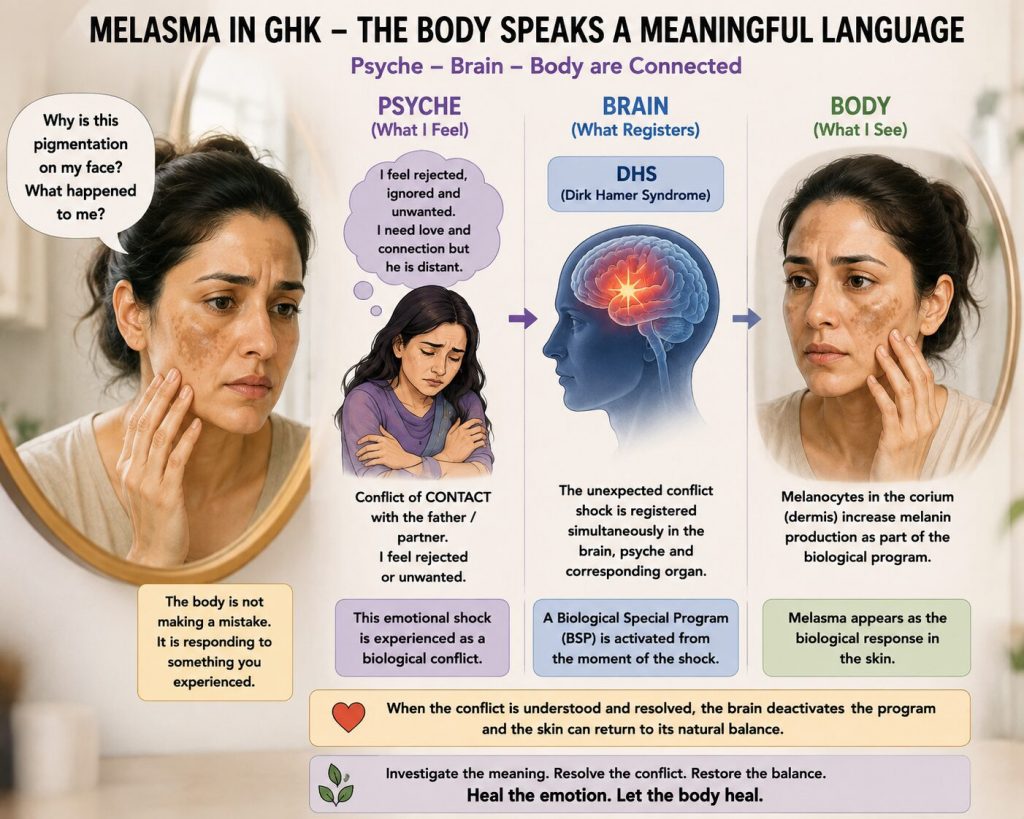
🔍 The GHK Interpretation of Pigmentation
According to LearningGNM, the corium skin has a protective function. Within the GHK model, an experience perceived as an attack, insult, criticism, humiliation, or feeling soiled may be associated with a biological program involving this layer of skin. (Learning GNM)
Examples given within the GHK framework include experiences such as:
- Feeling attacked or physically threatened
- Being verbally attacked or harshly criticized
- Feeling humiliated or insulted
- Feeling discriminated against
- Feeling “soiled” or unclean
- Feeling that one’s integrity has been attacked
- Experiencing a particular part of the body as being attacked or “soiled”
The location can therefore become part of the case-taking process.
🌸 Why the Face?
When pigmentation appears predominantly on the face, GHK-style case taking can explore the person’s relationship with:
Appearance
“How do I feel about the way I look?”
Being seen
“Do I feel judged or exposed?”
Identity
“Has something happened that changed how I see myself?”
Relationships
“Did someone make me feel rejected, criticised or humiliated?”
Contact
“Was there a significant change in physical or emotional contact with someone?”
These questions aren’t intended to manufacture an emotional explanation. They are used to establish a timeline and personal meaning around the symptom.
🤰 Melasma During Pregnancy
Pregnancy-associated facial pigmentation is particularly interesting from a GHK perspective.
When melasma begins during pregnancy, the case-taking process can explore what changed in the woman’s life around pregnancy.
For example:
“What changed in your relationship after becoming pregnant?”
“Did you feel closer to your partner—or more distant?”
“Did you feel rejected, neglected or controlled?”
“Was there an unexpected change in physical contact?”
“Did becoming a mother change how you felt about your own identity?”
“How did you feel about your changing body and appearance?”
The important point is that GHK case-taking looks for the specific experience, rather than simply concluding:
“Pregnancy caused the pigmentation.”
🧠 The Psyche–Brain–Skin Connection
The central GHK idea is that psyche, brain and organ are considered parts of one biological process.
LearningGNM describes the corium as being controlled from the cerebellum, and its model associates corium changes with attack or “feeling soiled” conflicts. (Learning GNM)
The GHK case-taking sequence therefore becomes:
Unexpected experience
↓
How did I perceive it?
↓
What did it mean to me?
↓
Which biological conflict does GHK associate with that perception?
↓
Which tissue is involved?
↓
What phase is the body apparently in?
↓
Are there recurring triggers?
This is why two people can experience the same external event but potentially have very different biological responses within the GHK model.
🔄 What About Recurring Pigmentation?
One of the most useful GHK concepts for chronic or recurring conditions is the idea of tracks.
LearningGNM describes recurring skin conditions as potentially resulting from repeated reactivation of the original separation conflict through associated “tracks.” It calls a prolonged unresolved cycle “hanging healing.” (Learning GNM)
For a GHK practitioner, this leads to questions such as:
When did the pigmentation first appear?
What was happening immediately beforehand?
When does it become more noticeable?
Are there particular people or situations associated with worsening?
Does the same emotional experience keep repeating?
Does looking in the mirror itself now trigger distress?
That last question is particularly important.
A person develops pigmentation.
Then they become distressed about their appearance.
They worry about being judged.
They become increasingly conscious of their face.
The appearance itself becomes emotionally charged.
From a GHK perspective, the original conflict and later “tracks” may therefore need to be distinguished.
🔁 The Possible Cycle
A GHK-style case may be explored as:
Unexpected emotional experience
↓
Conflict shock
↓
Biological response
↓
Visible pigmentation
↓
Concern about appearance
↓
New emotional trigger
↓
Reactivation of the original pattern
The practitioner therefore doesn’t stop at:
“When did the melasma start?”
The next question becomes:
“What happens in your life when it becomes more noticeable?”
🧩 A GHK Case-Taking Example
Imagine a woman whose pigmentation began during pregnancy.
Rather than immediately assigning a conflict, the practitioner could ask:
Practitioner:
“When did you first notice the pigmentation?”
Woman:
“About four months into pregnancy.”
Practitioner:
“What was happening in your life around that time?”
Woman:
“My husband had become very distant. I felt completely unwanted.”
Practitioner:
“What did that experience mean to you?”
Woman:
“I felt rejected. I wanted him close, but I felt he didn’t want to be around me.”
Now there is a story worth investigating.
The practitioner can then explore:
contact → rejection → pregnancy → relationship change → emotional perception → onset of pigmentation
That is fundamentally different from simply saying:
“Your hormones caused melasma.”
The GHK approach asks whether there is a specific biological conflict corresponding to the person’s experience.
🌿 Resolution From a GHK Perspective
The objective is not to fight the skin.
It is to understand the underlying experience.
1. Identify the experience
What happened unexpectedly?
2. Identify the perception
How did the person experience it?
3. Identify the biological conflict
What conflict does GHK associate with that perception?
4. Identify recurring tracks
What people, places, situations, memories or sensations reactivate the experience?
5. Resolve the emotional situation
Can the person change their relationship with what happened?
6. Restore self-acceptance
Can the person stop experiencing their appearance as something shameful or defective?
7. Observe the biology
What happens to the skin as the emotional pattern changes?
🌸 The Deeper Question
Melasma can become much more than a cosmetic concern.
A woman may begin with:
“Why are these dark patches appearing?”
But after deeper case-taking, the questions can become:
“When did I begin feeling rejected?”
“When did I begin feeling judged?”
“When did I stop feeling comfortable in my own skin?”
“What happened to my relationship?”
“What happened to the way I see myself?”
And ultimately:
“Can I make peace with what happened?”
That is where the GHK perspective moves from treating the visible skin to investigating the story behind it.
The GHK takeaway
“Don’t only ask what is happening on the skin. Ask what happened in the person’s life when the skin changed.”
Within GHK, pigmentation and skin symptoms are interpreted as meaningful biological programs rather than random malfunctions. LearningGNM specifically associates the corium with attack/“feeling soiled” conflicts and the epidermis with separation conflicts, with the skin’s location and timing considered important in case-taking. (Learning GNM)
Reference: LearningGNM — Skin
Note: The “father/contact” interpretation sometimes presented specifically for melasma is not established as a dedicated melasma explanation on the LearningGNM skin page; it should therefore be presented as a GNM-derived interpretation rather than attributed directly to LearningGNM as a specific melasma protocol.