I got a call asking for homeopathic remedies to address Canine distemper outbreak in Andaman and Nicobar islands
Canine Distemper Through the Lens of Germanic New Medicine (GNM)
In Germanic New Medicine, diseases in animals—including dogs—are not viewed as random attacks by malicious pathogens or genetic failures. Instead, they are understood as Biological Special Programs (BSPs) triggered by a specific, unexpected biological conflict shock (DHS) tailored to the animal’s survival needs.
Modern veterinary science attributes Canine Distemper to the Canine distemper virus (CDV). In GNM, viruses, bacteria, and fungi are not the cause of the disease; rather, they are intelligent symbionts managed by the brain to assist during the Healing Phase (PCL Phase) of a biological conflict.
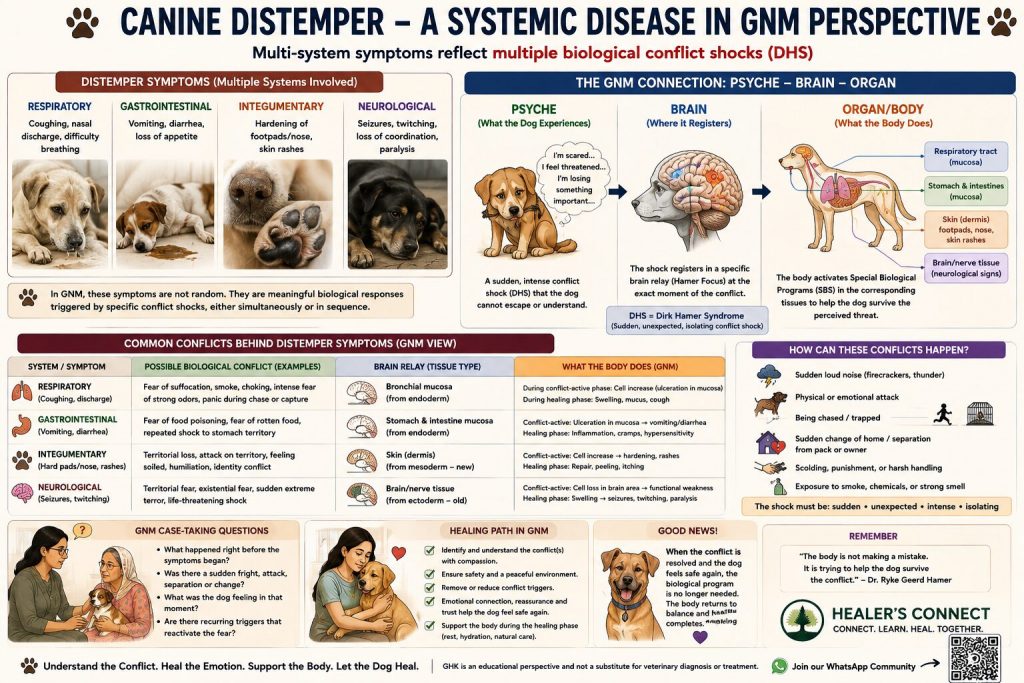
The Biological Conflicts Behind Canine Distemper Symptoms
Canine Distemper is a systemic disease that typically affects multiple organ systems: respiratory (coughing, nasal discharge), gastrointestinal (vomiting, diarrhea), integumentary (hardening of the footpads/nose, skin rashes), and neurological (seals/twitches). In GNM, a multi-system condition like distemper usually represents a combination of specific conflict shocks running simultaneously or sequentially:
1. Respiratory Involvement (Bronchial Cough / Pneumonia)
- The Conflict: Territorial Fear Conflict or Death-Fright Conflict.
- The Context for a Dog: A dog experiences a sudden terror regarding its territory (home, owner, yard) being threatened, or an existential “death-fright” (e.g., being abandoned, trapped, or facing an extreme threat to its life).
- Active Phase: Widening of the bronchial tubes or cellular proliferation in the lung alveoli to maximize oxygen for “fight or flight.”
- Healing Phase: Once safety is restored, the body repairs the tissues using fungi/bacteria, resulting in inflammation, heavy discharge, coughing, and fever as the body cleans out the excess tissue.
2. Gastrointestinal Involvement (Vomiting / Diarrhea)
- The Conflict: “Indigestible morsel” or “an not able to digest” (relates to the intestinal mucosa).
- The Context for a Dog: Something happened in the dog’s environment that it literally “could not swallow” or digest—such as a sudden change in the household, a harsh punishment, a fight with another animal, or toxic/unwanted food forced upon it.
- Active Phase: Ulceration of the intestinal lining to digest or process the “indigestible” situation more efficiently.
- Healing Phase: Rebuilding of the intestinal lining with the help of bacteria, causing diarrhea, cramps, and discharge as the conflict resolves.
3. Integumentary Involvement (Hardening of Footpads and Nose / “Hard Pad Disease”)
- The Conflict: Separation Conflict or “Attacking the Integrity of the Boundary” (Skin/Epidermis).
- The Context for a Dog: Dogs are pack animals whose primary sensory connection is tactile and olfactory. A severe separation conflict (losing an owner, being separated from the mother too early, or losing a companion animal) directly impacts the skin and outer barriers.
- Active Phase: Ulceration and sensory desensitization of the skin/pads so the dog feels less pain from the separation.
- Healing Phase: Swelling, thickening, and hardening of the skin cells (hyperkeratosis) to repair the barrier. This corresponds classically to the “hard pad” symptom of distemper.
4. Neurological Involvement (Twitches / Seizures)
- The Conflict: Motor Conflict or “Crashed/Trapped” Conflict (impacting the motor cortex or periostium).
- The Context for a Dog: Being physically trapped, restrained against its will, or experiencing a shocking event where it felt completely helpless to move or escape.
Questions to Ask to Find the Root Cause (The DHS)
To uncover the specific biological conflict that triggered the distemper program in a dog, one must investigate the timeline leading up to the symptoms. Ask the following questions regarding the dog’s recent history:
- The Separation Question:
- Did the dog experience a sudden separation from its owner, mother, or a companion animal shortly before getting sick? (e.g., boarding, rehoming, owner traveling, or death of a pack mate).
- The Territorial / Home Environment Question:
- Was there a sudden disruption, intruder, or major change in the dog’s living space or territory? Did someone new enter the home, or was the dog moved to an unfamiliar environment?
- The Fear / Shock Question:
- Did the dog experience an unexpected fright, a near-miss accident, a severe punishment, or an intense threat that left it feeling helpless?
- The “Indigestible” / Relational Question:
- Was there a sudden shift in the dynamics of the household—such as constant shouting, hostility, or a change in routine that the dog found completely “unacceptable” or stressful?
- The Timing of Healing:
When did the “coughing and discharge” actually start? (Remember: GNM teaches that symptoms like discharge, coughing, and fever mean the conflict has already been resolved and the body is healing. Look for what changed for the better 1 to 3 weeks before the physical symptoms appeared).
I did a query to understand was there any incidents that caused the stuck conflict for the dogs in the island and found this 👇👇
In July 2026, the Department of Animal Husbandry & Veterinary Services (AH&VS) officially confirmed an outbreak of the Canine Distemper Virus (CDV) in Sri Vijaya Puram (formerly Port Blair) and surrounding areas in the Andaman and Nicobar Islands.
When analyzing a widespread regional outbreak through the strict framework of Germanic New Medicine (GNM), a simultaneous or clustered presentation across a local animal population implies that a collective, shared environmental shock (DHS) occurred, hitting multiple animals in the same timeframe and trapping them in a parallel biological conflict before shifting collectively into the healing phase.
Evaluating the local events and weather patterns preceding the outbreak window reveals the following environmental and situational factors matching the “trapped/fright” criteria:
1. Heavy Monsoon Weather, Thundersqualls, and Coastal Alerts
- The Incident: The Andaman and Nicobar administration frequently issues severe weather advisories during the peak monsoon season, featuring heavy downpours, intense lightning, thundersqualls, and gusty winds ranging between 30 to 60 kmph, alongside swell surge alerts for the coast.
- The GNM Mapping (The Trapped/Fright Shock): Sudden, violent tropical squalls accompanied by cracking thunder and lightning create an island-wide sensory shock. For stray and outdoor-dwelling dogs, sudden torrential downpours combined with violent thunder acts as an inescapable environmental trap. Unable to find dry or secure shelter, the animals experience a collective death-fright and territorial/isolation shock, trapped by open elements and deafening atmospheric noise. When the storm passes or they find temporary shelter (conflict resolution), their bodies simultaneously enter the healing phase, leading to the sudden cluster of respiratory discharge, coughing, and neurological manifestations characteristic of a localized outbreak.
2. Public Celebrations, Gatherings, and Local Festivals
The GNM Mapping (Territorial and Restraint Shock): During public festivities, community celebrations, or local events, many pet and stray dogs experience sudden territorial intrusion (crowds invading their usual roaming grounds) or are abruptly tied up, restricted, or locked indoors by owners to prevent them from wandering into festival crowds or reacting to commotion. This sudden physical restriction (being chained or locked away during a noisy community disruption) places the animal directly into a “trapped/motor” conflict and a territorial stress loop, triggering the exact sequence of stress followed by healing-phase symptoms once the commotion subsides.
The Incident: The islands frequently host community gatherings, cultural events, and regional food or monsoon festivals (such as the Island Monsoon Food & Culture Festival or local community celebrations leading up to the season). These events regularly feature large crowds, public activities, and bursts of localized celebration.