Osteoporosis – Germanic Healing Knowledge (GHK) Perspective
Based on Caroline Markolin’s “Rethinking Osteoporosis” – LearningGNM
Osteoporosis is conventionally defined as a condition in which bones lose mineral density and become increasingly porous and fragile. The LearningGNM document raises questions such as why osteoporosis affects some postmenopausal women but not others, and why bone loss appears in different anatomical locations in different people.
Germanic Healing Knowledge (GHK/GNM) offers a very different interpretation: bone changes are linked to what it calls a “self-devaluation conflict.” This framework is not accepted as established medical science, so the discussion below describes the source’s claims rather than presenting them as proven causes of osteoporosis.
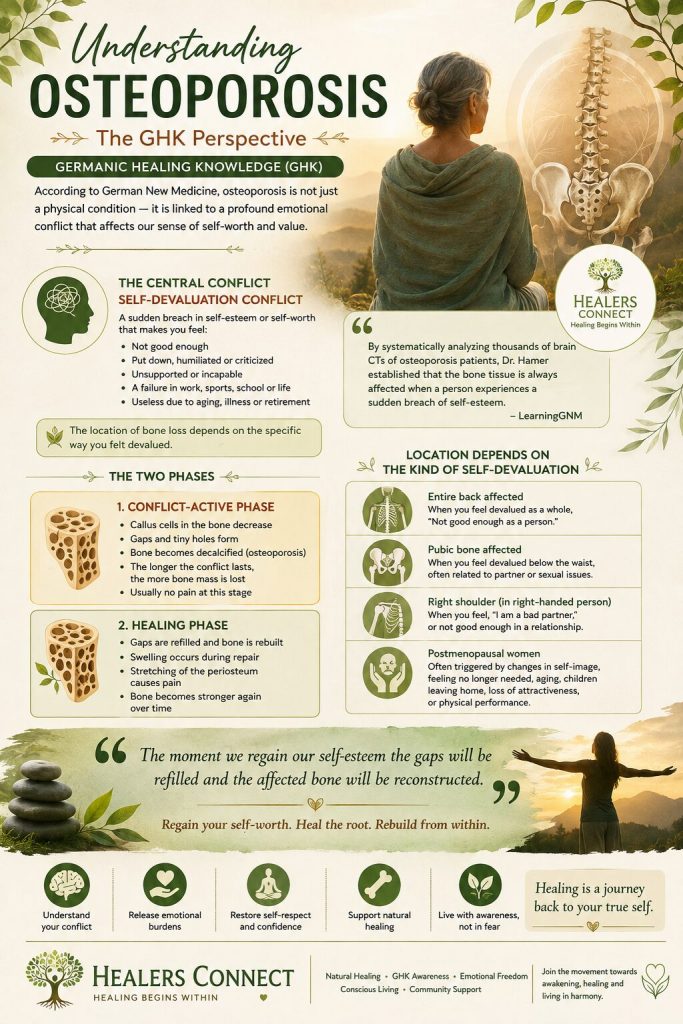
The Central Conflict: Self-Devaluation
According to the supplied LearningGNM article, Dr. Hamer associated bone tissue changes with a sudden breach of self-esteem or self-worth, termed a self-devaluation conflict.
The document gives examples such as:
- Being unfairly criticized or put down
- Failing at work, school, or sports
- Feeling unsupported
- Feeling incapable because of illness or aging
- Losing confidence after retirement
- Feeling that one is no longer useful or valuable
Importantly, GHK proposes that the precise nature of the self-devaluation determines which bones become involved.
Why Location Matters in GHK
The source gives several examples.
A generalized feeling of worthlessness or inadequacy is associated with involvement of the entire back.
Feeling devalued below the waist, including certain partner-related experiences, is associated in the document with the pubic bone.
The source also gives the example of feeling “I am a bad partner” affecting the shoulder, with laterality depending upon biological handedness.
Therefore, GHK case-taking does not simply ask:
“Do you have low self-esteem?”
It asks:
“In what specific way did you suddenly feel devalued, incapable, inadequate, unsupported, or no longer useful?”
What Happens During the Conflict-Active Phase?
Within the GHK model, bones and other supportive tissues are controlled from the cerebral medulla.
The LearningGNM article claims that during an active self-devaluation conflict, bone tissue undergoes loss of cells, creating microscopic gaps or holes. It identifies this process with decalcification/osteoporosis and states that the longer the conflict remains active, the greater the loss of bone mass.
In simplified GHK language:
Self-devaluation → Conflict activity → Bone tissue loss
This is why identifying when the person’s perception of themselves changed is central to GHK case-taking.
The Healing Phase
According to the article, once the person regains their self-esteem and resolves the conflict, reconstruction of the affected bone begins.
The source describes:
Conflict resolution → rebuilding → swelling → pain → eventual strengthening
It specifically proposes that swelling during reconstruction stretches the periosteum surrounding the bone and can produce considerable pain.
This is an important distinction in the GHK framework: pain does not necessarily correspond to the moment of the original conflict. It may be interpreted as occurring after conflict resolution during repair.
“Hanging Healing” and Recurrent Bone Problems
The supplied osteoporosis article does not specifically develop the term “hanging healing.” However, within the broader GHK framework, this term refers to repeated interruption of healing through conflict relapses.
Applied as a GHK case-taking concept, someone might repeatedly move through:
Self-devaluation → partial resolution → healing → trigger → renewed self-devaluation → healing again
This is particularly relevant when someone repeatedly encounters the same person, situation, activity, diagnosis, or belief that reminds them of the original experience.
For example:
“My back is weak.”
“I can’t do what I used to do.”
“I’m becoming useless.”
“My bones are deteriorating.”
Within a GHK-oriented therapeutic conversation, such interpretations could themselves become recurring self-devaluation themes.
Menopause and Osteoporosis – LearningGNM’s Interpretation
The document pays particular attention to postmenopausal osteoporosis.
Rather than attributing osteoporosis primarily to hormonal changes, the article proposes that changes in a woman’s self-perception and self-esteem around menopause may be important within the GNM model.
Examples it gives include:
- Children leaving home
- Feeling no longer needed
- Changes in physical performance
- Changes in sexual confidence
- Changes in mental performance
- Feeling less attractive
- Increasing vulnerability of self-confidence
The document therefore interprets the association between menopause and osteoporosis psychologically rather than primarily hormonally.
That interpretation conflicts with current medical evidence: conventional medicine recognizes age, menopause-related estrogen decline, genetics, nutrition, medications, activity level, smoking/alcohol and various diseases as established contributors to osteoporosis.
GHK Case-Taking Questions for Osteoporosis
A facilitator exploring the GHK perspective could ask:
- When did the reduction in bone density first become apparent?
- What was happening in your life before that period?
- When did you begin feeling less capable, valuable or useful?
- Did somebody criticize, reject, humiliate or undermine you?
- Did retirement, aging, illness or loss of physical ability change how you saw yourself?
- Which bone or region is affected, and what did that body region represent in your life at that time?
- What situations repeatedly make you think, “I can’t do this anymore”?
- Has receiving the osteoporosis diagnosis itself made you feel physically weak or defective?
The objective within this framework would be to identify not merely an unpleasant event but the specific moment and meaning of self-devaluation attached to it.
GHK-Oriented Resolution
From a psychological perspective, the work would center on moving from:
“I am weak.”
to “My worth is not determined by my physical performance.”
From:
“Nobody needs me anymore.”
to “My purpose has changed; it has not disappeared.”
From:
“My body has failed me.”
to “I can care for my body without judging myself through it.”
And from:
“I am becoming useless.”
to “My value is intrinsic and is not diminished by age.”
The purpose of this emotional work can be meaningful regardless of whether one accepts GHK’s biological claims.
Key GHK Insight
Within Germanic Healing Knowledge, osteoporosis is interpreted as the biological expression of an active self-devaluation conflict. The particular bones involved are proposed to correspond to the specific way in which the individual experienced the loss of self-worth. Resolution begins, in this framework, when the person genuinely regains their sense of value, capability and self-respect.
The supplied LearningGNM article then describes reconstruction of the bone following conflict resolution and proposes that this repair period can involve swelling and significant pain.
Source: Caroline Markolin, Ph.D., Rethinking Osteoporosis, LearningGNM.