Understanding Dentin, Enamel, Jaw Bones and Jaw Muscles Through Germanic Healing Knowledge
Our teeth may look like a single structure, but Germanic Healing Knowledge (GHK/GNM) makes an important distinction: dentin, tooth enamel, jaw bones and jaw muscles are different tissues, controlled from different areas of the brain and associated with different biological conflict themes.
This distinction is essential when exploring recurring cavities, tooth sensitivity, loose teeth, jaw pain, TMJ problems or teeth grinding through the GHK framework.
The LearningGNM material used for this article is Biological Special Programs – Teeth and Jaw, written by Caroline Markolin, Ph.D. It divides the subject into three principal sections: Dentin and Jaw Bones, Enamel, and Jaw Muscles.
Structure of a Tooth
Before exploring the conflicts, we need to understand what part of the tooth is involved.
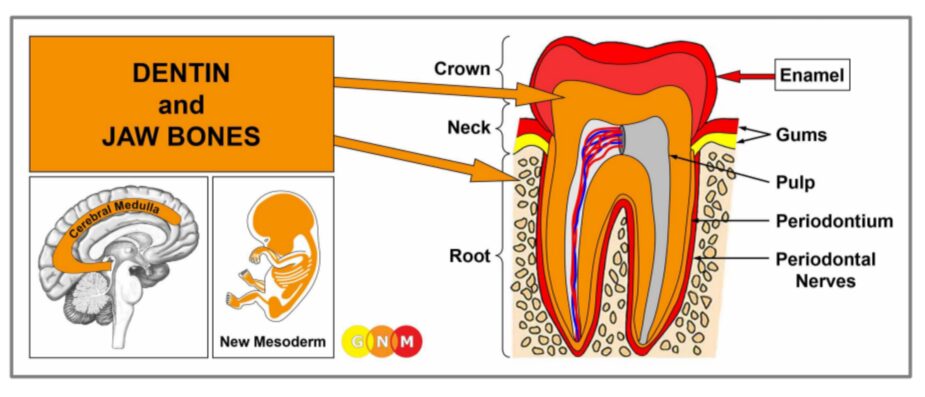
A tooth consists primarily of:
- Enamel – the hard outer covering of the crown.
- Dentin – the dense calcified tissue making up most of the tooth.
- Pulp – the inner chamber containing blood vessels and nerves.
- Periodontium – supporting tissue surrounding the dentin.
- Jaw bone – the maxilla or mandible into which the tooth is anchored.
The source describes odontoblasts within the pulp as cells capable of producing dentin, comparing their function with bone-building osteoblasts. It consequently describes the pulp as somewhat analogous to the “bone marrow” of the tooth.
This anatomy becomes important because GHK does not give every dental problem the same conflict.
The Fundamental GHK Distinction
A useful way of remembering the model presented in the source is:
DENTIN
“I cannot bite.”
ENAMEL
“I am not allowed to bite.”
JAW MUSCLES
“I cannot / am not allowed to bite, act or express myself.”
JAW BONE
A more intense form of the bite/self-devaluation conflict.
Let’s examine each individually.
1. Dentin – “I Cannot Bite”
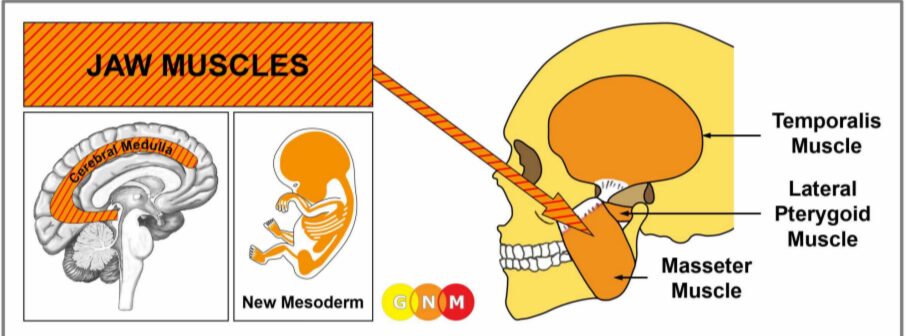
According to LearningGNM, dentin and jaw bones originate from what GNM calls the new mesoderm and are controlled from the cerebral medulla. The control is crossed: right-sided dental structures correspond to the left cerebral hemisphere and vice versa.
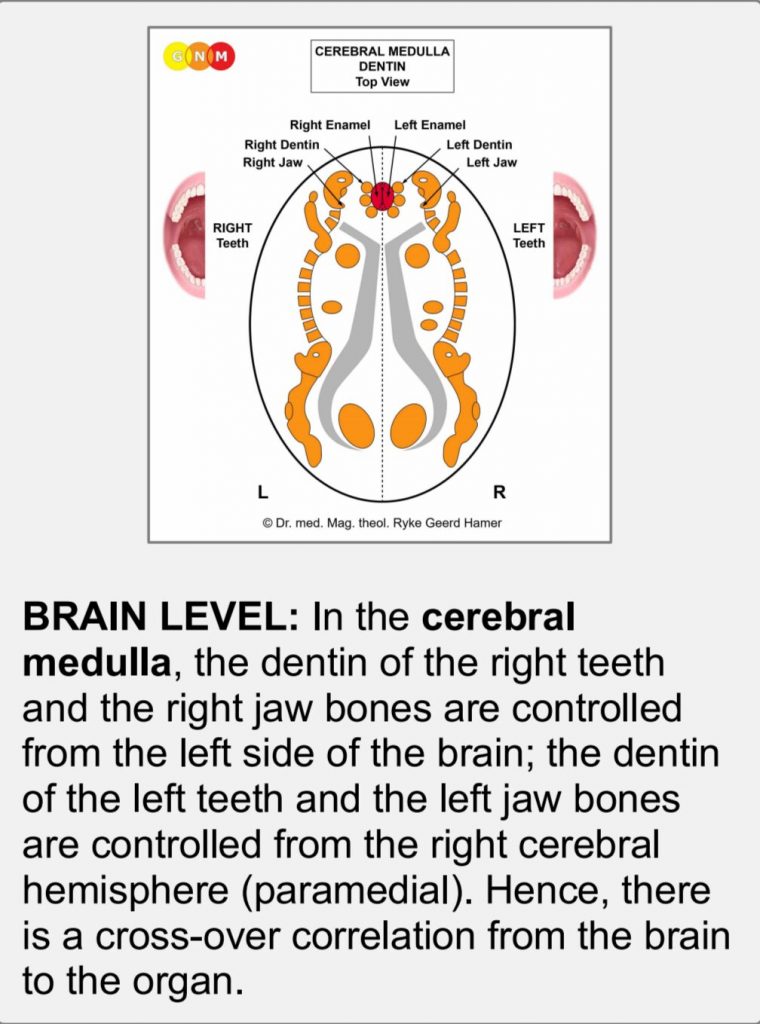
The biological conflict assigned to dentin is:
Not being able to bite.
This can be literal—for example, difficulty manipulating food—or figurative.
Figuratively, it means:
“I want to fight back, defend myself or show my teeth, but I can’t.”
The source describes situations where someone perceives themselves as being in the weaker position.
Examples
A child might feel unable to stand up to:
- A parent
- An older sibling
- A bigger child
- A teacher
An adult might experience the same dynamic with:
- A boss
- A senior colleague
- A spouse or family member
- A government official
- A police officer
- A doctor
- A judge
- A bank manager
The document also lists discrimination, oppression, abuse, punishment, restrictions, provocations and being scolded as circumstances that could be experienced as this type of bite conflict.
The central perception is:
“I can’t fight back.”
GHK categorizes this dentin-related bite conflict as a type of self-devaluation conflict.
2. Why the Particular Tooth Matters
One of the more interesting aspects of the LearningGNM model is that it does not treat every tooth identically.
It relates the conflict interpretation to the biological function of the particular tooth.
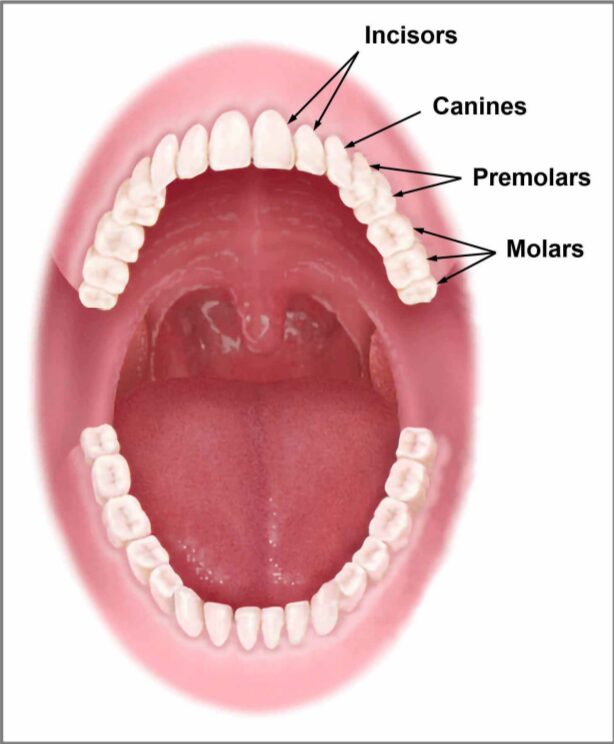
Incisors – “Biting”
The front teeth cut and bite.
The corresponding dentin conflict is described as:
Not being able to bite, snap at someone or show one’s teeth.
Canines – “Gripping”
Canines grip and tear.
Their corresponding conflict is described as:
Not being able to snatch a person.
Molars – “Grinding”
Molars crush and grind.
The corresponding conflict is described metaphorically as:
Not being able to crunch or grind an opponent.
This is why GHK case-taking should ideally record the exact tooth involved, rather than simply writing “dental problem.”
3. Dentin Cavities – Conflict-Active Phase
According to the source, during the conflict-active phase there is loss of dentin, producing cavities.
An important distinction made in the document is that dentin cavities themselves are described as painless until sufficiently advanced to expose or affect the pulp.
When the pulp becomes exposed, sensitivity to:
- Heat
- Cold
- Sweet
- Sour
may occur.
The source further states that extensive dentin loss during prolonged conflict activity can weaken the tooth’s internal structure sufficiently for the tooth to break.
4. Dentin Healing – Why Toothache Can Appear Later
This introduces another important GHK concept:
Symptoms can become more noticeable after conflict resolution.
According to the LearningGNM document, during the healing phase, dentin cavities are refilled with dentin callus produced by odontoblasts.
The soft callus is described as eventually hardening.
During this rebuilding process, swelling can stretch the periodontium surrounding the tooth.
Because this tissue is highly sensitive, the source proposes that this can cause severe toothache.
If swelling develops toward the interior of the tooth, pressure upon the pulp is described as potentially producing very intense pain.
Therefore, within the GHK framework:
Pain does not necessarily mean that the original conflict is currently active.
The phase and tissue involved need to be determined.
5. Jaw Bones – A More Intense Bite Conflict
The same general conflict family is assigned to the jaw bones, but LearningGNM describes the jaw-bone conflict as being perceived more intensely.
During conflict activity, the source describes decalcification (osteolysis) of the jaw.
If prolonged, it describes consequences including:
- Receding gums
- An apparently longer tooth neck
- Loose teeth
- Unstable teeth
- Periodontal degeneration
- Risk of losing the tooth
The document calls degeneration of the periodontal structure periodontosis.
6. Jaw Healing – Swelling and Pain
After resolution of the conflict, the LearningGNM model describes recalcification of the jaw.
The source states that this reconstruction can be accompanied by swelling and pain because of stretching of the periosteal layer surrounding the jaw bone.
This again illustrates the GHK distinction between:
Conflict activity → tissue loss
and
Conflict resolution → reconstruction, swelling and potentially pain.
7. Tooth Enamel – A Completely Different Conflict Nuance
Enamel needs to be distinguished from dentin.
The source classifies enamel as ectodermal tissue controlled from the cerebral cortex.
And here the wording of the conflict changes significantly.
Dentin:
“I cannot bite.”
Enamel:
“I am not allowed to bite.”
According to LearningGNM, the individual could potentially fight back or “bite,” but something prevents them from doing so.
For example:
- Social rules
- Etiquette
- Ethical considerations
- Authority
- Fear of consequences
- Not wanting to hurt another person
The source specifically gives refraining from saying something or stopping oneself from snapping at someone as possible examples.
It additionally associates enamel with not being allowed or able to hold onto something, describing this as a type of separation conflict.
8. Enamel Cavities
According to the source, the conflict-active phase involves ulceration/loss of enamel, resulting in cavities.
Unlike the description of dentin cavities, enamel involvement can be associated with pain and sensitivity.
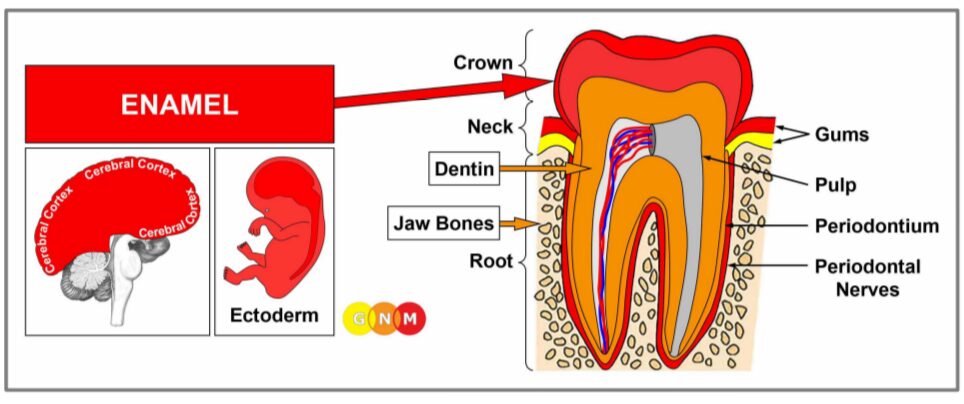
LearningGNM describes:
- Tooth pain
- Heat sensitivity
- Cold sensitivity
- Enamel loss
- Darkening/blackening with prolonged activity
within this program.
The document describes restoration of enamel during the healing phase as very slow, even without conflict relapses, and states that the repaired area can remain darker.
9. Jaw Muscles – “I Cannot Express or Act”
Jaw muscles introduce another layer.
They include the muscles responsible for:
- Opening the mouth
- Closing the mouth
- Biting
- Chewing
- Clenching
- Grinding
- Jaw movement during speech
The masseter is identified as the principal chewing muscle.
According to LearningGNM, the conflict associated with these muscles can involve:
Not being able or not being allowed to bite an opponent.
But importantly, the document extends this to:
Not being able or not being allowed to say something or express oneself.
It can also be experienced literally as difficulty or reluctance to open the mouth, including experiences surrounding dental procedures.
This provides a different avenue of case-taking for someone suffering from chronic jaw tension.
Instead of only asking:
“Why is your jaw tight?”
one might explore:
“What are you continually stopping yourself from saying?”
10. Bruxism – Teeth Grinding During Sleep
The source places bruxism—excessive grinding or clenching of the teeth—during what GNM calls the Epileptoid Crisis of the jaw-muscle program.
It describes spasms of the jaw muscles during this phase and notes that grinding or clenching commonly occurs during sleep.
Following this phase, the document describes normalization of jaw-muscle function.
For GHK case-taking, recurrent bruxism would therefore warrant investigation of recurring conflict cycles rather than simply treating the teeth as the primary problem.
11. Right Tooth or Left Tooth? Handedness Matters
GHK also considers biological handedness.
The document states that whether the teeth or jaw on the right or left side are involved depends upon:
- Biological handedness
- Whether the conflict concerns a mother/child
- Or a partner
relationship.
Therefore, proper GHK case-taking ideally establishes handedness before interpreting laterality.
The side of the symptom should not be interpreted in isolation.
A Simple GHK Dental Map
| Tissue | Central GHK Conflict Theme | GHK Phase of Tissue Loss |
|---|---|---|
| Dentin | “I cannot bite/fight back.” | Conflict-active |
| Jaw bone | More intense bite/self-devaluation conflict | Conflict-active |
| Enamel | “I am not allowed to bite/snap back.” | Conflict-active |
| Jaw muscles | Cannot / not allowed to bite, act or express | Conflict-active functional/tissue changes |
| Dentin repair | Conflict has resolved | Healing |
| Jaw reconstruction | Conflict has resolved | Healing |
| Bruxism | Jaw-muscle program | Epileptoid Crisis |
This table is a simplified summary of the distinctions described throughout the source.
GHK Case-Taking for Dental Problems
Instead of beginning with a general question such as “What emotional problem caused my tooth issue?”, a more precise GHK investigation would proceed in stages.
First: Identify the tissue
Is the primary issue involving:
Enamel? Dentin? Jaw bone? Jaw muscle? Gum?
This matters because they do not share one biological program.
Second: Identify the exact tooth
Is it an:
Incisor? Canine? Molar?
The source assigns different functional meanings to them.
Third: Establish laterality
Right or left?
Then establish biological handedness and whether the relevant relationship is interpreted as mother/child or partner-related.
Fourth: Find the DHS
Ask:
When did the problem begin?
Then look backward for the unexpected event that fits the specific conflict theme.
Fifth: Find the precise perception
Questions might include:
Who did you want to fight back against but couldn’t?
Who were you unable to answer?
When did you feel weaker than another person?
What did you desperately want to say but stop yourself from saying?
Were you capable of responding but felt you were not allowed to?
Was there somebody or something you wanted to hold onto but couldn’t?
The wording matters because “unable to bite” and “not allowed to bite” lead to different tissues within this model.
Understanding Recurrent Dental Problems
A particularly useful application of the GHK framework is investigating why the same tooth or same side repeatedly becomes symptomatic.
Rather than repeatedly searching for a new conflict, a facilitator would investigate whether the individual keeps encountering the same emotional track.
For example:
Boss → feeling unable to answer → conflict
then:
Weekend → away from boss → resolution
then:
Monday → boss again → relapse
then:
Holiday → resolution
Such a pattern could theoretically create repeated cycles of conflict activity and healing within the GHK model.
The Germanic Healing Knowledge specifically discusses “hanging healing” in relation to prolonged pressure on the tooth pulp.
An Important Distinction: Gums Are Another Program
It would be incorrect within GHK to automatically assign every gum problem to the dentin bite conflict.
The source specifically notes that conditions such as gum abscess and gingivitis relate to the mouth submucosa and mouth surface mucosa rather than simply to the dental-bone program.
We will therefore explore gums separately in another article.
The Bigger GHK Insight
The most useful lesson from the Teeth & Jaw material is that there is no single “tooth conflict.”
The question is not merely:
“What is the emotional conflict behind my dental problem?”
The more precise questions are:
Which tissue is involved?
Which tooth is involved?
Which side is involved?
Was I unable to fight back—or was I capable but not permitted to?
Was I unable to hold onto someone or something?
Was there something I desperately wanted to say but couldn’t express?
Am I conflict-active, healing, or repeatedly cycling between the two?
Once these distinctions are made, the GHK interpretation becomes considerably more specific.
Key Insight
“The teeth don’t tell one story. In the GHK framework, dentin can reflect ‘I cannot bite,’ enamel ‘I am not allowed to bite,’ while the jaw muscles can involve being unable to act, bite or express oneself. Understanding the tissue changes the entire case.”
Primary source: Biological Special Programs – Teeth and Jaw, Caroline Markolin, Ph.D., LearningGNM. The document identifies itself as LearningGNM material and includes a disclaimer that its information does not replace professional medical advice.