(White Vaginal Discharge) in Young Girls
In Germanic Healing Knowledge (GHK), the interpretation depends on the tissue involved, the age of the child, and whether the discharge is occurring during a conflict-active or healing phase.
Leucorrhoea is often associated with the vaginal mucosa, which in GHK is linked to separation conflicts and issues of contact, connection, and belonging.
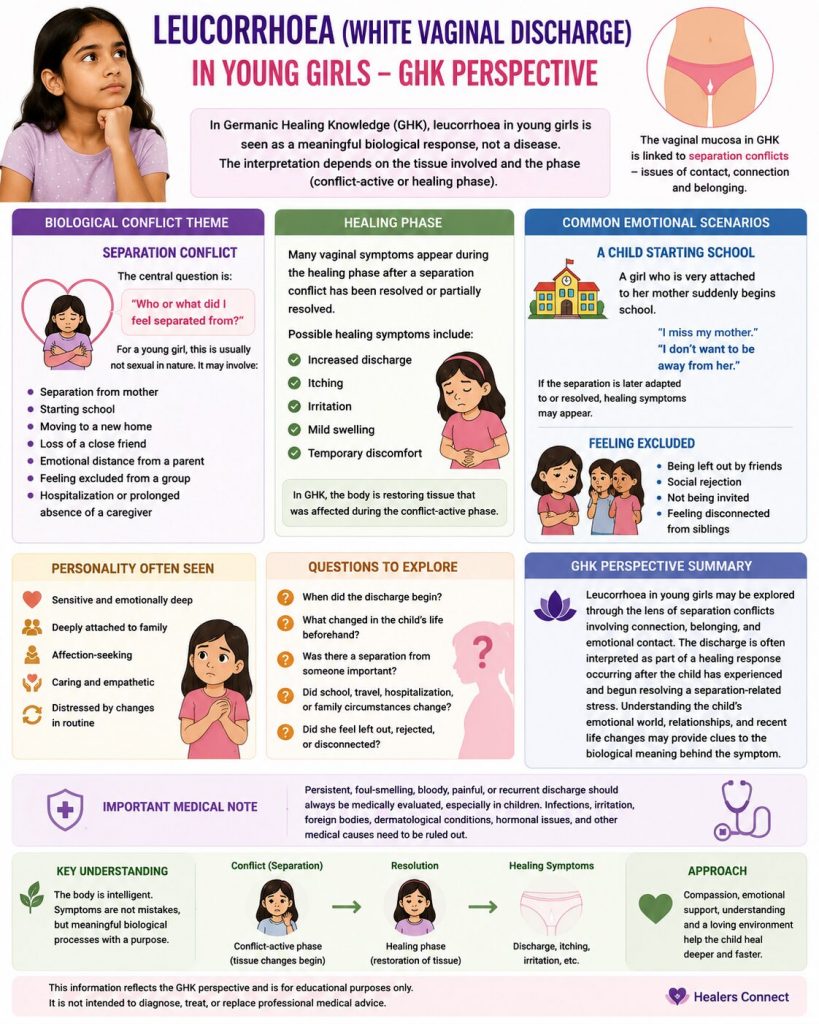
Biological Conflict Theme
Separation Conflict
The central question is:
“Who or what did I feel separated from?”
For a young girl, this may not be sexual in nature. More commonly, it could involve:
- Separation from mother
- Starting school
- Moving to a new home
- Loss of a close friend
- Emotional distance from a parent
- Feeling excluded from a group
- Hospitalization or prolonged absence of a caregiver
Healing Phase
According to GHK, many vaginal symptoms appear during the healing phase after a separation conflict has been resolved or partially resolved.
Possible healing symptoms include:
- Increased discharge
- Itching
- Irritation
- Mild swelling
- Temporary discomfort
In this model, the body is restoring tissue that was affected during the conflict-active phase.
Common Emotional Scenarios
A Child Starting School
A girl who is very attached to her mother suddenly begins school.
Inner experience:
“I miss my mother.”
“I don’t want to be away from her.”
If the separation is later adapted to or resolved, healing symptoms may appear.
Feeling Excluded
A child may experience:
- Being left out by friends
- Social rejection
- Not being invited
- Feeling disconnected from siblings
The biological interpretation would again revolve around separation and loss of contact.
Personality Often Seen
Many children experiencing separation themes are:
- Sensitive
- Deeply attached to family
- Affection-seeking
- Caring and emotionally connected
- Distressed by changes in routine
Questions to Explore
- When did the discharge begin?
- What changed in the child’s life beforehand?
- Was there a separation from someone important?
- Did school, travel, hospitalization, or family circumstances change?
- Did she feel left out, rejected, or disconnected?
Healers Connect Summary
GHK Perspective: Leucorrhoea in young girls may be explored through the lens of separation conflicts involving connection, belonging, and emotional contact. The discharge is often interpreted as part of a healing response occurring after the child has experienced and begun resolving a separation-related stress. Understanding the child’s emotional world, relationships, and recent life changes may provide clues to the biological meaning behind the symptom.
Leucorrhoea (White Vaginal Discharge) in Adults and Teens – GHK Perspective
Leucorrhoea, or white vaginal discharge, is not viewed in GHK as a disease in itself. Instead, it is understood according to the biological tissue involved, its embryological origin (germ layer), and whether the individual is in the conflict-active or healing phase of a biological program.
Tissue Involved
The vaginal lining consists of two embryologically distinct tissues:
1. Vaginal Mucosa (Old Ectoderm)
- Controlled from the cerebral cortex
- Associated with separation conflicts
- Concerned with contact, intimacy, connection, and belonging
2. Glands of the Cervix (Endoderm)
- Controlled from the brainstem
- Associated with procreation and reproductive “morsel” conflicts
- Can contribute to increased mucus production
The interpretation depends on which tissue is involved.
Primary Biological Conflict
Separation Conflict
The central biological question is:
“Who or what did I feel separated from?”
Examples include:
- Separation from a loved one
- Relationship breakup
- Emotional distance from a partner
- Rejection
- Feeling excluded
- Loss of intimacy
- Longing for contact
In adolescents:
- Friendship conflicts
- Romantic disappointments
- Feeling left out
- Not belonging to a peer group
may become important themes.
Conflict-Active Phase
During the active phase of a separation conflict:
Vaginal Mucosa (Old Ectoderm)
Biological changes may include:
- Microscopic ulceration of the mucosa
- Reduced sensitivity
- Often no obvious symptoms
Biological purpose:
The temporary reduction in tissue is believed to increase the likelihood of reconnecting with the lost contact by making the tissue more receptive.
Many individuals remain unaware of this phase.
Healing Phase
Once the separation conflict is resolved:
Examples:
- Reconciliation occurs
- Contact is restored
- The individual emotionally accepts the separation
- The emotional stress decreases
The body enters repair mode.
Healing Symptoms May Include
- Increased vaginal discharge
- White discharge (leucorrhoea)
- Itching
- Irritation
- Mild swelling
- Increased sensitivity
- Local inflammation
According to GHK, these symptoms represent restoration of the tissue that was affected during the conflict-active phase.
If Cervical Glands Are Involved
Germ Layer
Endoderm
Conflict Theme
Reproductive morsel conflict:
Examples:
- Desire for pregnancy
- Loss of a partner
- Fear of not having children
- Relationship insecurity
Conflict-Active Phase
- Cell proliferation in glandular tissue
- Increased mucus production
Healing Phase
Traditionally associated in GHK with microbial-assisted breakdown and normalization of excess tissue.
Common Emotional Themes
In Young Girls
- Separation from mother
- Starting school
- Moving home
- Hospitalization
- Loss of a friend
In Teenagers
- Friendship breakups
- Social exclusion
- Feeling rejected
- Romantic disappointment
- Not feeling accepted
In Adult Women
- Marital separation
- Divorce
- Emotional distance
- Sexual rejection
- Loss of intimacy
Personality Patterns Often Observed
Individuals experiencing recurrent separation conflicts may often be:
- Highly sensitive
- Deeply attached to relationships
- Affection-seeking
- Empathetic
- Fearful of abandonment
- Distressed by emotional distance
GHK Summary
Vaginal Mucosa (Old Ectoderm)
Conflict Theme:
Separation conflict
Conflict-Active Phase:
- Ulceration of mucosa
- Reduced sensation
- Usually few symptoms
Healing Phase:
- White discharge (leucorrhoea)
- Itching
- Irritation
- Swelling
- Tissue restoration
Cervical Glands (Endoderm)
Conflict Theme:
Reproductive morsel conflict
Conflict-Active Phase:
- Increased glandular activity
- Increased mucus production
Healing Phase:
- Restoration and normalization
Key Question in GHK
Rather than asking:
“Why am I having discharge?”
GHK asks:
“Who or what was I separated from, and when did that separation begin or resolve?”
Understanding the emotional timeline often provides the most important clues for interpreting leucorrhoea within the GHK framework.