Understanding the Condition
Conventional medicine describes Sickle Cell Disease as an inherited disorder affecting hemoglobin within red blood cells.
From a GHK perspective, the genetic mutation itself is not traditionally explained through a specific conflict shock. Instead, we explore:
- The biological purpose of the affected tissues
- The symptoms experienced by the individual
- The emotional conflicts that may accompany or aggravate those symptoms
Germ Layer Analysis
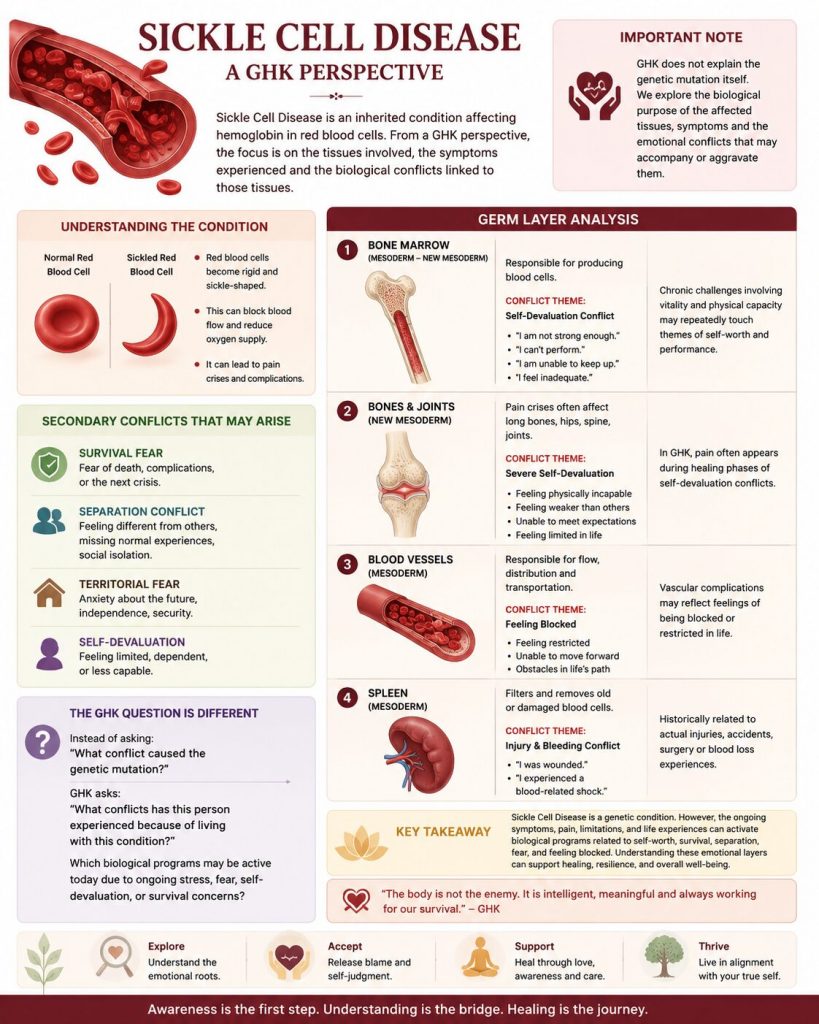
1. Bone Marrow (Mesoderm – New Mesoderm)
The bone marrow is responsible for producing blood cells.
In GHK, tissues derived from the new mesoderm are associated with:
Self-Devaluation Conflicts
Biological themes:
- “I am not strong enough.”
- “I can’t perform.”
- “I am unable to keep up.”
- “I feel inadequate.”
Because the bone marrow produces blood, chronic challenges involving vitality and physical capacity may repeatedly touch themes of self-worth and performance.
2. Bones and Joints (New Mesoderm)
Pain crises often affect:
- Long bones
- Hips
- Spine
- Joints
These structures also belong to the new mesoderm.
Conflict theme:
Severe Self-Devaluation
Examples:
- Feeling physically incapable
- Feeling weaker than others
- Feeling unable to meet expectations
- Feeling limited in life
In GHK, pain often appears during healing phases of self-devaluation conflicts.
3. Blood Vessels (Mesoderm)
Vascular complications are common in sickle cell disease.
Blood vessels relate to:
- Flow
- Distribution
- Transportation
Symbolically, GHK practitioners may explore:
- Feeling blocked
- Feeling restricted
- Feeling unable to move forward
Though this is more interpretive than directly described in GHK literature.
4. Spleen Involvement
The spleen plays an important role in blood filtration.
In GHK, the spleen is associated with:
Injury and Bleeding Conflicts
Biological theme:
“I was wounded.”
“I experienced a blood-related shock.”
Historically, this referred to actual injuries, accidents, surgery, or blood loss experiences.
5. Survival Themes
Because sickle cell disease often involves:
- Fatigue
- Hospitalizations
- Medical interventions
- Pain crises
Many patients develop secondary conflicts involving:
Survival Fear
- Fear of death
- Fear of complications
- Fear of the next crisis
Separation Conflict
- Feeling different from others
- Missing normal childhood experiences
- Social isolation
Territorial Fear
- Anxiety about the future
- Concerns about independence
The GHK Question Is Different
Rather than asking:
“What conflict caused the genetic mutation?”
GHK would more likely ask:
“What conflicts has this person experienced because of living with this condition?”
And:
“Which biological programs may be active today due to ongoing stress, fear, self-devaluation, or survival concerns?”
Summary
GHK Perspective: Sickle Cell Disease itself is understood conventionally as a genetic condition. Within the GHK framework, the emphasis shifts toward the tissues involved—particularly bone marrow, bones, and blood-related structures—which belong largely to the new mesoderm and are associated with self-devaluation themes. The chronic experience of pain, limitation, hospitalizations, and uncertainty may also generate secondary conflicts involving survival fear, separation, and reduced self-worth. Exploring these emotional dimensions may help individuals better understand their healing journey while continuing appropriate medical care.