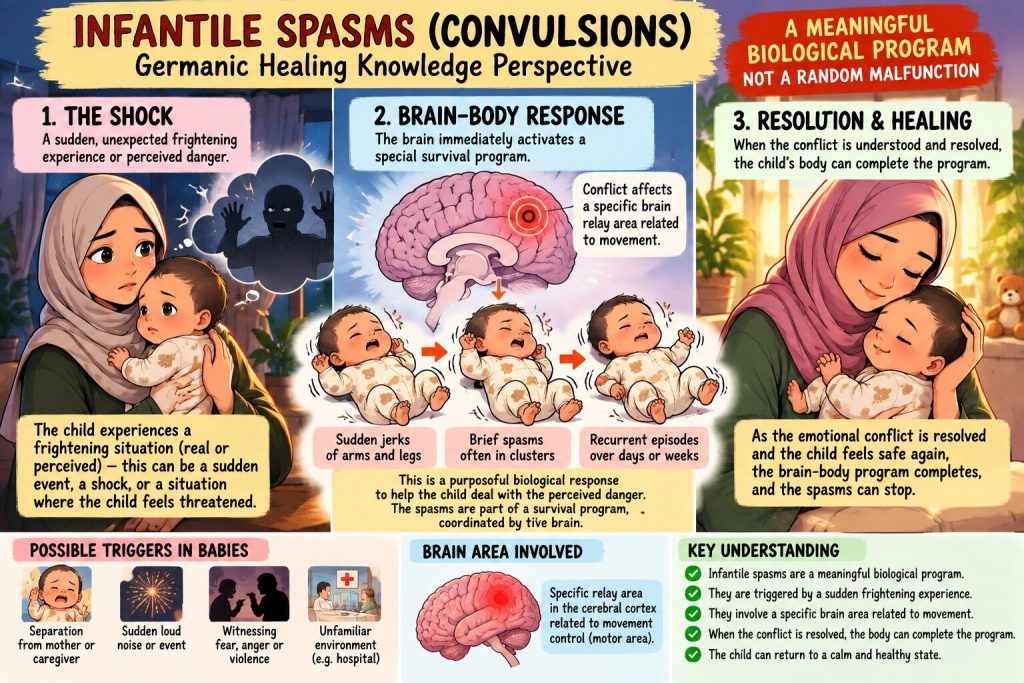
Infantile Spasms & Convulsions
Germanic Healing Knowledge (GHK) Perspective
In Germanic Healing Knowledge (GHK), infantile spasms and convulsions are not viewed as random neurological defects or brain malfunctions. Instead, they are categorized as the Epileptic Crisis (epileptische Krise) occurring at the turning point of a Motor Conflict program (motorischer Konflikt).
1. The Underlying Biological Conflict (DHS)
A motor conflict is triggered by a sudden, unexpected shock (Dirk Hamer Syndrome) characterized by the feeling of being “trapped,” “pinned down,” “unable to flee or escape,” “unable to defend oneself,” or “unable to hold onto someone.”
In infants and young children, Dr. Hamer notes that these conflict shocks frequently occur intrauterinely (in the womb) or during early infancy:
- Intrauterine Motor Shocks: Severe domestic arguments or shouting between parents during late pregnancy can cause the fetus to experience an intense impulse to flee or resist that cannot be executed in the womb.
- Birth & Infant Restraint: Feeling violently bound or forcibly held down during traumatic delivery, tight swaddling/wrapping during medical interventions, or painful procedures can trigger a motor shock of “not being able to defend oneself or escape”.
2. The Two-Phase Mechanism & Purpose of the Convulsion
Like all biological special programs (SBS), motor conflicts follow a predictable two-phase course:
1. Conflict-Active Phase (ca-Phase)
While the motor shock is active, there is a functional loss, weakness, or partial motor paralysis in the muscle groups corresponding to the specific motor relay in the brain’s motor cortex (Gyrus praecentralis).
2. Conflict Resolution (Conflictolyse / CL)
When the environment becomes peaceful or the restraint ends (e.g., the child feels safe with the mother), the brain relay enters the healing phase (pcl-Phase), causing fluid and brain edema to accumulate in the motor relay.
3. The Epileptic Crisis (EC) — The Convulsion
At the deepest point of vagotonic rest (frequently at night), the brain executes a rapid sympathicotonic spike. The biological purpose (Sinn) of this crisis is to physically “press out” the brain edema (auspressen) from the motor cortex relay so the neural tissue can normalize and scar.
Tonic & Clonic Spasms: As the motor relay expels the fluid, high-frequency neural firing triggers rhythmic clonic (jerking/spasms) and tonic (stiffening) muscle contractions.
3. Why Spasms Recur (Hanging Healing & Tracks)
When an infant suffers repeated or chronic infantile spasms, GHK attributes this to conflict relapses (Rezidive) or sensory tracks (Schienen):
- Tracks & Relapses: Subconscious sensory cues associated with the original shock (such as loud voices, specific sounds, smells, or hospital environments) instantly re-trigger the motor conflict. As soon as the trigger passes, the baby re-enters resolution, prompting another epileptic spasm.
- Bi-hemispheric Motor Constellation: If an infant experiences motor conflict shocks affecting both the left and right motor cortex hemispheres simultaneously (e.g., feeling unable to escape on both sides), they enter a motor schizophrenic constellation, which manifests as bilateral motor spasticity, ticks, or generalized convulsive fits.
4. Therapeutic Orientation in GHK
From the GHK perspective, resolving infantile spasms requires:
- Identifying and eliminating subconscious environmental triggers or shouting/stress in the household.
- Providing absolute physical freedom, warmth, and reassuring maternal connection to deactivate the restraint shock.
- Avoiding medical panic and invasive secondary traumas that reactivate the feeling of being trapped or bound.