Anal Fissures, Hemorrhoids &
Rectal Ulcerations
Understanding the biological conflict framework described in Dr. Ryke Geerd Hamer’s Vermächtnis Einer Neuen Medizin – Teil 1
The Biological Perspective
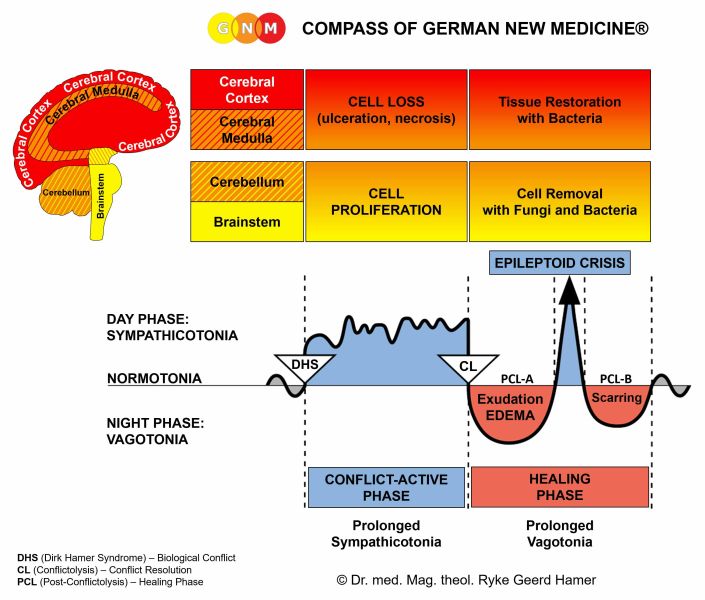
In Dr. Hamer’s framework, anal fissures, hemorrhoids and rectal ulcerations are associated with the ectodermal squamous epithelium (Plattenepithel) and are understood according to the principles of the two-phase biological program.
The central idea is to distinguish what occurs during the conflict-active phase (ca-phase) from what occurs after conflict resolution (pcl-phase).
Tissue Origin & Brain Control
Tissue Type
The rectal and anal mucosal lining described in this framework is classified as ectodermal squamous epithelium (Plattenepithel), belonging to the outer germ layer (Ektoderm).
Brain Relay
The corresponding brain relay is described as being located in the left temporal lobe (linker Temporallappen) of the cerebral cortex.
Biological Conflict Content
Within Hamer’s model, the biological conflict associated with this tissue is described as varying according to handedness, gender and hormonal status.
Right-handed Woman
Identity Conflict (Identitäts-Konflikt) — described as feeling uncertain about one’s position, role or identity.
Left-handed Man
Territorial Anger Conflict (Revierärger-Konflikt).
Territorial Marking
Also associated with conflicts involving identity, standing, belonging or uncertainty about where one belongs.
The Two-Phase Biological Program
🔻 Conflict-Active Phase — ca-Phase
During the conflict-active phase, the ectodermal mucosa is described as undergoing cell loss and ulceration.
In the anal/rectal region this is described as rectal or anal mucosal ulcers (Rektumplattenepithel-Ulcera).
🔺 Healing Phase — pcl-Phase
Following resolution of the conflict (Conflictolyse), the previously ulcerated tissue begins to repair.
This healing process is described as involving localized swelling, inflammation and pain.
Within this interpretation, conditions conventionally described as anal fissures, hemorrhoids or acute rectal inflammation may correspond to the healing phase of previously ulcerated mucosa close to the anus.
Diagnostic Brain CT Perspective
In Hamer’s model, the corresponding cerebral relay is described as showing a characteristic appearance during the conflict-active phase and changes during the healing phase.
Conflict-Active
A sharp target-ring / Schießscheiben-Konfiguration is described in the corresponding brain relay.
Healing Phase
A localized solution oedema (Lösungsoedem) is described as occurring as the biological program enters the healing phase.
The important distinction is between the conflict-active phase and the healing phase.
Understanding the sequence can change the way symptoms are interpreted within the Germanic Healing Knowledge framework.