What happens when treatment itself becomes part of the disease process?
In his writings, Dr. Ryke Geerd Hamer presents a fundamentally different interpretation of chemotherapy. Rather than viewing cytostatic treatment simply as an anti-cancer intervention, he examines what happens to the whole organism when highly cytotoxic substances are introduced during an already stressed or healing biological process.
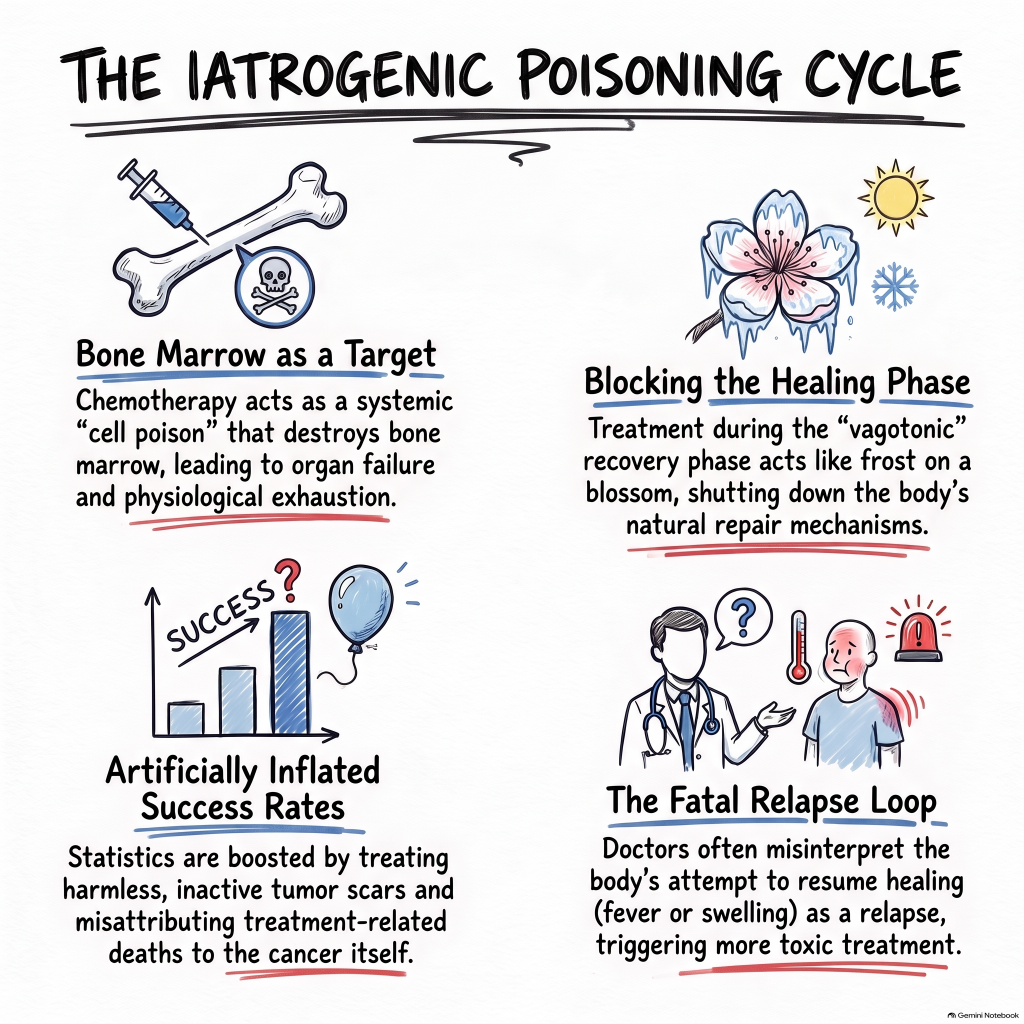
His discussion connects chemotherapy with bone-marrow suppression, systemic toxicity, disruption of the healing phase and what he calls an “iatrogenic vicious cycle.”
Failure to Distinguish the Cause of Death
Hamer argues that when a patient with cancer dies, the death is often attributed automatically to “cancer”, without adequately distinguishing between different possible processes occurring in the patient.
Disease Progression
Advanced biological processes associated with the underlying disease.
Secondary Conflicts
Additional biological or psychological shocks occurring during the course of illness.
Treatment Effects
Toxicity and complications associated with medical interventions.
Cytostatics as “Cell Poisons”
In Krebs – Krankheit der Seele, Hamer describes cytostatics (Zytostatika) as strongly toxic substances whose purpose is to inhibit cell division.
He particularly emphasizes their effect on tissues with rapidly dividing cells, including the bone marrow, and associates this with suppression of blood-cell formation and anemia.
The sequence described in his text
Cell division inhibited
Blood-cell production affected
Anemia & physiological stress
The above represents Hamer’s interpretation as presented in his book, not a statement of current oncology consensus.
Chemotherapy During the Healing Phase
A central concept in Hamer’s model is the two-phase pattern: conflict activity is associated with sympathetic stress, while after conflict resolution the organism enters a vagotonic healing phase.
Conflict-Active Phase
- Sympathicotonia
- Stress and heightened alertness
- Biological program considered active
Healing / pcl-Phase
- Vagotonia
- Rest and regeneration
- Repair processes become prominent
“The organism switches from Sympathicotonie to Vagotonie.”
Hamer describes the transition as movement from stress / fight-activation toward rest, recovery and regeneration.
In this framework, Hamer argues that aggressive treatment during this recovery phase may interfere with what he regards as the organism’s natural reparative process.
The “Iatrogenic Vicious Cycle”
Hamer describes another mechanism that he considers particularly important: the possibility that signs appearing during recovery may be interpreted as evidence of renewed cancer activity.
Swelling · fever · fatigue · repair
This repeating sequence is what Hamer calls an “iatrogenic Teufelskreis” — an iatrogenic vicious cycle in which treatment-related effects and interpretations may, according to his model, lead to further interventions.
Hamer’s Challenge to Cancer Statistics
Hamer also challenges the way he believed chemotherapy outcomes and cancer statistics were interpreted.
His argument
He proposed that some lesions identified through increasingly sensitive diagnostic technologies could represent old, inactive or scar-like biological changes rather than actively progressing disease.
He then questioned whether treating such findings and subsequently counting the patient’s survival could influence how apparent treatment success was calculated.
This is an allegation and interpretation presented by Hamer in his writings. It should not be presented as an established fact about modern oncology statistics without independent evidence.
“What is ‘Death by Chemotherapy’?”
Hamer’s answer, presented in the context of his critique of cytostatic cancer treatment.
Source & Context
Primary text:
Dr. med. Ryke Geerd Hamer,
Krebs – Krankheit der Seele, 1987.
Further development:
Vermächtnis Einer Neuen Medizin – Teil 1.
The concepts on this page are presented as Hamer’s historical medical theory and terminology. They are not equivalent to current evidence- based oncology guidelines or scientific consensus.