Resolving Family & Relationship Disputes Through the Lens of Germanic Healing Knowledge
When Conflict Is No Longer About “Who Is Wrong”
Family and relationship disputes are rarely as simple as they appear from the outside.
A couple may fight about money, household responsibilities, intimacy, parenting, in-laws or communication. Yet beneath the visible argument there can be layers of fear, hurt, insecurity, disappointment, territoriality, separation, self-devaluation and other emotional experiences.
The Germanic Healing Knowledge (GHK) framework offers a very different way of looking at these situations. Instead of immediately asking:
“Who is responsible?”
it encourages us to ask:
“What emotional pattern is active in each person, and what is triggering it?”
This shift can profoundly change the way a family looks at conflict.

We All Have Emotional Experiences — But In a Constellation, We Become a Pattern
Every person experiences emotions differently.
A painful experience may produce withdrawal in one person, anger in another, anxiety in someone else, and compulsive behaviour in another.
GHK uses the concept of constellations to describe particular combinations of biological and psychological conflict experiences. From this perspective, behaviour is not necessarily understood as a person’s permanent identity.
A person is not simply:
- “an aggressive person”
- “a manipulator”
- “a liar”
- “a jealous partner”
- “a cheater”
- “a lazy husband”
- “a difficult wife”
Instead, the GHK lens asks:
What pattern is active in this person right now?
That distinction can reduce blame.
It does not mean that harmful behaviour should be excused. It means that understanding the pattern may make it possible to respond to the person without becoming trapped in the behaviour.
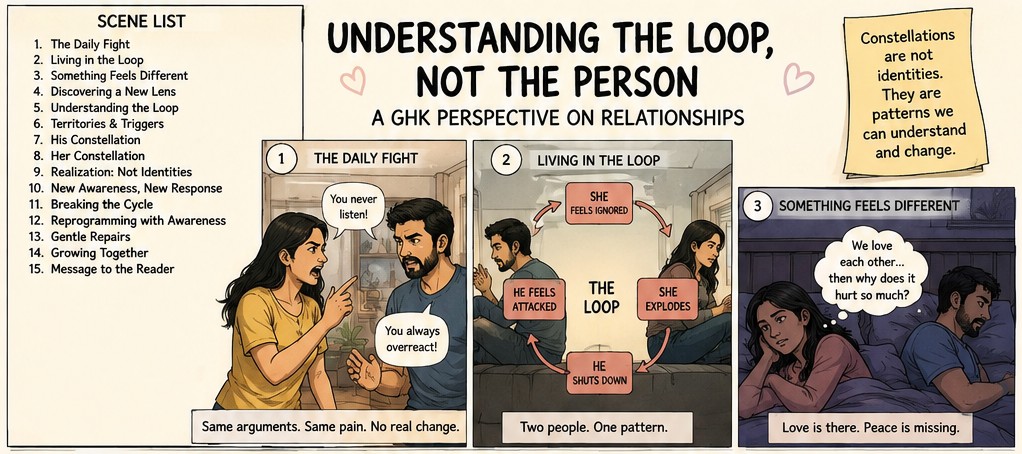
A Fighting Couple Can Be Seen as Two Active Constellations
Imagine a couple having a major argument.
One partner becomes aggressive.
The other withdraws.
The withdrawal triggers more aggression.
The aggression creates more fear.
Fear produces further withdrawal.
Soon the original issue has disappeared beneath a cycle of reactions.
From a conventional relationship perspective, each person may construct a case against the other:
“They started it.”
“No, they always do this.”
“They never understand me.”
“They are the problem.”
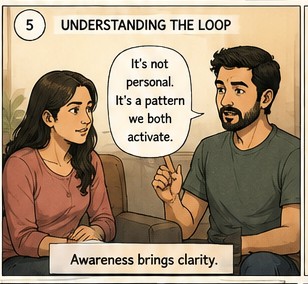
A GHK-oriented exploration instead asks:
What is active in Partner A?
What is active in Partner B?
What happened immediately before the escalation?
What does each person perceive the other person’s behaviour to mean?
What previous experiences are being reactivated?
The couple can then begin to see the argument not as one villain and one victim, but as an interaction between two nervous systems, two histories and two sets of emotional perceptions.
That does not remove responsibility.
It can, however, remove some of the blame.
Aggression May Be a Pattern — Not an Identity
Aggressive behaviour can be deeply destructive to relationships.
But labelling someone simply as “an aggressive person” may close the door to understanding.
The more useful question is:
“What happens inside this person immediately before the aggression?”
Is there:
- a perceived attack?
- humiliation?
- rejection?
- loss of control?
- territorial threat?
- fear?
- helplessness?
- accumulated resentment?
- an old emotional wound being reactivated?
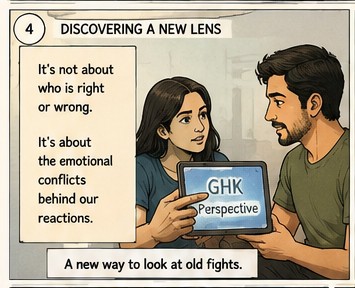
The same principle can be applied to manipulation, repeated lying, jealousy, flirtatious behaviour, compulsive relationship-seeking or dramatic mood changes.
Understanding does not mean tolerating abuse.
It means separating:
the person from the pattern,
so that the pattern can be examined.
The Trigger Is Often More Important Than the Argument
One of the most useful questions in relationship work is:
“What happened just before the reaction?”
A partner may say something seemingly insignificant.
The other person suddenly develops a headache, becomes furious, shuts down or leaves the room.
To an observer, the reaction may appear disproportionate.
But if that moment resembles an earlier emotional experience, the present situation may carry much greater emotional meaning for the person.
This is where the GHK concept of tracks can become interesting as a way of exploring recurring triggers.
A smell, sentence, facial expression, location, person or situation may remind someone of an earlier experience.
The reaction can then appear to come “out of nowhere.”
Instead of asking only:
“Why are you behaving like this?”
we can ask:
“What did this moment remind you of?”
That question can transform a confrontation into an investigation.
When Two People Keep Triggering Each Other
Some relationships develop a predictable cycle.
For example:
Partner A feels ignored → becomes demanding → Partner B feels attacked → withdraws → Partner A experiences abandonment → becomes more aggressive → Partner B withdraws further.
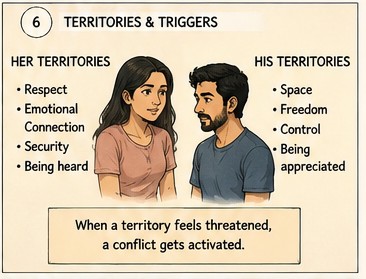
Neither person necessarily wakes up intending to create this cycle.
Yet both participate in maintaining it.
Once the pattern becomes visible, the couple can begin to interrupt it.
The goal is no longer:
“How do I make my partner change?”
but:
“How do we stop activating this cycle?”
That is a fundamentally different approach to relationship repair.
A Complete Emotional and Health History Can Reveal Patterns
A relationship dispute should not always be examined in isolation.
People live with bodies, histories, stresses and health concerns.
A person dealing with persistent pain, headaches, digestive problems, sleep difficulties, fatigue or another health concern may also be carrying considerable emotional pressure.
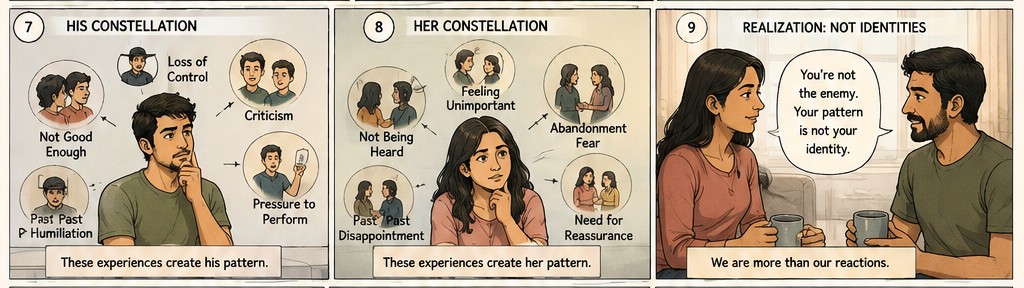
A GHK-oriented consultation might therefore explore:
- major emotional shocks
- relationship history
- separation experiences
- fears
- territorial experiences
- self-worth experiences
- recurring triggers
- significant changes preceding symptoms
- family dynamics
- current sources of pressure
The purpose should be understanding patterns, not assigning every symptom to an emotional conflict.
“Don’t Use Another Person to Regulate Everything You Feel”
One particularly important relationship insight is the tendency to make another person responsible for regulating our internal emotional state.
We may unconsciously demand:
“Make me feel safe.”
“Make me feel important.”
“Make my anxiety disappear.”
“Prove that you love me.”
“Give me attention so I can feel worthy.”
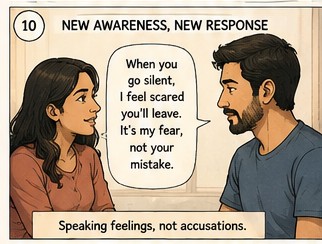
When two people repeatedly use each other to regulate unresolved emotional states, the relationship can become exhausting.
In spiritual language, one might describe this as “feeding on another person’s spirit.”
A more psychologically grounded description would be emotional over-dependence or external regulation.
The healthier direction is to develop the capacity to recognise:
“This feeling is happening inside me. My partner may influence it, but they are not solely responsible for resolving it.”
That recognition can create enormous space within a relationship.
From Blame to Curiosity
Consider the difference between these two statements:
“You are making me angry.”
and
“Something in this interaction is activating intense anger in me. Let’s understand what it is.”
The first statement assigns the entire cause externally.
The second creates room for investigation.
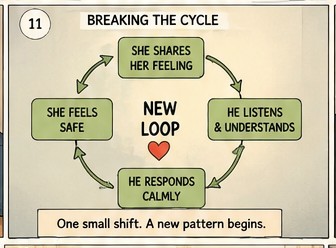
Likewise:
“You are impossible.”
can become:
“We keep entering the same pattern. What activates it?”
And:
“You never understand me.”
can become:
“What do I desperately need to be understood about?”
This doesn’t eliminate accountability.
It creates the possibility of shared accountability.
When Health Problems Become Part of the Relationship Conflict
Families can become trapped in another cycle when one person’s health problems create pressure on everyone.
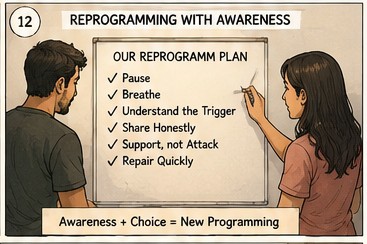
A partner may become the caregiver.
The caregiver becomes exhausted.
The person who is unwell feels guilty or dependent.
The caregiver becomes resentful.
The patient feels rejected.
The resentment produces another conflict.
The cycle repeats.
Instead of reducing the entire situation to:
“You don’t help enough.”
or
“You don’t understand how difficult my illness is.”
it can be useful to map the entire system:
symptom → fear → responsibility → resentment → guilt → withdrawal → further conflict.
GHK may provide one interpretive language for exploring the emotional side of this cycle, while appropriate medical care addresses the physical side.
The Goal Is Not to Win the Argument
Perhaps the greatest transformation happens when the objective of a relationship changes.
Instead of:
Who is right?
ask:
What is happening here?
Instead of:
Who started it?
ask:
What activated the cycle?
Instead of:
How do I change them?
ask:
What can I understand about myself and my pattern?
Instead of:
Why are they behaving like this?
ask:
What might they be experiencing?
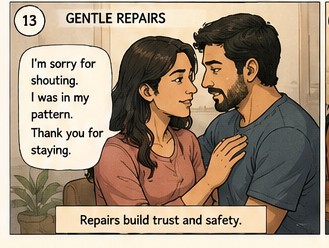
And finally:
What would stop us from triggering each other again?
Could GHK Help Us Build a Less Blaming Culture?
Whether or not one accepts the biological claims of GHK, there is a potentially valuable relational principle in examining behaviour through patterns rather than fixed identities.
A family that learns to say:
“This is a pattern we are caught in”
rather than:
“You are the problem”
has already changed the conversation.
Children can learn that anger is something to understand rather than an identity.
Partners can learn that conflict does not necessarily mean the relationship has failed.
Parents can learn to investigate triggers rather than simply punish behaviour.
And individuals can learn to take responsibility for their own emotional responses without taking responsibility for everyone else’s.
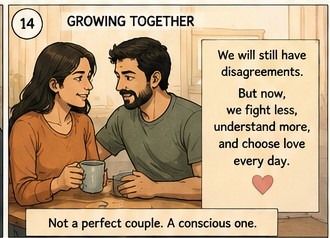
GHK Can Save a Civilisation — If We Mean the Shift in Perspective
The most powerful contribution that a conflict-oriented framework could potentially make is not promising that every disease or relationship problem can be “switched off.”
It is teaching people to become observers of patterns.
Imagine families where people learn to recognise:
Trigger → reaction → escalation → pattern → awareness → choice.
Imagine couples who stop keeping score.
Imagine parents who ask what is happening underneath a child’s behaviour.
Imagine communities where people are less interested in identifying villains and more interested in understanding cycles.
That kind of cultural shift could be transformative.
Because civilisation is ultimately built from relationships.
And relationships change when people stop seeing each other merely as problems to be corrected and begin seeing themselves as human beings caught in patterns that can be understood, interrupted and changed.
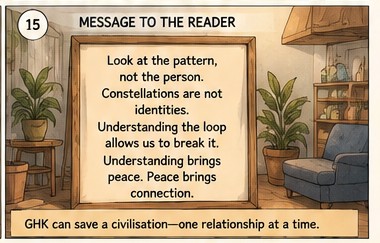
The essential question becomes:
“What pattern are we creating together—and what would happen if we stopped feeding it?”
That may be one of the most powerful questions we can bring into a family, a marriage and ultimately into society.
Healers Connect
Awareness • Understanding • Responsibility • Compassion
Above image : Narcissistic constellation & Casanova constellation
Bonus Section
Even the Most Extreme Behaviour Can Be Seen Through a Less Blaming Lens
One of the most powerful possibilities of looking at behaviour through constellations is that it can change how we interpret even the most painful expressions of despair.
A suicide note, for example, is often read primarily as a statement of blame:
“You did this to me.”
“You took everything from me.”
“I have nothing left.”
But if we step back and explore the person’s experience through the lens of territory, loss, separation and constellation patterns, another layer may become visible.
A person may have experienced the loss of a relationship, home, family position, livelihood, social identity, authority, belonging or what they perceived as their place in the world. The experience of “I have lost my territory” can become profoundly destabilising.
In a GHK framework, combinations of unresolved conflicts are sometimes described as constellations. Looking at the behaviour through this framework can shift the question from:
“Why would this person do this to everyone?”
to:
“What happened to this person’s sense of belonging, territory, security and identity?”
That does not excuse harmful behaviour, nor does it mean that every suicide note has one particular biological explanation. But it can help families approach an unbearable situation with less accusation and more understanding.
Instead of reading only the final words, we can ask:
What was lost?
What did this person feel had been taken away?
Where did they feel they no longer belonged?
What territory—physical, relational, social or emotional—did they experience as lost?
What constellation of experiences may have accumulated before the final crisis?
This kind of inquiry can be especially important after a death, when surviving family members can spend years trapped in anger, guilt and blame.
Understanding the possible emotional patterns does not erase responsibility. It creates the possibility of compassion without denying the pain caused.
And that may be one of the deepest purposes of understanding constellations: not to label people, but to make even the most difficult human behaviour more understandable and therefore less divisive.