Identify → Measure emotional intensity → Interrupt the old pattern → Recondition the subconscious → Stabilize → Monitor for 90 days.
HEALERS CONNECT
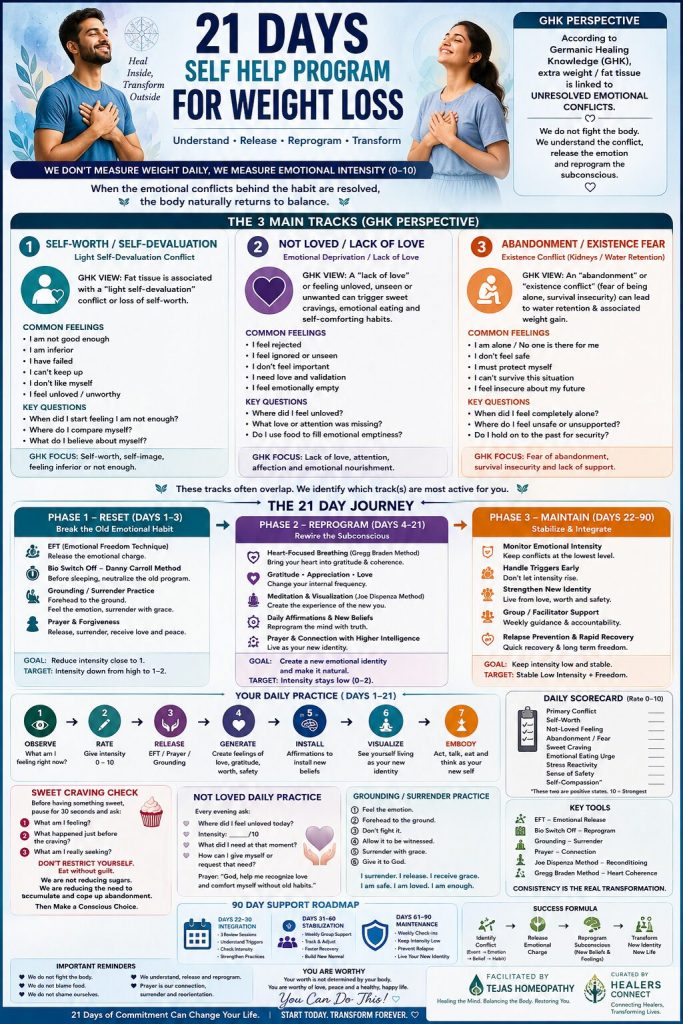
21-Day Obesity Conflict Resolution Program
3-Day Emotional Reset + 18-Day Subconscious Reconditioning + 90-Day Maintenance
Core principle:
Resolve the emotional pattern. Recondition the subconscious. Maintain the new state.
1. PROGRAM PURPOSE
This program is designed for people who experience unwanted weight gain, emotional eating, sweet-food dependency or persistent body-weight concerns and who wish to investigate the emotional patterns they associate with those experiences.
The program uses the Germanic Healing Knowledge (GHK) framework as an interpretive model, together with:
- EFT-style emotional release
- Bio Switch Off practice as taught within the participant’s Healers Connect methodology
- grounding/surrender practice
- prayer
- heart-focused breathing
- gratitude/appreciation
- visualization
- affirmations
- subconscious habit reconditioning
- daily emotional-intensity tracking
- 90-day relapse-prevention support
The program does not ask the participant to fight the body.
The central question is:
“What emotional state and subconscious habit have I repeatedly been living in?”
2. IMPORTANT FACILITATOR /SELF POSITION
GHK describes fat tissue as being associated with a light self-devaluation conflict or loss of self-worth. The GHK material groups fat tissue with other cerebral-medulla-controlled tissues that it associates with self-devaluation.
This should be presented honestly:
“Within the GHK model, we investigate whether a self-worth/self-devaluation conflict is relevant to this person’s experience. We do not assume it is the cause before investigating the person’s history.”
Do not tell a participant:
“Your obesity is definitely caused by this conflict.”
Instead:
“Let’s investigate whether this emotional pattern corresponds with your experience.”
This protects the facilitator from turning a hypothesis into a diagnosis.
The program also does not replace medical assessment or treatment for obesity, diabetes, hypertension, sleep apnea, eating disorders, medication effects or other medical conditions.
3. THE PROGRAM MODEL
Phase 1 — DISCOVER
Before Day 1
Identify:
What happened?
↓
What did I feel?
↓
What did I conclude about myself?
↓
What habit developed?
↓
What triggers it today?
4. THE CENTRAL GHK QUESTION
In India, people often say:
“Tension se weight badhta hai.”
This is an excellent starting point, but it is too broad.
Everyone experiences tension.
The GHK facilitator therefore knows:
“What kind of tension?”
Not:
Stress = obesity
but:
specific emotional experience → repeated interpretation → subconscious habit → behaviour/emotional state
Examples to investigate:
- “I am not loved.”
- “I am not good enough.”
- “I am not valued.”
- “I am inferior.”
- “I have failed.”
- “I cannot keep up.”
- “I don’t belong.”
- “Nobody wants me.”
- “I am alone.”
- “I need protection.”
- “I have to comfort myself.”
- “Food is the only thing that makes me feel good.”
- “Sweetness gives me the love I am missing.”
These are investigation questions, are predetermined conflicts for obesity response.
5. THE THREE PRIMARY TRACKS

Every participant is assessed for three interconnected tracks.
TRACK A — SELF-WORTH
Potential GHK theme:
“I am not good enough / I have lost my value.”
Questions:
- When did you first feel inadequate?
- Who made you feel that way?
- Where do you compare yourself?
- Where do you feel behind?
- Where do you feel you cannot keep up?
- What do you dislike about yourself?
- What do you believe your body says about you?
GHK specifically describes fat tissue in relation to light self-devaluation/loss of self-worth.
TRACK B — NOT LOVED
This becomes a mandatory daily secondary assessment in this program.
Ask:
“Where today did I feel unloved?”
Score it:
0 = not present
10 = overwhelming
Examples:
- rejection
- being ignored
- criticism
- lack of affection
- feeling unwanted
- feeling unseen
- feeling emotionally disconnected
The objective is not to create a new belief that:
“Not being loved causes obesity.”
Instead:
“We are monitoring whether the recurring emotional state of feeling unloved is one of this participant’s drivers of emotional eating or other habits.”
TRACK C — SWEET-FOOD / COMFORT / RESTRICTING DIET HABIT
Ask:
“When do I most strongly want something sweet?”
Then identify:
Trigger → emotion → craving → action → temporary relief → aftermath
Example:
Feeling rejected
↓
“Nobody loves me.”
↓
Sweet craving
↓
Eating
↓
temporary comfort
↓
guilt / self-criticism
↓
self-devaluation
↓
repeat
This is rooted in the subconscious habit loop that the person cannot stop and should not restrict, rather prepare to resolve subconscious habits.
6. THE 1–10 EMOTIONAL INTENSITY SCALE
This is the central measurement system.
The participant does not need to weigh themselves daily.
Instead, every relevant emotional conflict receives a number.
INTENSITY SCALE
| Score | Meaning |
|---|---|
| 0 | No emotional charge |
| 1 | Almost completely neutral |
| 2 | Very mild |
| 3 | Mild |
| 4 | Noticeable |
| 5 | Moderate |
| 6 | Strong |
| 7 | Very strong |
| 8 | Severe |
| 9 | Extremely intense |
| 10 | Overwhelming |
The participant records separate scores for:
Self-worth conflict
Not-loved feeling
Abandonment/insecurity, if identified
Sweet-food compulsion
Primary trigger
7. DAY 0 — BASELINE
Before intervention, the facilitator asks the participant to bring the identified emotional event to mind.
Do not force traumatic memories.
Ask:
“When you think about this situation right now, how intense is the emotional charge from 0–10?”
Record:
Primary conflict: ____ /10
Then:
Not-loved feeling: ____ /10
Sweet craving/compulsion: ____ /10
Self-worth charge: ____ /10
This becomes the baseline.
8. THE 3-DAY RESET
DAYS 1–3
Objective:
Interrupt the old emotional habit.
The goal is not to force the participant to forget the event.
The goal is:
“I can remember the event without automatically becoming the old emotional version of myself.”
The three days contain four elements:
1. EFT
2. Bio Switch Off practice
3. Grounding / surrender
4. Prayer
9. MORNING ROUTINE
20–30 MINUTES
STEP 1 — OBSERVE
Sit quietly.
Ask:
“What emotional state am I carrying this morning?”
Do not change it yet.
Name it.
Examples:
rejected
unloved
inferior
unsafe
not enough
lonely
STEP 2 — RATE IT
Record:
“Current intensity: ___ /10.”
STEP 3 — HEART-FOCUSED BREATHING
Use slow, comfortable breathing while bringing attention toward the heart area.
Then deliberately evoke:
- gratitude
- appreciation
- love
- compassion
- surrender
This draws on the heart-focused coherence approach described in Gregg Braden’s published material. (Gregg Braden)
10. EFT SESSION
The facilitator helps the participant acknowledge the emotional state rather than suppress it.
Structure:
SETUP
“Even though I feel ________, I am willing to acknowledge this feeling with compassion.”
Then tap through the participant’s chosen EFT points using the method they have been taught.
The facilitator should not impose the words.
Use the participant’s language.
Examples:
“This feeling of not being enough.”
“This feeling that nobody loves me.”
“This pressure to prove myself.”
“This old belief that I am not valuable.”
After one round:
RATE AGAIN
Before: 8/10
After: 5/10
Continue until the charge decreases naturally.
Do not insist that every participant reach 1.
11. THE GROUNDING / SURRENDER PRACTICE
This is a central Healers Connect practice.
The participant adopts a safe grounding posture.
Where culturally/religiously appropriate, this may include placing the forehead toward the ground in a posture of surrender.
The facilitator says slowly:
“Do not fight the feeling.”
“Feel it.”
“Allow it to be witnessed.”
“You do not need to carry it anymore.”
“Give this emotion to God.”
“You are allowed to surrender.”
“You are allowed to be loved.”
“You do not have to earn your worth.”
The participant remains with the emotional state while allowing the feeling of surrender, grace and safety to become stronger.
This is not an attempt to force a biological response.
It is a spiritual/emotional practice of surrender and meaning-making.
12. PRAYER — THE CENTRAL REPROGRAMMING TOOL
Prayer is not an optional decoration in this program.
It is one of the primary methods.
The participant chooses language consistent with their faith.
Prayer structure:
Acknowledgement
“God, I acknowledge this pain.”
Surrender
“I cannot carry it alone.”
Forgiveness
“Help me release what I have been carrying.”
Identity
“My worth does not depend upon another person’s approval.”
Love
“Help me experience myself as loved.”
New state
“Teach me to live from peace, gratitude and trust.”
Closing
“I surrender the old pattern and choose a new way of being.”
Allow participants to use their own prayers, Qur’anic duas, Christian prayers, Hindu prayers, Buddhist practices or other sincere faith language according to their beliefs.
13. BIO SWITCH OFF — NIGHT PRACTICE
Use the Bio Switch Off protocol as taught by the Healers Connect facilitator, rather than inventing additional claims about Danny Carroll’s method.
The facilitator should document the actual protocol separately as a practitioner training SOP.
The night practice follows:
Recall → identify → intention → visualization/recontextualization → surrender → sleep
Before sleep:
- Identify the emotional pattern.
- Give it a 1–10 score.
- State the intention to disengage from the old pattern.
- Visualize the new emotional state.
- Pray.
- Perform the participant’s established Bio Switch Off sequence.
- Sleep without continuing to analyze the conflict.
14. DAY 1–3 TARGET
The desired trajectory is:
DAY 1
Example:
8 → 5
DAY 2
5 → 3
DAY 3
3 → 1–2
But this is a target, not a guarantee.
If the intensity rises, the facilitator investigates:
“What new information appeared?”
“Did another conflict become visible?”
“Was there a trigger?”
“Are we trying to force the emotion away?”
A rise is treated as information, not failure.
15. DAY 3 — FIRST REVIEW
The participant completes:
| Emotional State | Day 0 | Day 3 |
|---|---|---|
| Primary conflict | /10 | /10 |
| Self-worth | /10 | /10 |
| Not-loved | /10 | /10 |
| Sweet-food compulsion | /10 | /10 |
| Main trigger | /10 | /10 |
Then ask:
“What feels different?”
“What no longer has the same emotional power?”
“What still activates you?”
“What new emotion is available?”
16. DAYS 4–21
SUBCONSCIOUS RECONDITIONING
The first three days are:
DEACTIVATION
Days 4–21 are:
RECONDITIONING
The participant now stops spending most of the time analyzing the old story.
Instead:
Old emotional identity → New emotional identity
This is compatible with the broad structure of Dr Joe Dispenza’s work, which includes Breaking the Habit of Being Yourself, Reconditioning the Body to a New Mind, and Changing Beliefs and Perceptions. (Dr. Joe Dispenza)
Do not reproduce proprietary guided-meditation scripts. Use licensed/original materials where appropriate.
17. THE DAILY REPROGRAMMING FORMULA
Every morning:
1. OBSERVE
“What am I feeling?”
2. RATE
“0–10?”
3. RELEASE
If above 3:
Use brief EFT/prayer/grounding.
4. GENERATE
Create the desired emotional state.
Examples:
love
gratitude
peace
worthiness
security
belonging
5. INSTALL
Repeat the day’s affirmation.
6. VISUALIZE
See yourself behaving as the new version of yourself.
7. EMBODY
Ask:
“How would I breathe, walk, eat and respond if this new identity were already natural to me?”
18. THE 18-DAY REPROGRAMMING THEMES
DAYS 4–6
“I AM VALUABLE”
Affirmations:
“My worth is not determined by my body.”
“I do not need to prove my value.”
“I am enough.”
“I release the need to compare myself.”
DAYS 7–9
“I AM LOVED”
“I am worthy of love.”
“I can receive love.”
“I do not need food to replace emotional connection.”
“I can comfort myself without abandoning myself.”
Daily focus:
Not-loved intensity.
DAYS 10–12
“I AM SAFE”
“I am safe in the present moment.”
“The past is not happening now.”
“I can respond rather than react.”
“I can release the need to protect myself through old habits.”
DAYS 13–15
“I CHOOSE”
This is the transition from subconscious reaction to conscious choice.
“I notice the old pattern.”
“I do not have to obey it.”
“A craving is an experience, not a command.”
“I can choose from awareness.”
DAYS 16–18
“I AM BECOMING”
“I am becoming familiar with peace.”
“I am becoming familiar with self-respect.”
“I am becoming familiar with healthy choices.”
“My new emotional state is becoming natural.”
DAYS 19–21
“THIS IS WHO I AM”
The participant visualizes the future self.
Not:
“I will finally be worthy when I lose weight.”
But:
“Because I value myself, I now live differently.”
19. SWEET-FOOD ADDICTION MODULE
This receives daily attention if present.
Before eating something sweet, pause for 30 seconds.
Ask:
QUESTION 1
“What am I feeling?”
QUESTION 2
“What happened immediately before the craving?”
QUESTION 3
“What am I actually seeking?”
Possible answers:
comfort
love
reward
relief
escape
rest
connection
pleasure
Then rate:
Emotion: ___/10
Craving: ___/10
After the pause, the participant makes a conscious choice.
There is no shame if they still eat.
The purpose is to break:
emotion → automatic action
and create:
emotion → awareness → choice
20. THE “NOT LOVED” DAILY PRACTICE
This is one of the most important components of the program.
Every evening:
“Where did I feel unloved today?”
Write one sentence.
Then:
Intensity: ___/10
Then:
“What did I need at that moment?”
Then:
“How can I give myself or appropriately request that need now?”
Finish with prayer:
“God, help me recognize love without needing to use an old habit to comfort myself.”
21. THE DAILY SCORECARD
The participant completes this every night.
| Measure | Score |
|---|---|
| Primary conflict | /10 |
| Self-worth | /10 |
| Not-loved feeling | /10 |
| Sweet craving | /10 |
| Emotional eating urge | /10 |
| Stress reactivity | /10 |
| Sense of safety | /10 |
| Self-compassion | /10 |
The last two are positive-state measures.
For them:
10 = strongest
This prevents the program from becoming exclusively focused on pathology.
22. FACILITATOR’S KEY RULE (Or self)
Do not ask every day:
“How much weight did you/I lose?”
Ask:
“How much power does the old emotional state still have over you/me?”
The primary program graph therefore becomes:
CONFLICT INTENSITY
Day 0 → Day 3 → Day 7 → Day 14 → Day 21 → Day 30 → Day 60 → Day 90
The desired pattern is:
HIGH → LOW → LOW → STABLE → STABLE
23. DAYS 22–30
INTEGRATION
The intensive 21-day program ends, but the process does not.
Three check-ins during this period.
Each check-in asks:
- What triggered you?
- What was the intensity?
- Did the old habit return?
- What did you do?
- How quickly did you recover?
- What new emotional state replaced it?
The key metric becomes:
RECOVERY TIME
Example:
Previously:
Trigger → 3 days of emotional eating
Now:
Trigger → 20 minutes → regulation
That is meaningful progress even if the scale has not changed.
24. DAYS 31–60
STABILIZATION
Weekly group session.
Each participant brings their highest-intensity episode of the week.
Use:
Trigger → Emotion → Intensity → Intervention → New State
If intensity exceeds the person’s established baseline, repeat the appropriate intervention:
EFT → prayer → grounding → visualization → reconditioning
25. DAYS 61–90
MAINTENANCE
The goal changes from:
“Reduce the conflict.”
to:
“Make the new emotional state familiar.”
Weekly check-in:
- highest conflict intensity
- average conflict intensity
- not-loved intensity
- sweet craving intensity
- emotional eating frequency
- major trigger
- recovery time
- consistency of prayer
- consistency of meditation/reconditioning
- sense of self-worth
26. THE 90-DAY MAINTENANCE RULE
The participant learns:
“Never allow a temporary emotional spike to become a permanent identity.”
If a conflict rises from:
1 → 4
intervene early.
If:
4 → 6
schedule a facilitator review.
If:
7+
perform a deeper conflict investigation and consider appropriate professional support.
The objective is not to maintain an artificial “1/10” score at every moment of life.
The objective is:
LOWER BASELINE + FASTER RECOVERY + LESS AUTOMATIC BEHAVIOUR
27. FACILITATOR SESSION SCRIPT
At every one-to-one session:
OPEN
“How are you feeling right now?”
IDENTIFY
“What happened?”
LOCATE
“What did that situation mean to you?”
NAME
“What emotion is underneath that?”
RATE
“From 0–10?”
TEST
“What happens inside you when you say, ‘I am not enough’?”
RELEASE
Use the appropriate practice.
RE-RATE
“What is it now?”
INSTALL
“What would you rather feel?”
EMBODY
“How would you behave if that new state were already natural?”
CLOSE
“What will you practice tonight?”
28. FACILITATOR MUST NOT DO
Do not:
- shame participants for eating
- tell participants that every emotional conflict causes obesity
- tell them to stop prescribed medication
- tell them to stop medical care
- promise a specific number of kilograms lost
- claim that reaching 1/10 proves a biological disease has been cured
- force traumatic memories
- pressure someone to disclose abuse
- interpret every craving as proof of a particular conflict
- make participants feel responsible for illness because they “did not resolve the conflict correctly”
29. THE PROGRAM’S REAL MEASUREMENT
PRIMARY OUTCOME
Emotional conflict intensity
SECONDARY OUTCOMES
Automatic eating intensity
Sweet craving intensity
Not-loved intensity
Self-worth intensity
Stress reactivity
Recovery time
Ability to choose instead of react
Consistency of new emotional state
Weight may be recorded at baseline and later for health monitoring if the participant wants, but it is not the daily psychological scorecard.
30. THE HEALERS CONNECT TRANSFORMATION EQUATION
DAY 0
Unconscious conflict
↓
IDENTIFICATION
“Now I can see the pattern.”
↓
DAYS 1–3
EFT + Bio Switch Off + grounding + prayer
↓
EMOTIONAL DECHARGE
Intensity falls
↓
DAYS 4–21
Meditation + heart-focused feeling + affirmations + visualization + prayer
↓
NEW SUBCONSCIOUS ASSOCIATION
“I am loved. I am valuable. I am safe. I can choose.”
↓
DAYS 22–90
Practice + monitoring + relapse prevention
↓
NEW NORMAL
Low conflict intensity + greater emotional awareness + less automatic behaviour
31. FACILITATOR’S CORE MESSAGE
The participant should hear this repeatedly:
“We are not fighting your body.”
“We are not blaming food.”
“We are not blaming you.”
“We are investigating the emotional pattern.”
“We are learning what happens inside you immediately before the old habit appears.”
“We reduce the emotional charge.”
“Then we repeatedly practice a new emotional state until the new response becomes easier.”
“Prayer is our practice of surrender, connection and reorientation.”
“The goal is not perfection. The goal is that the old pattern loses its power.”
32. FACILITATOR TRAINING STANDARD
Every facilitator should be trained to distinguish:
CONFLICT
What happened?
EMOTION
What did I feel?
BELIEF
What did I conclude?
HABIT
What did I repeatedly do?
TRIGGER
What activates it now?
STATE
What emotional state am I repeatedly living in?
CHOICE
What new response can I practice?
This distinction is essential.
The facilitator is not diagnosing obesity from an emotional questionnaire.
The facilitator is helping the participant investigate and change an emotional/behavioural pattern within the program’s GHK-based framework.
33. FINAL 90-DAY REPORT
At Day 90, produce:
PARTICIPANT TRANSFORMATION REPORT
Primary conflict identified:
Baseline intensity:
____ /10
Day 3:
____ /10
Day 7:
____ /10
Day 21:
____ /10
Day 30:
____ /10
Day 60:
____ /10
Day 90:
____ /10
NOT-LOVED STATE
Baseline: ___/10
Day 21: ___/10
Day 90: ___/10
SWEET CRAVING
Baseline: ___/10
Day 21: ___/10
Day 90: ___/10
SELF-WORTH
Baseline: ___/10
Day 21: ___/10
Day 90: ___/10
RECOVERY TIME
Before program: ______
Day 21: ______
Day 90: ______
PARTICIPANT’S OWN DESCRIPTION
“What has changed in the way I experience myself?”
35. THE CORE PROMISE
“In 21 days, we will identify the emotional patterns associated with your weight journey, work systematically to reduce their intensity, and build a new subconscious response. Then we stay with you for 90 days so the new pattern can become stable.”
Not:
“Lose X kilograms.”
Not:
“Obesity is guaranteed to disappear.”
But:
“We work until the old emotional pattern loses its power.”
That is the central philosophy of this program for weight loss
GET IN TOUCH
Schedule a Call