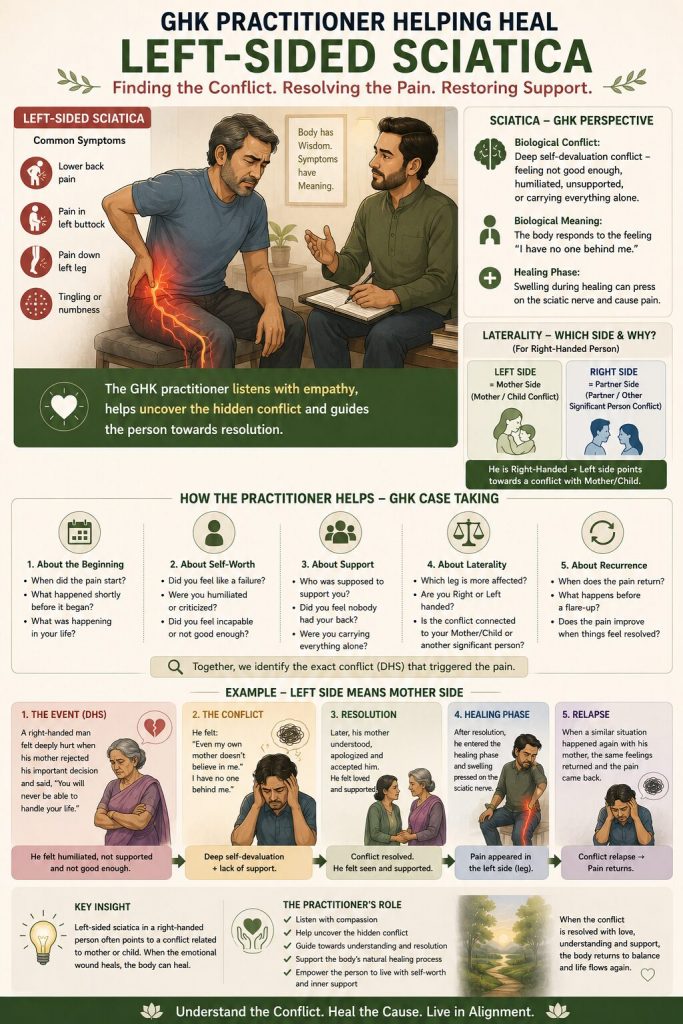
Sciatica refers to pain that follows the path of the sciatic nerve, commonly extending from the lower back through the buttock and into the leg.
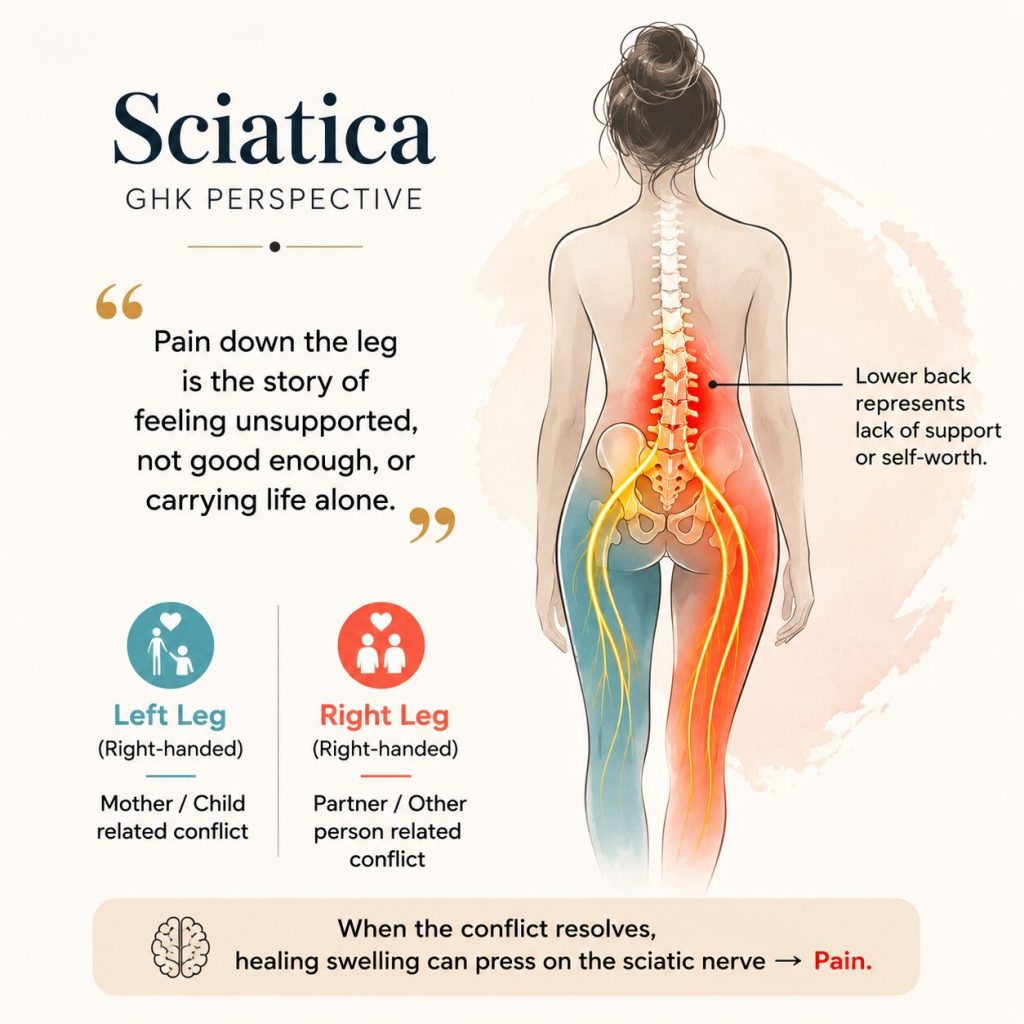
According to Germanic Healing Knowledge (GHK), sciatica is understood in relation to the lumbar spine, intervertebral disc and the biological conflict associated with the lower back.
In the GHK model, the underlying conflict is a central self-devaluation conflict—a profound experience that strikes at one’s sense of worth, strength, capability or support.
The Biological Conflict Behind Sciatica
Central Self-Devaluation Conflict
The lumbar spine is associated with a self-devaluation conflict that affects the core of one’s sense of self.
The experience may involve thoughts such as:
- “I am not good enough.”
- “I have failed.”
- “I cannot handle this.”
- “I have been humiliated.”
- “I am being degraded.”
- “I am not capable anymore.”
- “I am not being supported.”
- “Nobody has my back.”
GHK specifically associates the lower back with the experience of not being backed up or supported by someone important—such as a partner, family member, friend, teacher, colleague or employer.
The Meaning of the Lower Back
The lower back is the body’s central support structure.
From the GHK perspective, a person may therefore experience a lower-back conflict when life circumstances create a deep feeling of:
“I am carrying this alone.”
or
“Nobody is supporting me.”
Examples can include:
- Being abandoned by a partner
- Losing support from one’s family
- Being humiliated at work
- Losing one’s position or status
- Financial failure
- Being told that one is incapable
- Failure in an important responsibility
- Feeling unable to provide for the family
- Being blamed for something one believes was not one’s fault
- A situation in which one’s entire sense of competence is shattered
The conflict can be particularly intense when the event attacks something central to a person’s identity.
Why Does Sciatica Develop?
According to GHK, during the conflict-active phase, the lumbar vertebra associated with the self-devaluation conflict undergoes changes related to bone decalcification.
When the conflict is resolved, the healing phase begins. Swelling develops around the healing lumbar structures.
GHK describes sciatica as occurring when swelling associated with a healing lumbar disc presses against the sciatic nerve. The resulting pressure can produce pain radiating down the buttock and leg.
Therefore, in the GHK model:
Self-devaluation conflict → conflict resolution → healing and swelling → pressure on sciatic nerve → sciatica
Conflict-Active Phase
According to GHK:
During the active phase of a severe self-devaluation conflict:
- The affected bone undergoes decalcification.
- The person may experience constant mental stress.
- Sleep may become disturbed.
- The person may feel cold and withdrawn.
- Thoughts repeatedly revolve around the conflict.
- The feeling of inadequacy or lack of support remains active.
The exact location of the self-devaluation determines which part of the skeletal system is affected.
Healing Phase
Once the conflict is resolved, the body enters the healing phase.
According to GHK, the affected lumbar structures begin reconstruction and swelling develops.
This swelling can increase pressure around the nerve structures.
This may produce:
- Lower-back pain
- Pain in the buttock
- Shooting pain down the leg
- Tingling
- Numbness
- Pulling sensations
- Difficulty sitting or walking
- Muscle tension or spasms
GHK describes recurring sciatica as potentially corresponding to conflict relapses, where the original self-devaluation theme is repeatedly reactivated.
Right-Sided and Left-Sided Sciatica
One of the distinctive features of GHK is the principle of biological laterality.
The side of the body affected is interpreted according to:
- Biological handedness
- Whether the conflict is mother/child-related or partner-related
GHK states that a right-handed person responds to a mother/child conflict on the left side of the body, while a partner-related conflict affects the right side.
For a left-handed person, this relationship is reversed.
Right-Handed Person
| Side of Sciatica | GHK Relationship |
|---|---|
| Left leg | Mother or child |
| Right leg | Partner or another significant person |
Left-Handed Person
| Side of Sciatica | GHK Relationship |
|---|---|
| Right leg | Mother or child |
| Left leg | Partner or another significant person |
Here, “partner” in the GHK terminology can include people other than mother or child—such as father, sibling, relative, friend, colleague or other significant relationships.
Why Laterality Matters in Case Taking
Suppose a right-handed person develops sciatica predominantly in the left leg.
According to the GHK laterality principle, the practitioner would investigate whether the central self-devaluation conflict was connected to:
- Their child
- Their mother
- Someone they experience in a mother/child relationship
If the same person develops right-sided sciatica, the investigation would focus more toward:
- Partner
- Father
- Sibling
- Friend
- Colleague
- Another significant person
For a left-handed person, the sides are reversed.
This makes the side of the symptom an important clue during GHK case-taking.
The Deeper Meaning of “Not Being Supported”
The lower back has a particularly interesting biological symbolism in GHK.
A person may experience:
“I have no one behind me.”
“Nobody has my back.”
“I have to carry everything myself.”
“I cannot depend on anyone.”
The emotional experience may not always be consciously expressed in these exact words.
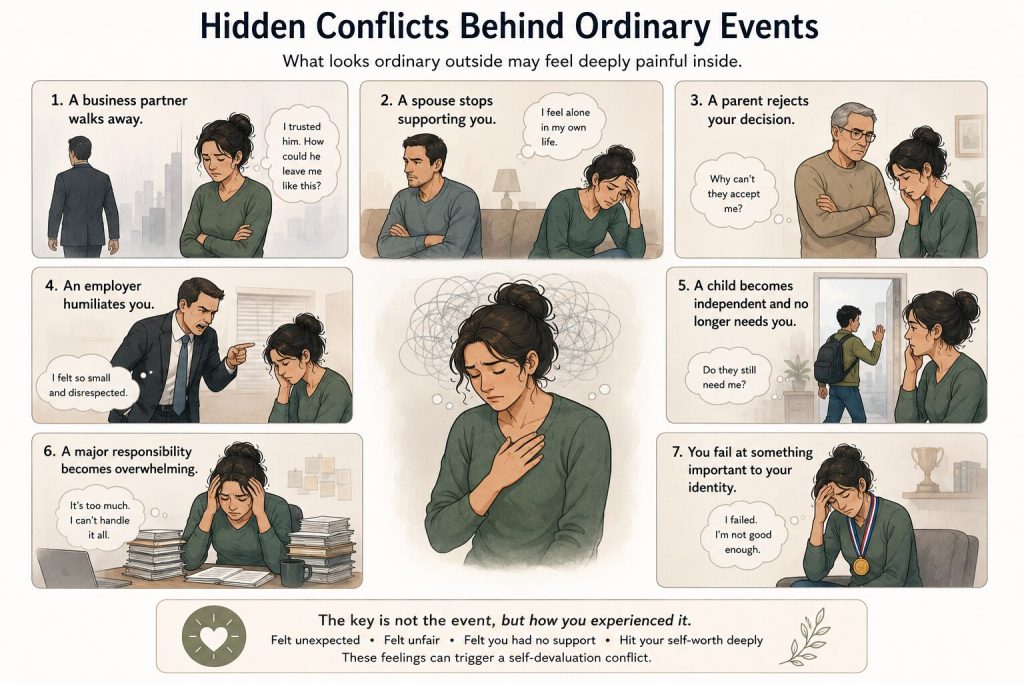
The important element, according to GHK, is how the person experienced the event, rather than the event itself.
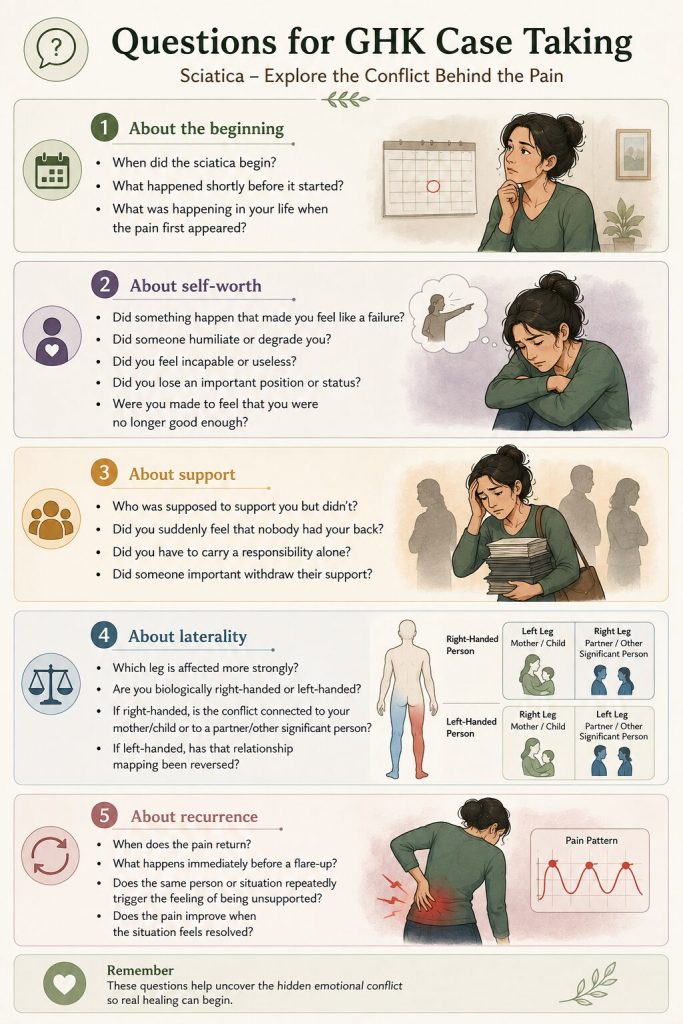
GHK Therapy Approach
The GHK approach focuses on finding the original conflict and understanding its biological meaning.
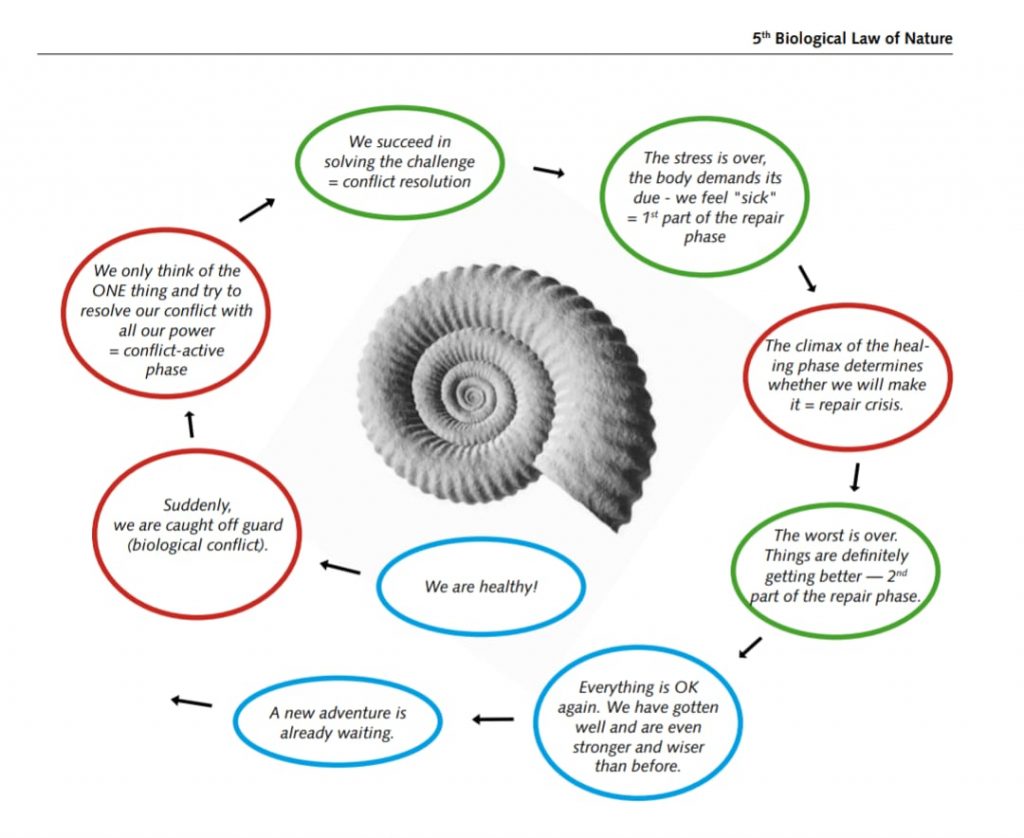
1. Identify the DHS
Find the unexpected event that created the strongest emotional impact.
The goal is not simply to ask:
“What is wrong with your back?”
but:
“What happened in your life that made you feel you were no longer strong enough, capable enough or supported enough?”
2. Identify the Exact Self-Devaluation
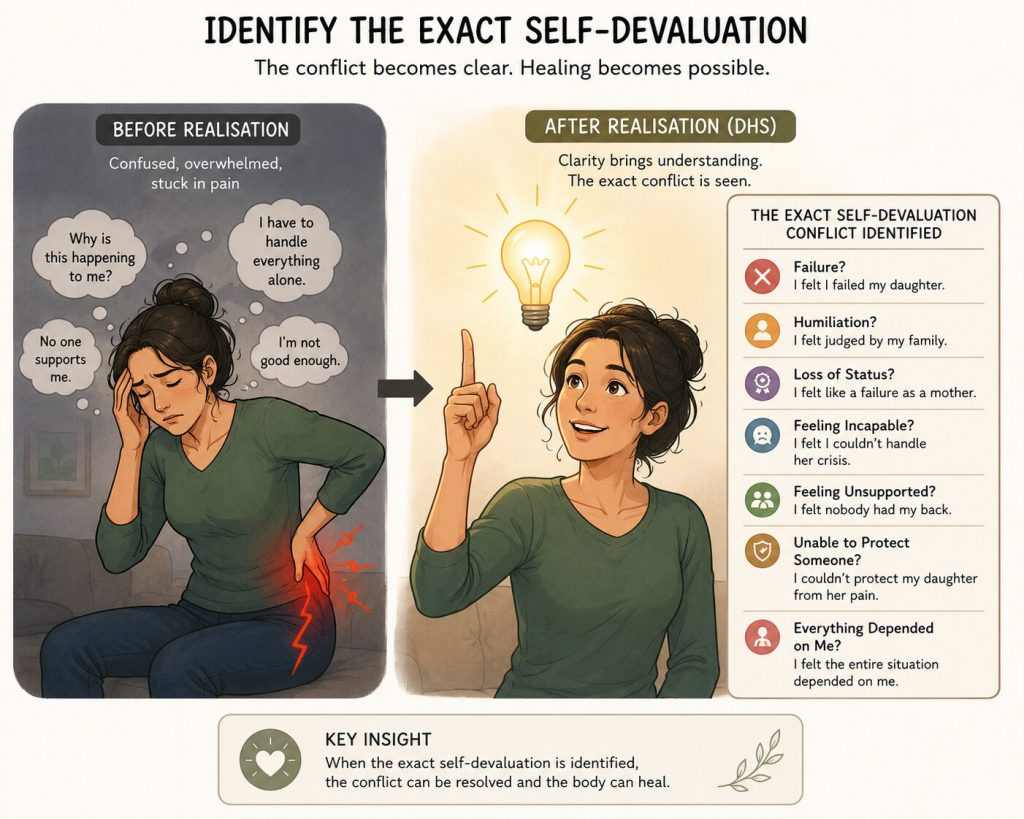
The conflict should be made specific.
Was it:
- Failure?
- Humiliation?
- Loss of status?
- Feeling incapable?
- Feeling unsupported?
- Being unable to protect someone?
- Feeling that everything depended upon you?
The more precisely the conflict is identified, the more meaningful the case-taking becomes within the GHK model.
3. Understand the Side
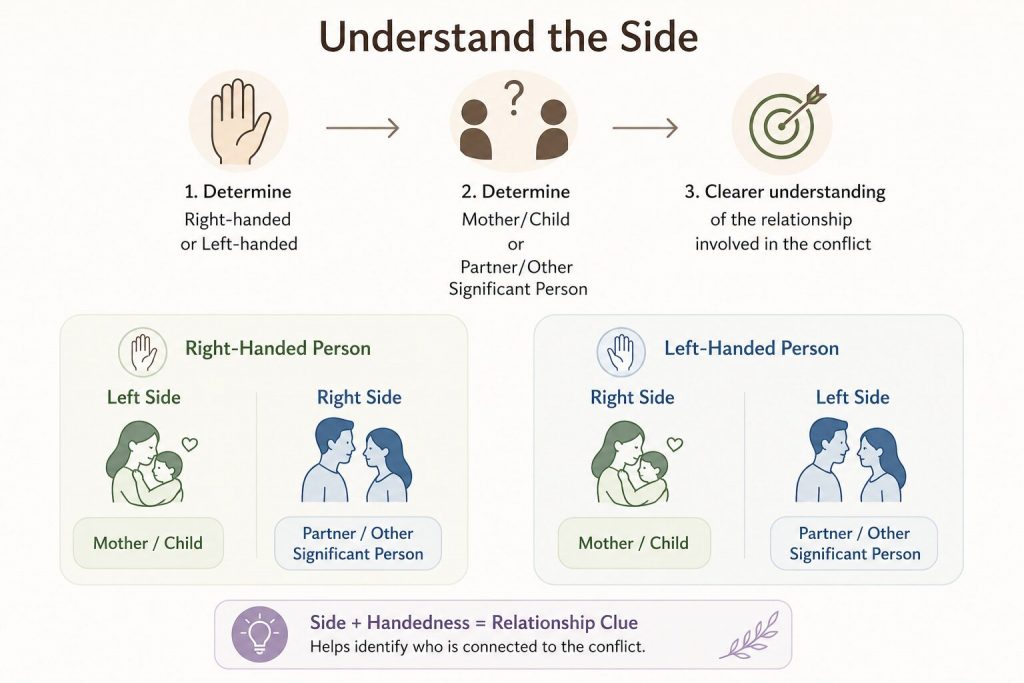
Determine:
Right-handed or left-handed?
Then determine:
Mother/child or partner/other significant person?
This creates a more precise picture of the relationship involved in the conflict.
4. Resolve the Conflict
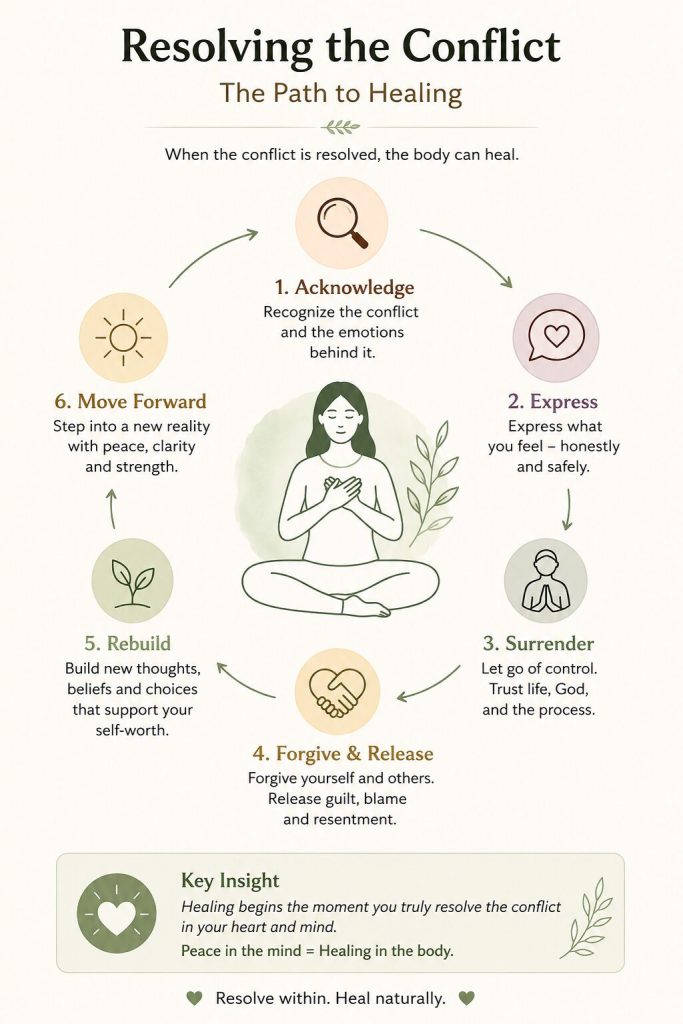
Resolution may involve:
- Understanding what actually happened
- Expressing suppressed emotions
- Forgiveness
- Releasing guilt
- Restoring self-worth
- Rebuilding relationships
- Prayer
- Faith
- Surrender
- Accepting what cannot be changed
- Finding new sources of support
The objective is to reach a genuine internal resolution rather than simply suppressing the memory.
5. Identify Conflict Relapses
If the pain repeatedly disappears and returns, GHK interprets this as potentially corresponding to repeated activation of the original conflict.
Therefore, ask:
“What happened just before the pain returned?”
The answer may reveal the same emotional theme.
Case Study
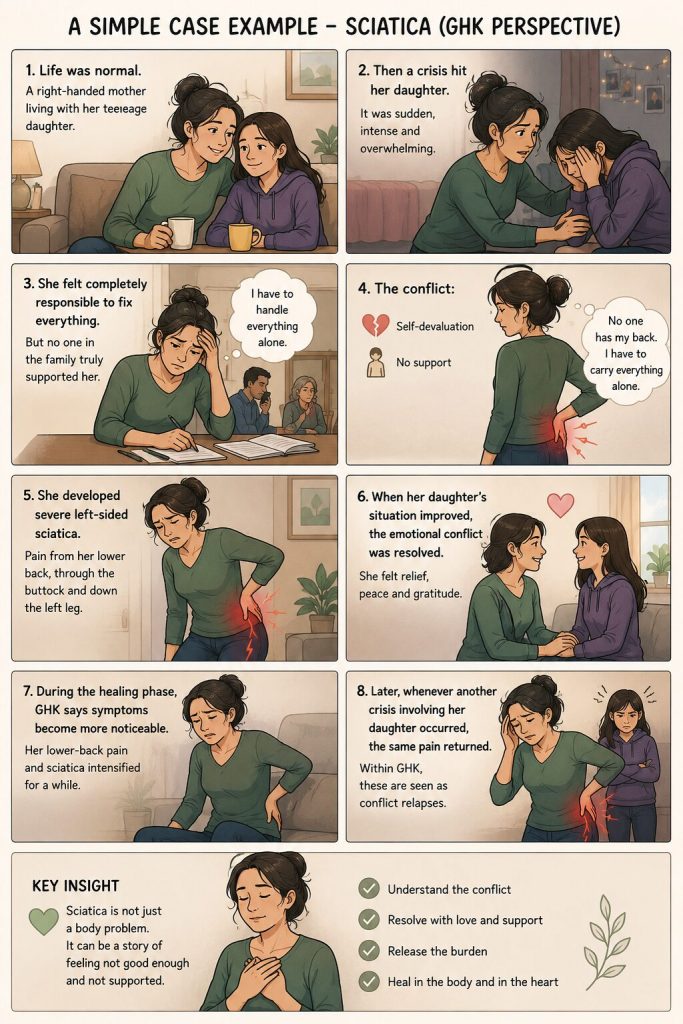
A right-handed woman develops severe left-sided sciatica.
During case-taking, she recalls that several months earlier her teenage daughter went through a serious crisis. She felt completely responsible for solving the situation but believed nobody in the family supported her.
She repeatedly thought:
“I have to handle everything alone.”
The conflict was associated with both self-devaluation and the feeling of having no support.
When the daughter’s situation improved, the emotional conflict was resolved and the woman entered what GHK describes as the healing phase. Her lower-back symptoms subsequently became prominent.
Later, whenever another crisis involving her daughter occurred, the same pain returned.
Within the GHK framework, the recurring symptoms would be explored as possible conflict relapses.
Key Insight
“Sciatica is not only about the leg. In the GHK model, it can be a story of the person who felt they had to carry life without support.”
The lower back represents support, strength and the ability to carry one’s responsibilities.
When the psyche experiences a profound loss of self-worth or feels completely unsupported, GHK proposes that a biological program involving the lumbar spine can be activated.
The side of the sciatica then provides another layer of information through biological handedness and relationship laterality.
Reference
Learning GNM — Bones and Joints / Sciatica:
Learning GNM – Bones and Joints
Learning GNM — Five Biological Laws / Laterality:
Learning GNM – Five Biological Laws
Text us to
Resolve Sciatica