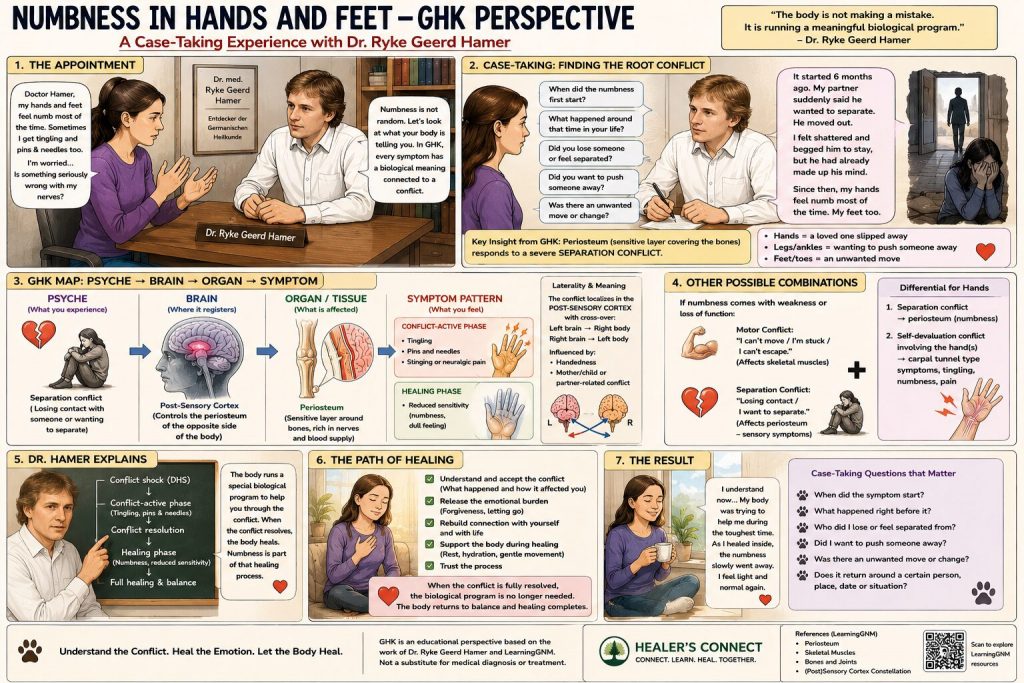
1. Severe separation conflict — periosteum
LearningGNM associates the periosteum with a severe separation conflict—experienced either as losing physical contact with someone or wanting to separate from someone. The site specifically localizes possible separation themes to different body areas:
- Hands: “a loved one slipped away”
- Legs/ankles: wanting to push someone away
- Feet/toes: an unwanted move
- Arms: being unable to hold a loved one or pet.
Interestingly, Germanic Healing Knowledge describes the periosteum as having a sensitivity pattern in which the healing phase produces hyposensitivity. It specifically says that the affected hands, arms, legs or feet can feel numb during this phase.
2. Tingling → numbness
In the same GHK model, the periosteum may produce tingling, sharp/stinging or “pins and needles” during conflict activity, while reduced sensitivity/numbness is associated with the healing phase.
So, within the GHK interpretation:
Separation conflict
↓
Periosteum involved
↓
Conflict-active phase → tingling / stinging / neuralgic pain
↓
Conflict resolution
↓
Healing phase → reduced sensitivity / numbness
3. If the numbness involves the hand or leg together with weakness
LearningGNM also distinguishes sensory from motor symptoms.
Its skeletal-muscle material associates motor symptoms with a motor conflict, while sensory numbness can indicate an additional separation conflict.
Therefore, if someone says:
“My leg is numb and I also can’t move it properly,”
GHK case-taking would investigate both:
Motor conflict:
“I can’t move / I’m stuck / I can’t escape.”
Separation conflict:
“I have lost contact / I want to separate.”
4. Hands specifically
LearningGNM gives a particularly clear example involving both hands and fingers, describing a severe separation conflict and associating the affected area with the post-sensory cortex.
Its material also discusses carpal tunnel symptoms—tingling, numbness and sharp nerve pain—as being interpreted within GNM in connection with a self-devaluation conflict involving the hand(s).
So for hand numbness, the case should distinguish between:
Separation → sensory/periosteal pathway
versus
Self-devaluation → musculoskeletal/hand pathway
rather than assigning one conflict automatically.
5. Feet and legs
For the lower extremities, LearningGNM’s periosteum material specifically associates:
Legs/ankles → wanting to push someone away
Feet/toes → an unwanted move
That gives useful questions for a GHK case:
- Who did I desperately want to push away?
- Who or what did I feel I had lost?
- Who did I want physical contact with but couldn’t have?
- Was there an unwanted move or change of location?
- When did the numbness first appear?
- Did it begin after the relationship/separation situation changed?
- Does the numbness return around a particular person, place, date or situation?
The GHK “psyche → brain → organ” map
Within this framework, the proposed sequence is:
PSYCHE
Separation / loss of contact
↓
BRAIN
Post-sensory cortex
↓
TISSUE
Periosteal nerves
↓
SYMPTOM
Tingling → reduced sensitivity / numbness
Germanic Healing Knowledge explicitly describes the cross-over relationship between the cortical area and the corresponding side of the body, with laterality influenced by handedness and whether the conflict is mother/child or partner-related.
GET IN TOUCH