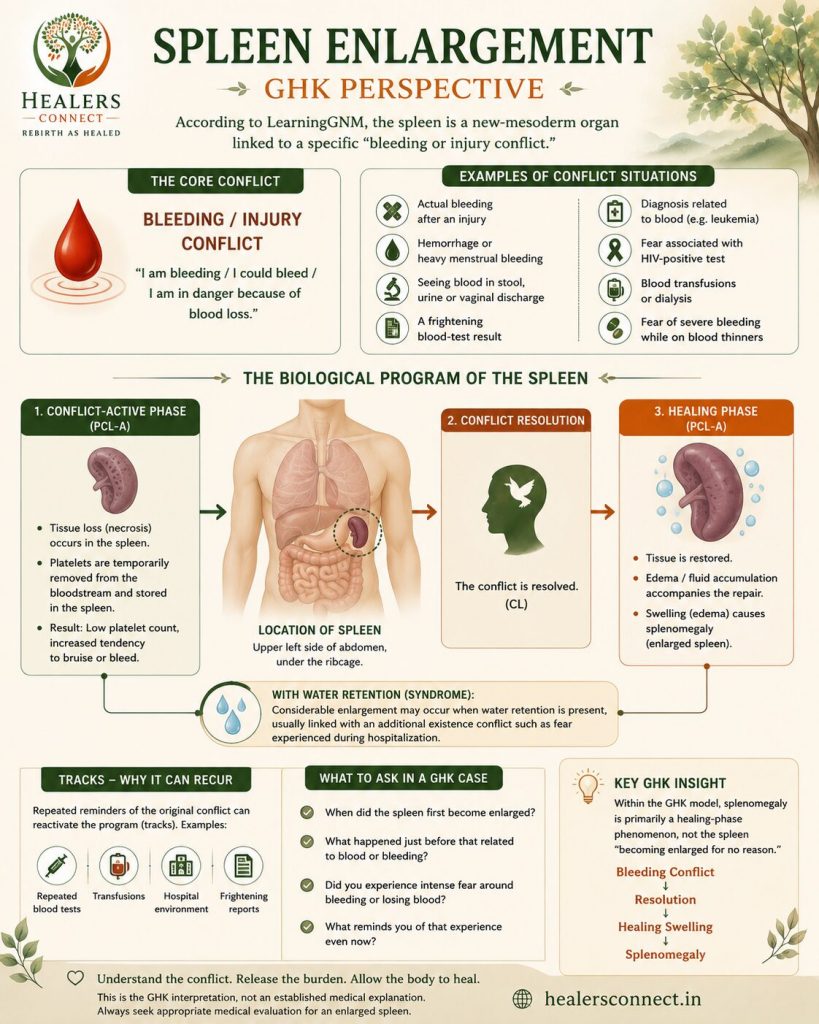
According to LearningGNM, the spleen is classified with the new-mesoderm organs and is associated with a specific “bleeding or injury conflict.” LearningGNM lists splenomegaly (enlarged spleen), splenitis and splenic cysts as possible manifestations of the spleen’s Biological Special Program. (learninggnm.com)
The proposed conflict
The central GHK theme is:
Bleeding / injury → fear around blood, bleeding or loss of blood.
LearningGNM gives examples including:
- Actual bleeding following an injury
- Hemorrhage
- Heavy menstrual bleeding
- Seeing blood in stool, urine or vaginal discharge
- A frightening blood-test result
- A diagnosis associated with blood, such as leukemia
- Fear associated with an HIV-positive test
- Blood transfusions or dialysis
- Fear of severe bleeding while taking blood-thinning medication (learninggnm.com)
The underlying biological theme described by LearningGNM is essentially:
“I am bleeding / I could bleed / I am in danger because of blood loss.”
Why does the spleen enlarge?
This is the particularly important part of the GHK interpretation.
LearningGNM proposes that during the conflict-active phase, tissue loss (necrosis) occurs in the spleen and platelets are temporarily removed from the bloodstream and stored in the spleen. It associates this phase with a reduced platelet count and increased susceptibility to bruising or bleeding. (np.learninggnm.com)
When the conflict is resolved, LearningGNM describes a healing phase (PCL-A) in which the tissue is restored. Edema/fluid accumulation accompanies the repair, and this swelling is proposed to produce splenomegaly. (np.learninggnm.com)
So, within this model:
Bleeding/injury conflict
↓
Conflict-active phase
↓
Spleen tissue loss + platelet reduction
↓
Conflict resolution
↓
Healing + swelling/edema
↓
Enlarged spleen
LearningGNM also describes considerable enlargement when water retention (“Syndrome”) is present, associating this with an additional existence conflict, such as fear experienced during hospitalization. (np.learninggnm.com)
What would be explored in a GHK case?
Rather than simply asking “Why is the spleen enlarged?”, a GHK facilitator would investigate:
1. When did the spleen first become enlarged?
2. What happened shortly beforehand involving blood or bleeding?
3. Was there:
- an accident or injury?
- unexpected bleeding?
- heavy menstruation?
- blood noticed in stool/urine?
- a frightening blood report?
- a diagnosis involving blood?
- a transfusion?
- repeated blood tests?
4. Did the person experience intense fear around the possibility of bleeding or losing blood?
5. Has the person subsequently encountered reminders of that experience?
LearningGNM specifically discusses repeated blood tests and transfusions as potential tracks that can reactivate the proposed blood conflict. (np.learninggnm.com)
The key GHK insight
Within the LearningGNM model, splenomegaly is primarily interpreted as a healing-phase phenomenon, rather than the spleen simply “becoming enlarged for no reason.”
Bleeding conflict → resolution → healing swelling → splenomegaly
The site’s own overview likewise maps “bleeding or injury conflict” → splenomegaly, splenitis and splenic cyst. (learninggnm.com)
Important distinction
This is LearningGNM’s proposed interpretation, not an established medical explanation for an enlarged spleen. Splenomegaly can have many medically important causes, including infections, liver disease, blood disorders and malignancies, so a newly discovered or significantly enlarged spleen warrants appropriate medical evaluation.
Primary LearningGNM source: LearningGNM — Lymphatic System / Spleen