What is Liver Cancer?
Conventionally, primary liver cancer (hepatocellular carcinoma) is a malignant growth arising from liver cells. Common risk factors include chronic hepatitis B or C infection, cirrhosis, alcohol-related liver disease, and metabolic liver disorders. (Liver Central)
GHK Perspective
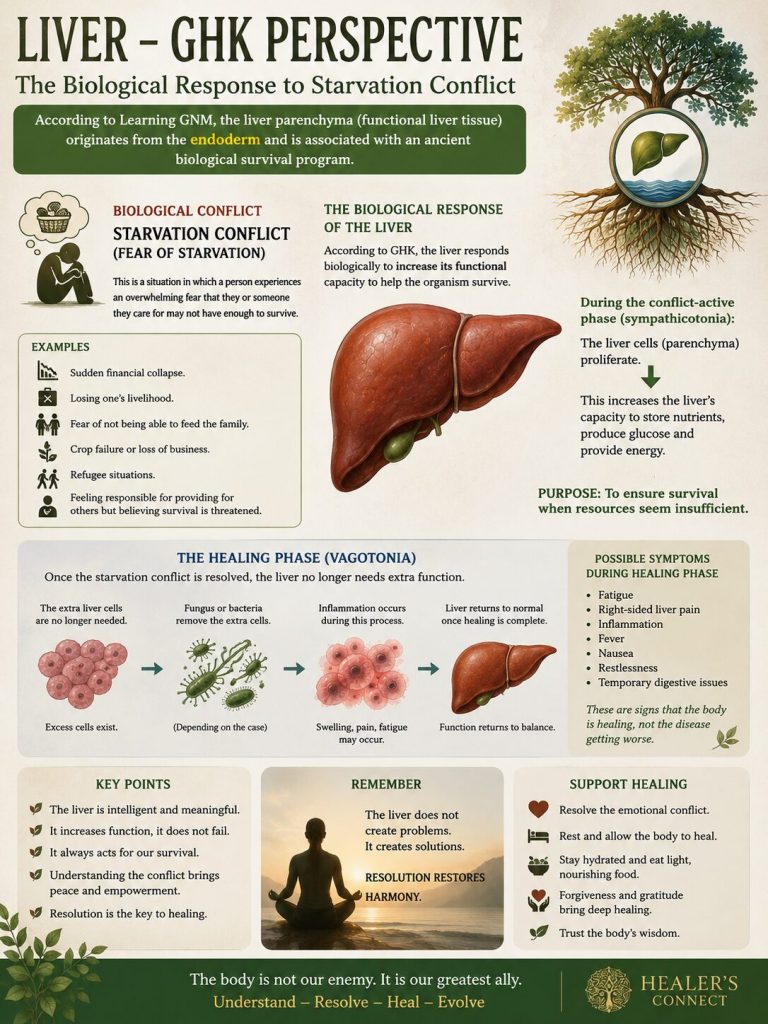
According to Learning GNM, the liver parenchyma (functional liver tissue) originates from the endoderm and is associated with an ancient biological survival program.
The biological conflict linked to the liver is a:
Starvation Conflict (Fear of Starvation)
Learning GNM describes this as a situation in which a person experiences an overwhelming fear that they or someone they care for may not have enough to survive.
Examples include:
- Sudden financial collapse.
- Losing one’s livelihood.
- Fear of not being able to feed the family.
- Crop failure or loss of business.
- Refugee situations.
- Feeling responsible for providing for others but believing survival is threatened.
According to GHK, the liver responds biologically to increase its functional capacity.
Biological Purpose
Learning GNM proposes that during the conflict-active phase, liver cells proliferate (adenocarcinoma growth) to increase liver function, allowing the body to make better use of available nutrients during a perceived starvation emergency.
This is interpreted as an ancient survival adaptation.
Conflict-Active Phase
According to Learning GNM:
- Liver gland cells multiply.
- Usually little or no pain is experienced initially.
- The biological purpose is considered to be increased metabolic capacity during starvation.
The longer the starvation conflict remains active, the larger the liver adenocarcinoma may become.
Healing Phase
Once the starvation conflict is resolved:
According to Learning GNM:
- The additional liver cells are broken down by fungi or mycobacteria (if available).
- During this phase there may be:
- fatigue,
- fever,
- night sweats,
- inflammation,
- temporary liver enlargement.
If these microbes are unavailable, Learning GNM proposes that the extra cells remain encapsulated rather than being broken down.
Questions During GHK Case Taking
- When did symptoms first appear?
- What major event occurred in the months beforehand?
- Did you experience a sudden fear of financial ruin?
- Did you worry about feeding yourself or your family?
- Did you unexpectedly lose employment or a business?
- Did someone close to you become financially dependent on you?
- Has the same fear repeatedly returned?
GHK Therapy Approach
Within the GHK framework, practitioners focus on:
- Identifying the original starvation conflict.
- Resolving the emotional perception of survival threat.
- Identifying recurring conflict tracks.
- Supporting emotional stability during the healing phase.
Case Example from Learning GNM
Learning GNM describes a representative example of a business owner who unexpectedly lost his company and experienced an intense fear that he would no longer be able to provide for his family. According to the GHK interpretation, this severe “starvation conflict” remained active for months, during which a liver adenocarcinoma developed. After his financial situation improved and the conflict resolved, he entered the healing phase, which was accompanied by inflammatory changes in the liver. This case is presented by Learning GNM to illustrate the proposed relationship between a perceived survival crisis and liver biological programs.
Learning GNM uses this example to explain the conflict theme; it is presented as an illustrative case within the GHK framework rather than as proof of causation.
Key Insight
According to Learning GNM, liver adenocarcinoma is interpreted as a biological adaptation to a severe starvation or survival conflict. The increase in liver cells is viewed as an attempt by the body to improve metabolic capacity during a perceived life-threatening shortage of resources. Once the conflict is resolved, the body is said to enter a healing phase in which the additional cells may be broken down if the appropriate microbes are present.
Reference: Learning GNM – Digestive System: Liver (Liver Parenchyma / Liver Adenocarcinoma section). Learning GNM does not appear to publish a standalone, fully documented patient case devoted exclusively to liver cancer on its website. The business-owner example above is an illustrative case described within its educational material rather than a separate case report.