Gout — The Germanic Healing Knowledge Perspective
When a Joint Heals Under the Influence of Water Retention
Gout is commonly understood through elevated uric acid, diet, alcohol consumption and the formation of painful crystals in a joint.
Germanic Healing Knowledge (GHK/GNM) approaches gout from a different direction.
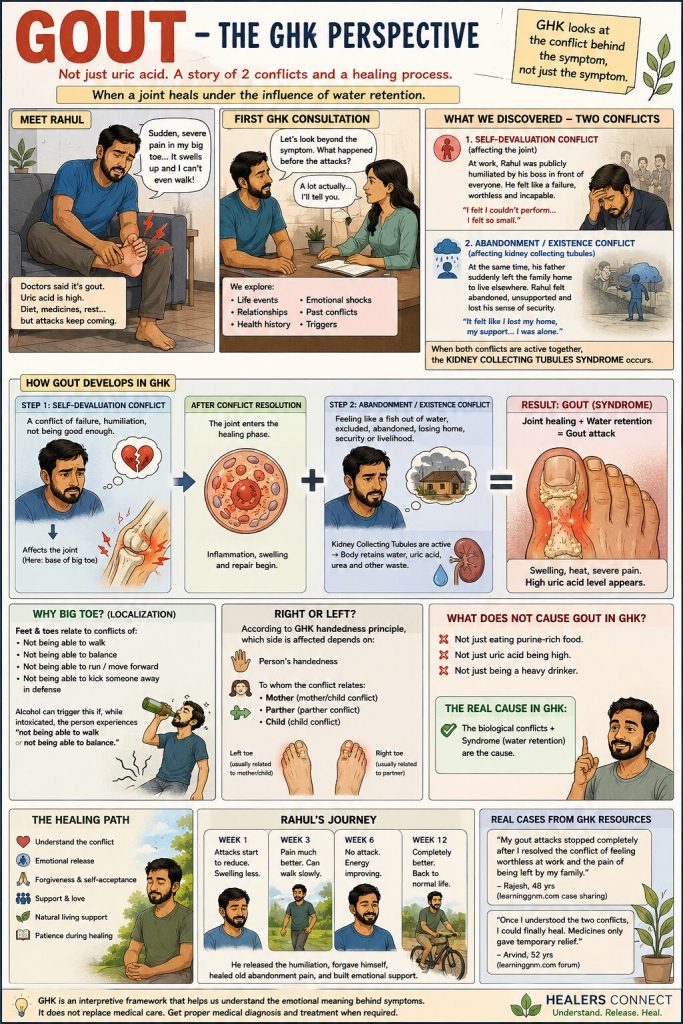
According to the GHK model described by LearningGNM, gout develops when a joint is in the healing phase of a self-devaluation conflict while water retention is simultaneously active because of an abandonment or existence conflict involving the kidney collecting tubules. This combination is referred to as the Kidney Collecting Tubules Syndrome, or simply the Syndrome.
Therefore, from this perspective, understanding gout requires looking at two biological programs at the same time:
1. The joint — self-devaluation conflict and its healing phase
2. The kidney collecting tubules — abandonment/existence conflict and water retention
1. The Joint: A Self-Devaluation Conflict
Within GHK, bones and joints are associated with self-devaluation conflicts, meaning experiences of loss of self-worth.
The source distinguishes between severe self-devaluation conflicts associated with bones and lighter self-devaluation conflicts associated with cartilage, tendons and ligaments. The exact location is interpreted according to the part of the body involved.
A generalized self-devaluation can arise from experiences such as:
- humiliation
- criticism or derogatory remarks
- failure
- poor performance
- shame
- guilt
- loss of status
- loss of work
- illness or injury
- feeling incapable
- feeling that one is no longer as good as before
The GHK interpretation therefore asks not simply:
“Why does this joint hurt?”
but:
“Where did I experience myself as inadequate, incapable or devalued?”
2. Why the Foot and Big Toe Matter
GHK gives specific conflict localizations to different parts of the skeletal system.
The feet, ankles, heels and toes are associated with conflicts involving:
- not being able to walk
- not being able to run
- not being able to jump
- not being able to dance
- not being able to balance
- not being able to kick someone away in defence
The underside of the heel is additionally associated with the figurative inability to “crush” a person or situation.
This becomes particularly relevant when gout affects the joint at the base of the big toe.
The question in a GHK investigation therefore becomes:
“Where in my life did I experience that I could not walk forward, could not maintain my balance, or could not defend myself?”
3. Gout Is Not Simply the Joint Program
This is the crucial distinction in the GHK interpretation.
According to LearningGNM, arthritis represents the healing of a joint accompanied by inflammation. When water retention caused by the Kidney Collecting Tubules Syndrome is present at the same time, this healing process is interpreted as gout.
In other words:
Self-devaluation conflict → joint healing → inflammation
plus
Abandonment/existence conflict → kidney collecting tubule activity → water retention
equals
Gout, according to the GHK model.
The retained water increases swelling during the healing process, which is why the combination can produce particularly painful joint inflammation.
4. The Kidney Collecting Tubules: “I Am Out of My Environment”
The second half of the picture comes from the kidney collecting tubules.
GHK describes their biological conflict theme as an abandonment, existence or refugee conflict.
The central experience is metaphorically described as:
“Like a fish out of water.”
This can correspond, within the GHK framework, to suddenly being removed from one’s familiar surroundings or losing one’s “pack.”
Examples described in the GHK material include experiences of:
- being excluded
- being rejected
- being unwanted
- being ignored
- being isolated
- being left alone
- losing emotional support
- losing one’s home
- losing one’s livelihood
- financial collapse
- losing a person who provided security
- being uprooted
- being forced to move
- feeling displaced or in exile
An existence conflict is described more specifically as the perception that one’s life or livelihood is at stake, including the feeling:
“I have lost everything.”
5. Why Water Retention Is Important in Gout
According to GHK, during the conflict-active phase of a kidney collecting tubule conflict, the organism retains water.
The source associates this phase with:
- water retention
- increased uric acid
- increased urea and creatinine
- reduced urine output
The intensity of the conflict is said to determine the degree of water retention.
This is why the Syndrome is so important in the GHK interpretation of gout.
The Syndrome is defined as:
active abandonment/existence conflict + another Biological Special Program in the healing phase.
When that healing program involves a joint, the additional water retention is interpreted as contributing to the large swelling and pain characteristic of gout.
6. Why Elevated Uric Acid Appears in the GHK Explanation
Uric acid becomes particularly important because gout is conventionally associated with elevated uric acid.
GHK does not interpret the elevated uric acid simply as evidence that the person consumed too much protein or purine-rich food.
The kidney collecting tubules are described as retaining not only water but also uric substances such as uric acid, urea and creatinine during the conflict-active phase.
Consequently, within this model, an elevated uric acid level is interpreted in the context of the water-retention program rather than being treated as the complete explanation for why the gout attack occurred.
7. What About Alcohol?
Gout in the joint at the base of the big toe is commonly associated with excessive alcohol consumption.
GHK does not say that every heavy drinker develops gout.
The LearningGNM explanation makes an important distinction: if intoxication becomes the circumstance in which a person experiences a conflict of “not being able to walk” or “not being able to balance,” then, according to the GHK model, the corresponding biological program can be activated.
So alcohol is not presented as a universal explanation.
The GHK question becomes:
What happened emotionally while the person was intoxicated?
Did the person:
- fall?
- lose balance?
- feel unable to walk?
- experience humiliation?
- feel physically incapable?
- experience an event that created a self-devaluation?
The relevant conflict is therefore investigated in relation to the specific experience, rather than assuming that alcohol alone explains the gout.
8. Why the Right or Left Big Toe?
GHK applies its handedness principle to localized self-devaluation conflicts.
According to the framework, whether a conflict affects the right or left side depends on:
the person’s handedness
and
whether the conflict relates to mother/child or partner relationships.
For gout involving the big toe, the localization is therefore investigated rather than treated as random.
The questions may include:
Is this about my partner?
Is this about my mother?
Is this about my child?
What exactly did I experience as a failure or inability in that relationship?
The GHK model therefore uses laterality and relationship context as part of the conflict investigation.
9. The Gout Attack
LearningGNM describes the acute pain of a gout attack in relation to the Epileptoid Crisis occurring during the healing process.
According to the source, inflammation of the gout nodules produces acute pain, particularly during this crisis.
From the GHK sequence, therefore, the attack is not necessarily interpreted as the moment when the original conflict began.
It may represent a particular point in the healing sequence.
This distinction is important when investigating timing.
The question becomes:
“What happened before the joint entered healing, and what was happening with the abandonment/existence conflict at the same time?”
10. The Two Conflicts to Investigate
For a person with gout, a GHK-style exploration would therefore look at two separate but interacting themes.
A. SELF-DEVALUATION / JOINT CONFLICT
Ask:
- Where did I feel I failed?
- Where did I feel incapable?
- Where did I feel humiliated?
- Where did I feel I could not perform?
- Where did I feel unable to walk forward?
- Where did I feel unable to maintain my balance?
- Who was involved?
- Was it related to my partner, mother or child?
B. ABANDONMENT / EXISTENCE CONFLICT
Ask:
- Where did I suddenly feel alone?
- Where did I feel excluded?
- Where did I lose my emotional shelter?
- Did I lose my home?
- Did I lose financial security?
- Did I lose someone who supported me?
- Did I feel uprooted?
- Did I feel that I had lost everything?
- Where did I feel like a “fish out of water”?
The GHK interpretation of gout becomes much clearer when these two dimensions are investigated together.
11. Why Diet Alone Is Not the GHK Explanation
A person experiencing gout is often told to change their diet, particularly by reducing foods associated with purines, and elevated uric acid is treated as an important factor.
GHK asks a different question:
Why is the biological program active in this particular person at this particular time?
Within the GHK model, dietary changes may therefore be viewed as secondary to understanding the underlying conflict.
The central issue is not simply:
“What did I eat?”
but:
“What biological conflict is active, and why is the body retaining water while this joint is healing?”
This is the distinctive feature of the GHK interpretation.
12. The GHK Map of Gout
The entire process can be represented simply:
Self-devaluation conflict
↓
Localized joint conflict
↓
Conflict resolution
↓
Joint enters healing phase
*
Abandonment / existence / refugee conflict
↓
Kidney collecting tubules retain water
↓
Syndrome
↓
More swelling during joint healing
↓
Gout
And, according to the GHK explanation, the acute gout attack can occur during the Epileptoid Crisis of the healing process.
The Central Question
From the GHK perspective, gout is therefore not reduced to:
“Too much uric acid.”
The deeper investigation is:
“Where did I experience a loss of self-worth, and where did I simultaneously experience abandonment, displacement or a threat to my existence?”
The joint tells one part of the story.
The kidney collecting tubules tell another.
The Syndrome connects them.
And the specific location—such as the big toe—provides another layer for investigating the conflict according to the GHK framework.