Leg Pain — Possible Causes According to GHK
In the GHK/GNM framework, “leg pain” is not assigned to one single conflict. The proposed interpretation depends on which tissue is involved, where the pain is located, and whether the person is in the conflict-active or healing phase.
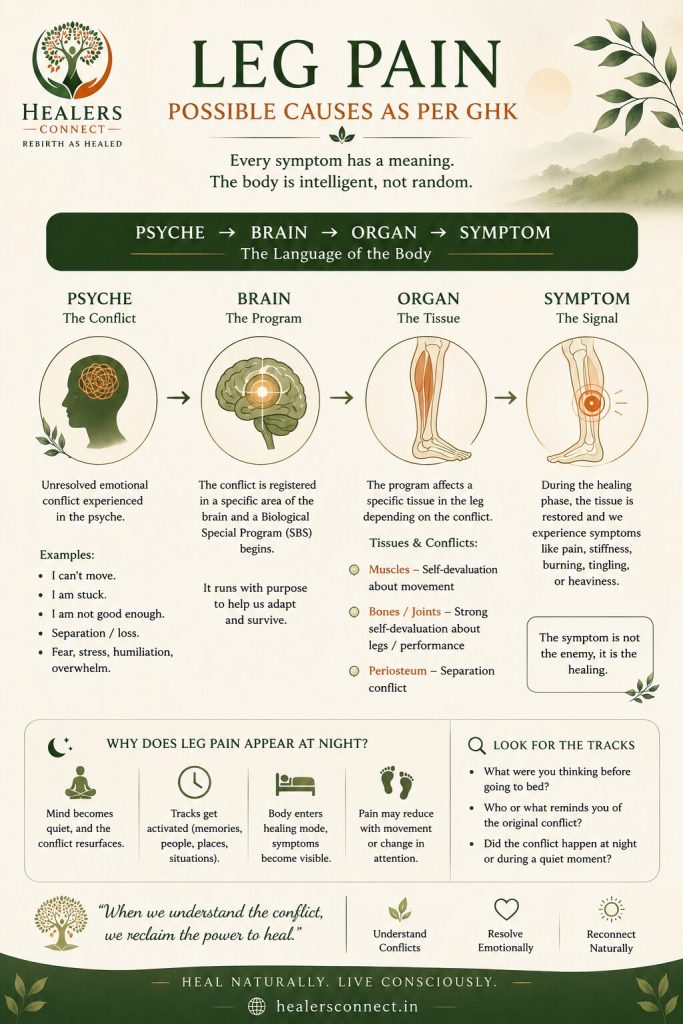
1. Muscle-related leg pain
Possible conflict:
Self-devaluation related to movement or physical ability.
Typical themes may include:
- “I can’t move.”
- “I am stuck.”
- “I can’t move forward.”
- “I can’t walk/run/perform as I should.”
- Feeling inadequate regarding physical performance.
GHK associates muscle symptoms particularly with self-devaluation conflicts, with pain potentially appearing during the healing phase.
2. Bone or joint-related leg pain
Possible conflict:
A stronger self-devaluation conflict concerning the legs, movement or physical performance.
Possible perceptions include:
- “My legs aren’t good enough.”
- “I can’t do what I should be able to do.”
- Feeling incapable or inadequate physically.
- Failure or humiliation related to athletic or physical performance.
3. Periosteum-related pain
If the pain is particularly sharp, burning, stinging or hypersensitive, GHK case-taking may consider the periosteum.
Possible conflict:
A separation conflict—especially an experience of unwanted separation or loss of physical contact.
The exact interpretation depends on the location and circumstances.
4. Pain appearing mainly at night
If leg pain repeatedly appears before going to sleep, GHK case-taking would look for a possible track associated with the original conflict.
Explore:
- What happens emotionally before bedtime?
- Who or what do you think about when lying down?
- Did the original conflict occur at night?
- Does being alone trigger particular feelings?
- Does the pain appear on the same days, after the same activities or following contact with a particular person?
- Does getting up and moving change the pain?
Within GHK, repeated exposure to such associations may produce conflict relapses and recurring healing phases.
A simple case-taking map
LEG PAIN → identify tissue → identify exact location → establish handedness/laterality → find the original conflict → identify current tracks → determine whether symptoms fit conflict activity or healing.
The key GHK question is therefore not simply:
“What is causing my leg pain?”
but:
“What was happening in my life when this particular part of my leg first became symptomatic—and what keeps reminding me of that experience?”
This is the GHK interpretation, rather than an established medical explanation for leg pain.