According to Germanic Healing Knowledge, “asthma” is not considered a single disease but can involve different Biological Special Programs, depending on which tissue is involved. The most common are the bronchial mucosa, bronchial muscles, and, in some cases, the laryngeal muscles.
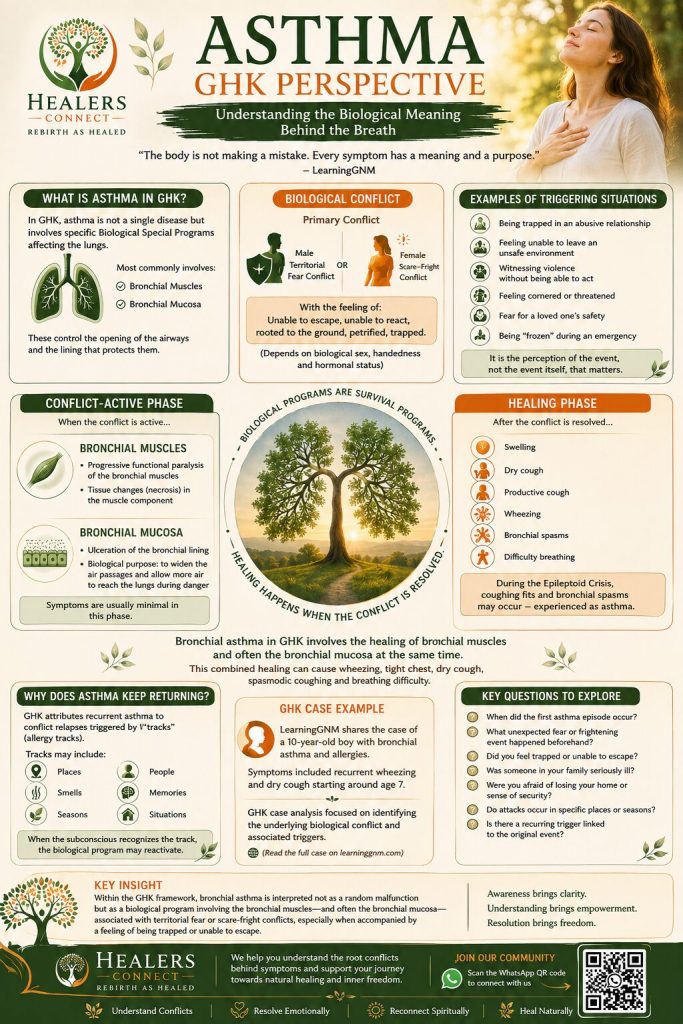
What is Bronchial Asthma in GHK?
LearningGNM describes bronchial asthma primarily as involving the bronchial muscles and often the bronchial mucosa.
Tissue Involved
- Bronchial muscles
- Bronchial mucosa (often simultaneously)
The bronchial muscles regulate the opening of the airways during breathing.
Biological Conflict
According to LearningGNM, the conflict associated with the bronchial muscles is:
Primary Conflict
- Male territorial fear conflict, or
- Female scare-fright conflict
The exact interpretation depends on:
- Biological sex
- Handedness
- Hormonal status
LearningGNM also states that the muscle program adds another important component:
Feeling unable to escape, unable to react, rooted to the ground, petrified, or trapped.
Examples
A person may experience:
- Being trapped in an abusive relationship
- Feeling unable to leave an unsafe environment
- Witnessing violence without being able to act
- Feeling cornered
- Experiencing intense fear for a loved one’s safety
- Being “frozen” during an emergency
Within the GHK framework, the person’s perception of the event is considered more important than the objective event itself.
Conflict-Active Phase
During conflict activity, LearningGNM describes:
Bronchial Muscles
- Progressive functional paralysis of the bronchial muscles
- Tissue changes (necrosis) in the muscle component
Bronchial Mucosa
- Ulceration of the bronchial lining
LearningGNM proposes that the biological purpose of mucosal ulceration is to widen the air passages, allowing more air to reach the lungs during a perceived danger. Symptoms may be minimal during this phase.
Healing Phase
After the conflict is resolved, LearningGNM describes reconstruction of the tissues.
Healing may include:
- Swelling
- Dry cough
- Productive cough
- Wheezing
- Bronchial spasms
- Difficulty breathing
The repair process of the bronchial muscles is described as producing coughing fits and bronchial spasms during the Epileptoid Crisis, which is labelled as bronchial asthma.
Bronchial Asthma
bronchial asthma involves:
- Healing of the bronchial muscles
- Often simultaneous healing of the bronchial mucosa
When both programs occur together, the combined healing response can produce:
- Wheezing
- Tight chest
- Dry cough
- Spasmodic coughing
- Breathing difficulty
This combined healing is also discussed alongside conditions such as spastic bronchitis and whooping cough within the LearningGNM framework. (Learning GNM)
Why Does Asthma Keep Returning?
LearningGNM attributes recurrent asthma to conflict relapses triggered by tracks (also called “allergy tracks”).
A track may include:
- A particular place
- A smell
- A season
- A person
- A memory
- A situation resembling the original conflict
When the subconscious recognizes the track, LearningGNM proposes that the biological program may reactivate, contributing to recurring symptoms. (Learning GNM)
Questions During GHK Case-Taking
A facilitator working within the GHK framework might explore:
- When did the first asthma episode occur?
- What unexpected fear or frightening event happened beforehand?
- Did you feel trapped or unable to escape?
- Was someone in your family seriously ill?
- Were you afraid of losing your home or sense of security?
- Do attacks occur in specific places or seasons?
- Is there a recurring trigger linked to the original event?
LearningGNM Case Example
LearningGNM publishes a case of a 10-year-old boy with bronchial asthma and allergies. The case describes recurrent wheezing and dry cough beginning around age seven. The GHK case analysis focused on identifying the underlying biological conflict and associated triggers according to the LearningGNM model. (Learning GNM)
Key Insight
“Within the GHK framework, bronchial asthma is interpreted not as a random malfunction but as a biological program involving the bronchial muscles—and often the bronchial mucosa—associated with territorial fear or scare-fright conflicts, especially when accompanied by a feeling of being trapped or unable to escape.”
This reflects the LearningGNM interpretation and is not accepted by mainstream medical science, which explains asthma primarily as a chronic inflammatory disease of the airways involving immune, genetic, and environmental factors.