In Germanic Healing Knowledge (GHK / GNM), Lumbar Spinal Stenosis (Spinalkanalstenose) and lower back conditions are classified under the New Mesoderm Special Biological Programs (SBS), which are controlled by the cerebral medulla (Großhirnmarklager).
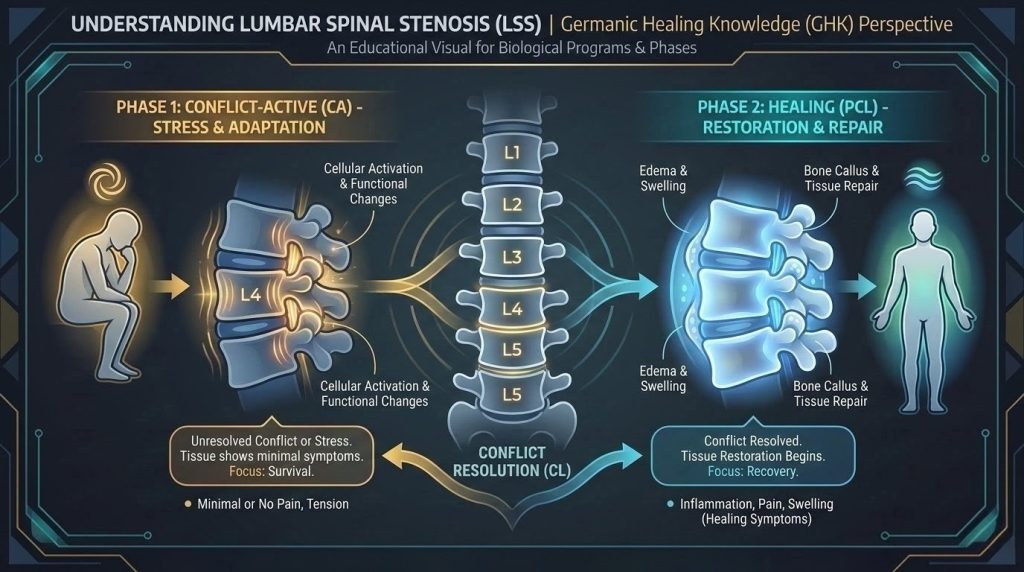
1. The Root Biological Conflict & Mechanism of Lumbar Stenosis
- Core Conflict Theme: Central Self-Worth Conflict (Zentraler Persönlichkeits-Selbstwerteinbruch / SWE).
- Subjective Sensation: Feeling “shaken to the core,” feeling that a life situation or burden is completely unbearable, or feeling defeated and incapable of standing up under heavy pressure (“I am not able to withstand this pressure,” “This breaks my backbone”).
- Biological Dynamics Across Phases:
- Conflict-Active Phase (ca-Phase): Controlled cell loss (osteolysis) occurs in the lumbar vertebrae (L1–L5) and intervertebral discs. This phase is usually painless.
- Healing Phase (pcl-Phase): Upon resolving the conflict (CL), the body rebuilds the bone and cartilage tissue with water edema and calcification. The affected bone structure ultimately becomes thicker and structurally stronger than before the conflict (the “Luxury Group” principle).
- How Spinal Stenosis Develops:
- Lumbar Spinal Stenosis develops as a result of a long-term hanging healing process (hängende Heilung) with recurring conflict relapses over months or years.
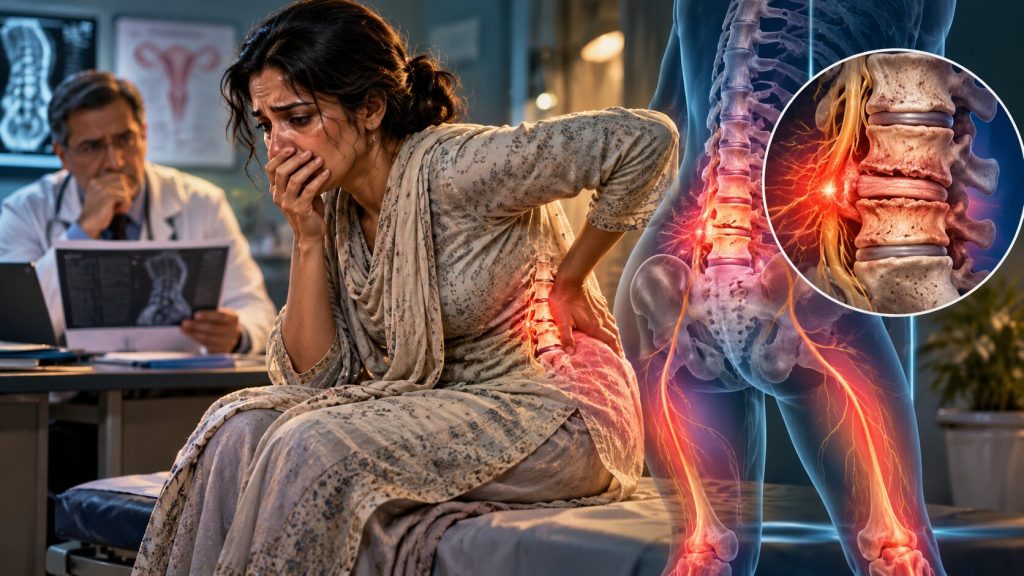
- With each repeated cycle of conflict active osteolysis followed by repair calcification, excessive bone tissue (callus) accumulates. Over time, this cumulative bone buildup leads to a permanent narrowing (stenosis) of the spinal canal, compressing the spinal cord or nerve roots and causing radiating pain down into the legs (sciatica).
2. Documented Case Examples from the Sources
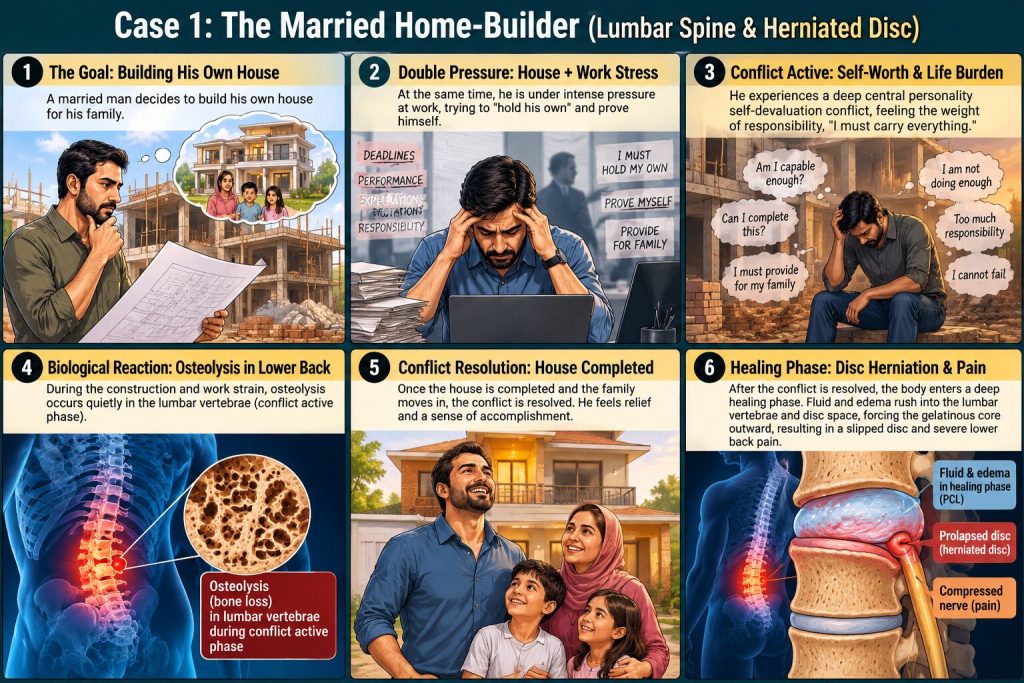
Case 1: The Married Home-Builder (Lumbar Spine & Herniated Disc)
- Conflict History: A married man was building his own house while simultaneously struggling to “hold his own” at work under intense pressure (central personality self-worth conflict).
- Biological Reaction: Throughout the construction and work strain, osteolysis occurred quietly in his lower back. Once the house was completed and the family moved in (conflict resolution), the organism plunged into a deep healing phase.
- Symptom Manifestation: Fluid and edema rushed into the lumbar vertebrae and disc space, forcing the gelatinous core outward and resulting in an acute slipped disc (prolapsed lumbar disc) and severe lower back pain.
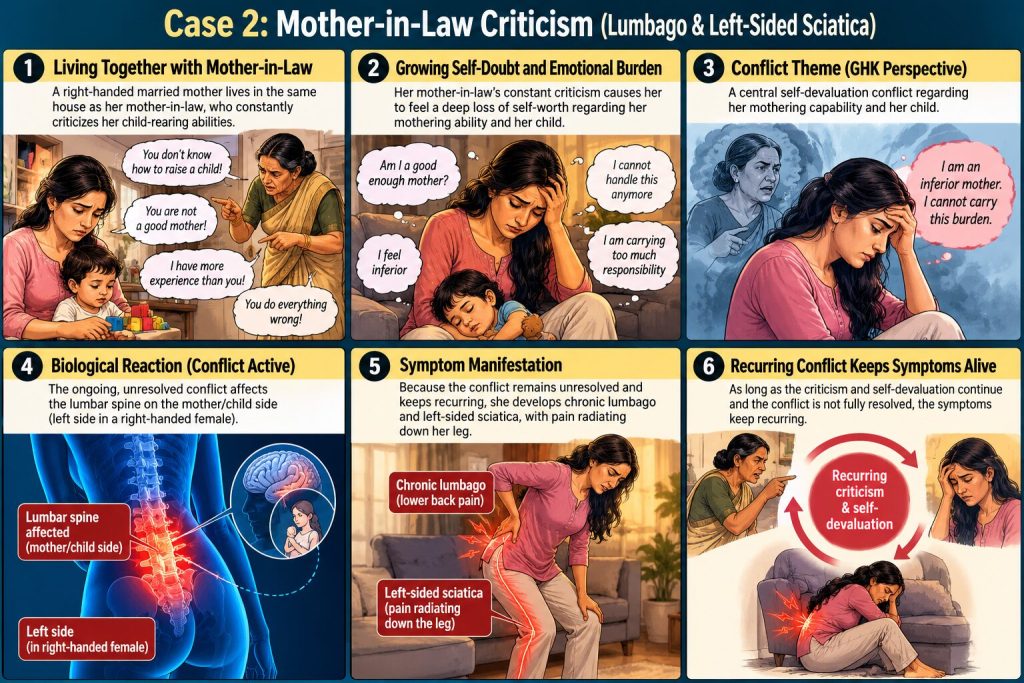
Case 2: Mother-in-Law Criticism (Lumbago & Left-Sided Sciatica)
- Conflict History: A right-handed married mother lived in the same house as her mother-in-law, who constantly criticized her child-rearing abilities, expressing no confidence in her.
- Subjective Feeling: Central loss of self-worth regarding her mothering capability and her child (“I am an inferior mother, I cannot carry this burden”).
- Symptom Manifestation: Because the conflict was unresolved and kept recurring, she suffered from chronic lumbago and left-sided sciatica (corresponding to the mother/child side in a right-handed female) radiating down her leg.
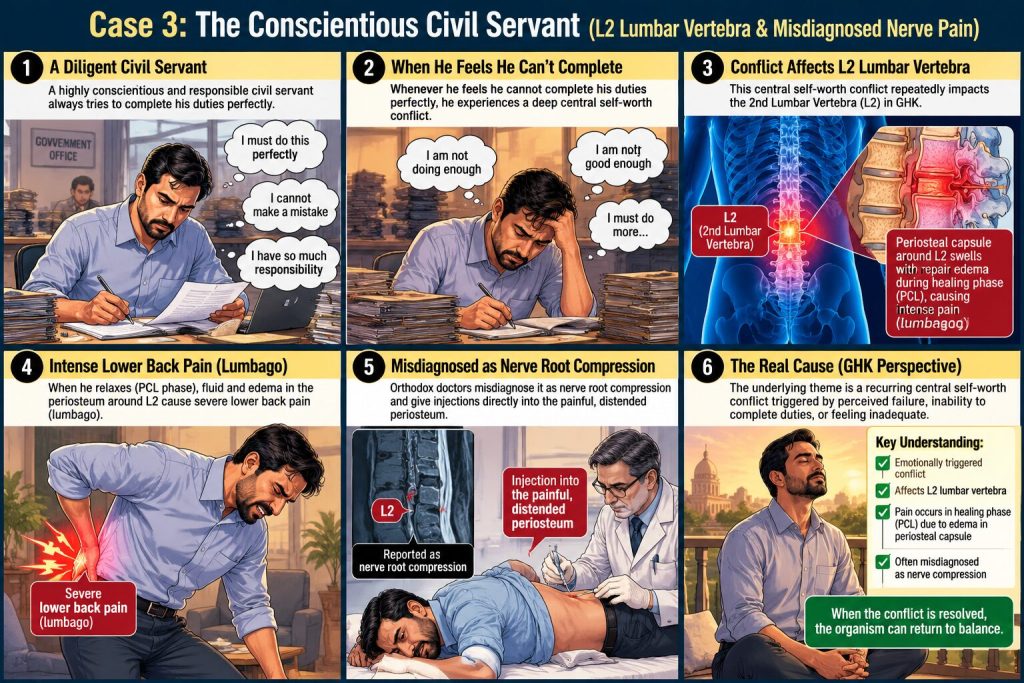
Case 3: The Conscientious Civil Servant (L2 Lumbar Vertebra & Misdiagnosed Nerve Pain)
- Conflict History: A diligent, highly conscientious civil servant suffered recurring central self-worth conflicts whenever he felt he couldn’t complete his duties perfectly.
- Symptom Manifestation: His conflicts consistently impacted the 2nd Lumbar Vertebra (L2). Whenever he relaxed (pcl-Phase), the periosteal capsule around L2 swelled with repair edema, causing intense lower back pain (lumbago). Orthodox doctors repeatedly misdiagnosed this as nerve root compression and injected anesthetics directly into the painful, distended periosteum.
Case 4: Diagnosis Shock & Lumbar Vertebra Collapse (L4/L5)
- Conflict History: A female patient received a terrifying cervical cancer diagnosis shock, which triggered a severe bilateral central self-worth conflict (“My core is collapsing / I am ruined”).
- Symptom Manifestation: Rapid osteolysis occurred across the 4th and 5th lumbar vertebrae (L4/L5), causing L4 to sinter down to 1 cm in height. When she later resolved her fear, massive repair edema filled the periosteal sac surrounding the collapsed L4/L5 vertebrae, compressing adjacent spinal structures and causing partial leg paralysis and intense lumbar pain.
3. GHK Self-Facilitation & Management Guidelines for Lumbar Stenosis
- Identify & Neutralize Tracks (Schienen): Chronic spinal canal narrowing is maintained by recurring conflict relapses. Pinpointing the exact daily triggers (work pressure, family criticism, financial stress) that cause central self-devaluation is essential to stop new osteolysis/calcification cycles.
- Dismantle Diagnosis Shock: The fear of a “narrowed spinal canal” or “permanent nerve damage” often acts as a secondary self-devaluation track. Reassuring the mind that the body is restoring structural integrity helps prevent new stress loops.
- Physical & Postural Support: Gentle stretching, targeted muscle building, gymnastics, and posture work help support the spine.
- Edema & Pain Management: During intense healing phases, resting in bed removes weight-bearing pressure from swelling vertebrae. Cool or warm applications, posture adjustment, or temporary anti-inflammatory measures can be used when repair pain is severe.