Beyond the “Immune System”
What if the language we use to describe disease also shapes the way we understand what the body is doing?
In Germanic Healing Knowledge (GHK / German New Medicine), the modern concept of an “immune system”—conceived as a defensive force fighting hostile invaders or rogue cells—is not part of the biological model proposed by Dr. med. Ryke Geerd Hamer.
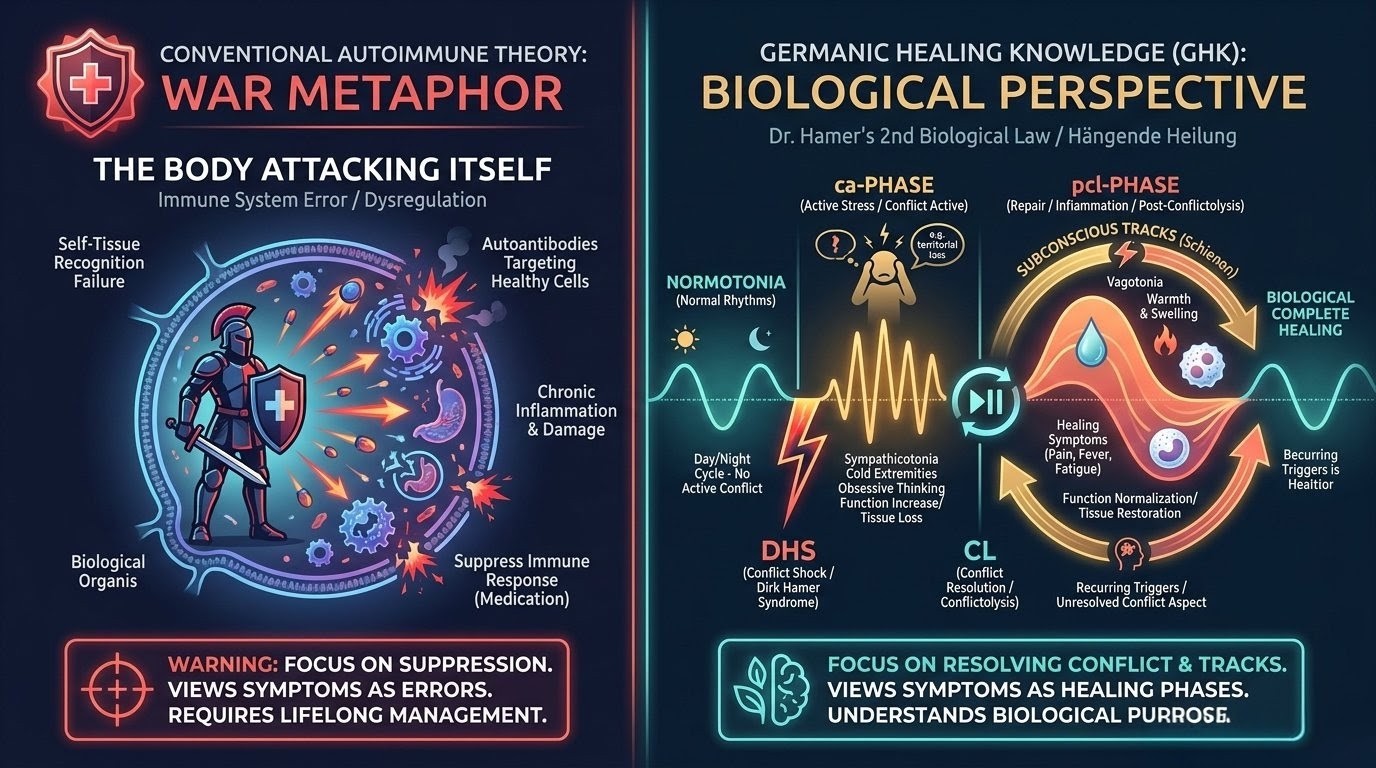
The GHK model describes biological processes through the synchronous relationship between psyche, brain and organ.
Dr. Hamer re-evaluated bodily processes through the 5 Biological Laws of Nature (5 Biologische Naturgesetze).
Within this framework, what conventional medicine calls “disease” or an “immune battle” is interpreted as a synchronized biological special program involving the psyche, brain and organ.
1. Why There Is No Concept of “Immunity” in GHK
A. Disease Is Not an “Error” or an “Attack”
Under GHK’s 5th Biological Law — The Quintessence, Nature is understood as operating according to meaningful biological programs.
Every physical symptom is interpreted as part of a Sinnvolles Biologisches Sonderprogramm (SBS) — a Meaningful Biological Special Program designed for survival.
Within this model, the program begins with a specific emotional conflict shock (DHS / Dirk Hamer Syndrome) and is understood to operate synchronously through the psyche, brain and organ.
If there is no “enemy” inside the body, the question changes: Is the body really fighting itself—or is it carrying out a biological program?
B. Microbes as Symbionts — The 4th Biological Law
In GHK’s 4th Biological Law — The Ontogenetic System of Microbes, bacteria, fungi and viruses are not primarily understood as hostile invaders. They are described as brain-directed biological helpers participating in specific phases of biological programs.
Fungi and Mycobacteria: In the GHK model, these are associated with the decomposition of certain old-brain-controlled tissues during the healing phase.
Bacteria: They are described as participating in the breakdown and rebuilding processes associated with specific tissues during repair.
Viruses: Within the GHK framework, viruses—where present—are associated with restoration processes involving certain epithelial tissues.
In this interpretation, microbes are not an invading army but participants in specific biological processes directed by the organism.
C. What About “Immune Symptoms”?
Fever, inflammation, swelling, fatigue and changes in white blood cell counts are commonly interpreted through the language of immune response.
Within GHK, many of these phenomena are instead interpreted as features of the vagotonic healing phase (pcl-Phase) following conflict resolution.
The same physical observation can therefore be given a completely different biological interpretation depending upon the model being used to understand it.
2. How Did the Concept of “Immunity” Develop?
The history of immunology is not simply the discovery of a word. It represents the development of an entire biological framework for understanding host responses to infection.
A. The Language of Immunity
The word immunity has historical roots in the Latin immunitas, associated with exemption or freedom from certain obligations. The biological meaning developed much later.
B. Cellular Pathology
During the nineteenth century, cellular pathology became an influential way of understanding disease. Rudolf Virchow’s work was central to this development.
C. Pasteur, Koch and Germ Theory
The late nineteenth century saw major developments in microbiology and germ theory. Pasteur, Koch and others helped establish microorganisms as important causes of infectious disease.
GHK fundamentally challenges this interpretation, particularly the idea that microbes are simply hostile agents whose presence itself explains disease.
D. Metchnikoff and Ehrlich
Elie Metchnikoff’s work on phagocytosis and Paul Ehrlich’s work on antibodies became foundational to the emerging field of immunology. They shared the 1908 Nobel Prize in Physiology or Medicine for their respective contributions to the understanding of immunity. :contentReference[oaicite:1]{index=1}
Why Does Talking About “Immunity” Make It True?
A biological term describes a model. The existence of a word, a metaphor, or a widely used framework does not by itself establish every assumption contained within that framework.
GHK asks us to examine the underlying observations differently: What exactly is happening in the psyche, brain and organ—and what biological meaning could be assigned to the process?
The GHK Reframing
In the GHK model, health is not understood primarily as a permanent battle between the organism and external enemies.
Instead, the 5 Biological Laws describe a proposed relationship between psyche → brain → organ → biological program → healing phase.
From this perspective, the question changes from “How do we defeat the disease?” to “What biological program is operating, and what initiated it?”
Summary
GHK does not use the conventional immune-system model as its starting point. It interprets disease, microbes and healing through the proposed 5 Biological Laws of Nature.
The purpose of exploring this perspective is not simply to replace one word with another, but to question the assumptions behind the biological model itself.
Explore the GHK perspective, ask questions, and learn through real case discussions.
🩺 Join the New Medicine Clinic — Sunday Portal