What Are Warts and Moles?
Conventional Medicine
Warts are benign skin growths commonly associated with infection by the Human Papillomavirus (HPV).
Moles (nevi) are usually benign collections of pigment-producing cells (melanocytes) that may be present from birth or develop over time.
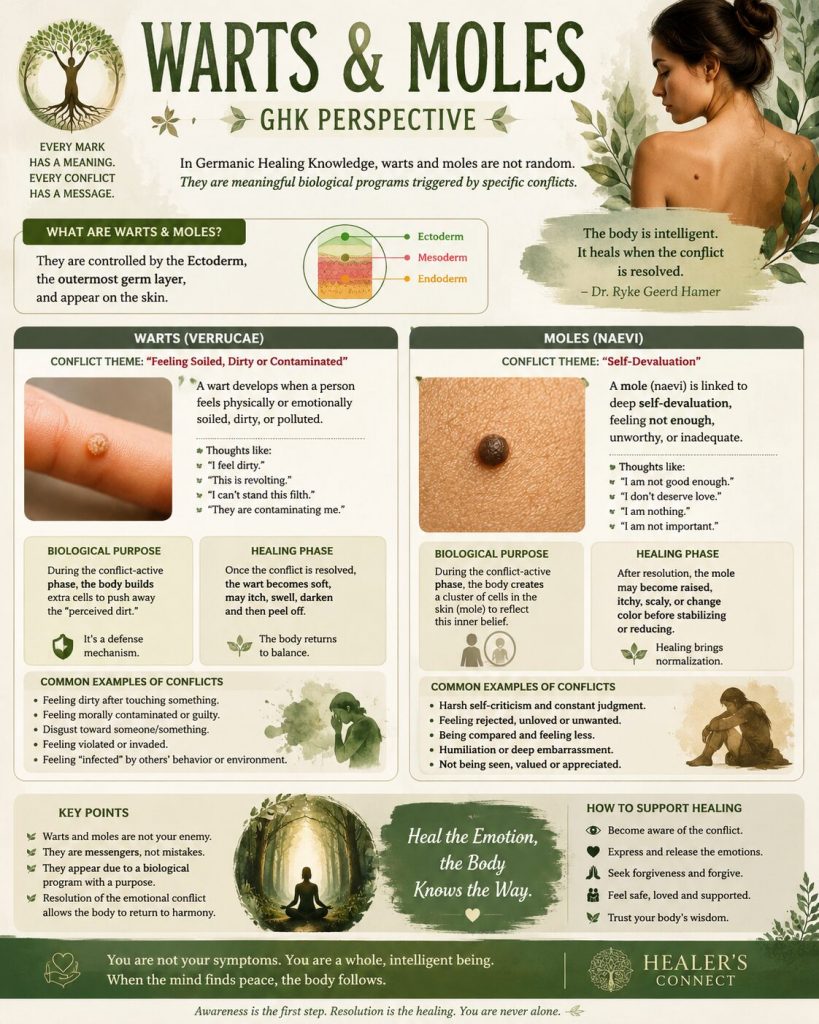
GHK Perspective on Warts
According to Learning GNM, viral infections are not considered the primary cause of warts.
Instead, Learning GNM classifies warts as epidermal healing symptoms related to a separation conflict involving the outer skin.
Biological Conflict
The biological conflict is a:
Separation Conflict
Examples include:
- Feeling separated from a loved one.
- Wanting physical contact.
- Being rejected.
- Being excluded.
- Losing affection.
- Wanting to separate from someone or something (depending on the location).
The location of the wart provides clues about the nature of the conflict.
Conflict-Active Phase
During the active conflict:
- Microscopic ulceration occurs in the epidermis.
- There is usually numbness or reduced sensation.
- Often no visible skin changes occur.
Healing Phase
Once the separation conflict is resolved:
- Epidermal repair begins.
- The skin thickens.
- Local swelling occurs.
- A wart may gradually appear.
According to Learning GNM, repeated conflict relapses can make warts persistent or recurrent.
Questions During GHK Case Taking
- Where exactly is the wart located?
- When did it first appear?
- What separation occurred beforehand?
- Does the wart repeatedly disappear and return?
- What emotional “track” keeps reactivating the conflict?
GHK Perspective on Moles
Learning GNM does not identify ordinary pigmented moles (melanocytic nevi) as a specific Special Biological Program with a defined emotional conflict in the way it does for conditions such as eczema, psoriasis, or warts.
However, if a raised lesion represents a growth arising from another skin tissue rather than a simple melanocytic nevus, the interpretation depends on the tissue of origin.
For example:
- Dermal (corium) growths are associated with a contamination (“feeling soiled”) or attack conflict.
- Epidermal changes are associated with separation conflicts.
Therefore, within GHK, it is important to identify what type of skin lesion is present before assigning a biological conflict.
Why Location Matters
Learning GNM emphasizes that the location often reflects the emotional content.
Examples:
- Hands: wanting or losing contact, work, or interaction.
- Face: separation involving identity, appearance, or recognition.
- Legs: wanting to move away from someone or somewhere, or feeling separated from freedom or movement.
- Feet: wanting to leave a place or return somewhere.
GHK Therapy Approach
Within the GHK framework, practitioners focus on:
- Identifying the original separation conflict.
- Understanding when it began.
- Identifying conflict tracks.
- Helping resolve recurring emotional triggers.
- Allowing healing without repeatedly reactivating the conflict.
Key Insight
According to Learning GNM, warts are interpreted as part of the healing phase following a separation conflict affecting the epidermis. Persistent or recurring warts are thought to indicate repeated conflict relapses. Ordinary pigmented moles, however, are not assigned a specific biological conflict in Learning GNM and should not automatically be interpreted as a Special Biological Program.