Germanic Healing Knowledge (GHK) Perspective
The skin is the organ of contact.
Every skin symptom asks one question:
“Who did I lose contact with, or whose contact do I not want?”
1. The Skin in GHK (Quick Foundation)
- Function: Contact, protection, bonding, separation
- Key conflict: Separation (real or symbolic)
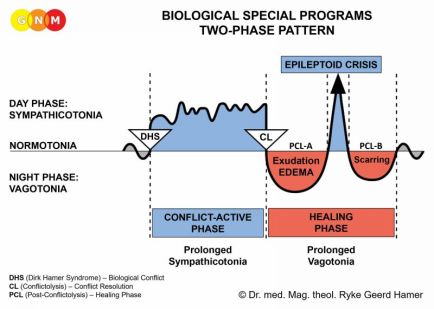
- Important rule:
- Conflict-active phase → dry, numb, pale skin
- Healing phase → redness, itching, oozing, flaking
👉 What modern medicine calls “dermatitis” is almost always the healing phase.
2. Atopic Dermatitis (Eczema) — GHK View
Biological Conflict
Painful or unexpected separation from a loved one
—or—
Longing for contact that is unavailable
This often involves:
- Mother–child separation
- Emotional abandonment
- Loss of physical closeness
- Forced independence too early
Typical Inner Experience
- “I want closeness but can’t have it.”
- “I lost someone I depended on.”
- “I was pushed away.”
In children, this may be:
- Weaning
- Birth of a sibling
- Daycare/school separation
- Hospitalization
- Mother under emotional stress
Phases
Conflict-active phase
- Dry skin
- Reduced sensitivity
- Often unnoticed
Healing phase (eczema)
- Redness
- Intense itching
- Weeping lesions
- Diagnosed as “atopic dermatitis”
👉 Steroids suppress healing, causing chronic relapse.
3. Seborrheic Dermatitis — GHK View
Biological Conflict
Unwanted contact
or
Feeling invaded / dirtied / crossed boundaries
This is not longing, but rejection.
Typical Inner Experience
- “I don’t want this contact.”
- “This person/situation is invading me.”
- “I feel polluted / contaminated / crossed.”
Common contexts:
- Marital intimacy without consent
- Forced caregiving
- Workplace intrusion
- Living situations with no personal space
- Authority imposing presence
- Religious, social, or moral pressure
Why Seborrheic Appears Where It Does
- Scalp: unwanted thoughts, dominance, authority
- Face: social contact, identity invasion
- Chest/back: forced closeness, territory intrusion
Phases
Seborrheic dermatitis often appears as conflict oscillation:
- Unwanted contact continues
- Temporary relief
- Re-exposure
- Chronic flaking/redness
4. Key Differences (GHK Lens)
| Aspect | Atopic Dermatitis | Seborrheic Dermatitis |
|---|---|---|
| Core conflict | Wanted contact lost | Unwanted contact present |
| Emotional tone | Longing, grief | Irritation, repulsion |
| Typical age | Infancy / childhood | Adolescence / adulthood |
| Nature | Separation | Boundary violation |
| Course | Flare during reconnection | Chronic with ongoing intrusion |
5. Why Symptoms Get Worse at Night
At night:
- Parasympathetic (healing) dominates
- Mind relaxes
- Body repairs
👉 Itching intensifies because healing intensifies.
6. Why It Becomes “Chronic”
Chronic dermatitis means:
- The conflict is unresolved
- Or mentally relived
- Or externally repeated
- Or healing is interrupted by suppression
This creates a loop: Conflict → Healing → Suppression → Re-conflict
7. Children & Inherited Patterns
Children often express:
- Mother’s unresolved separation conflict
- Family boundary violations
- Ancestral trauma linked to loss or invasion
The child’s skin is speaking the family field.
8. Resolution (GHK Way)
True healing requires conflict resolution, not skin treatment.
For Atopic Dermatitis
- Restore emotional contact
- Inner reunion with the lost person
- Acceptance of separation
- Safety and reassurance
- Touch with consent and presence
For Seborrheic Dermatitis
- Reclaim personal boundaries
- Acknowledge resentment
- Reduce unwanted exposure
- Inner permission to say NO
- Emotional detox of disgust/anger
9. Key Insight
The skin does not betray us.
It reveals where love was broken or boundaries were crossed.
Until the psyche is heard, the skin will continue to speak.