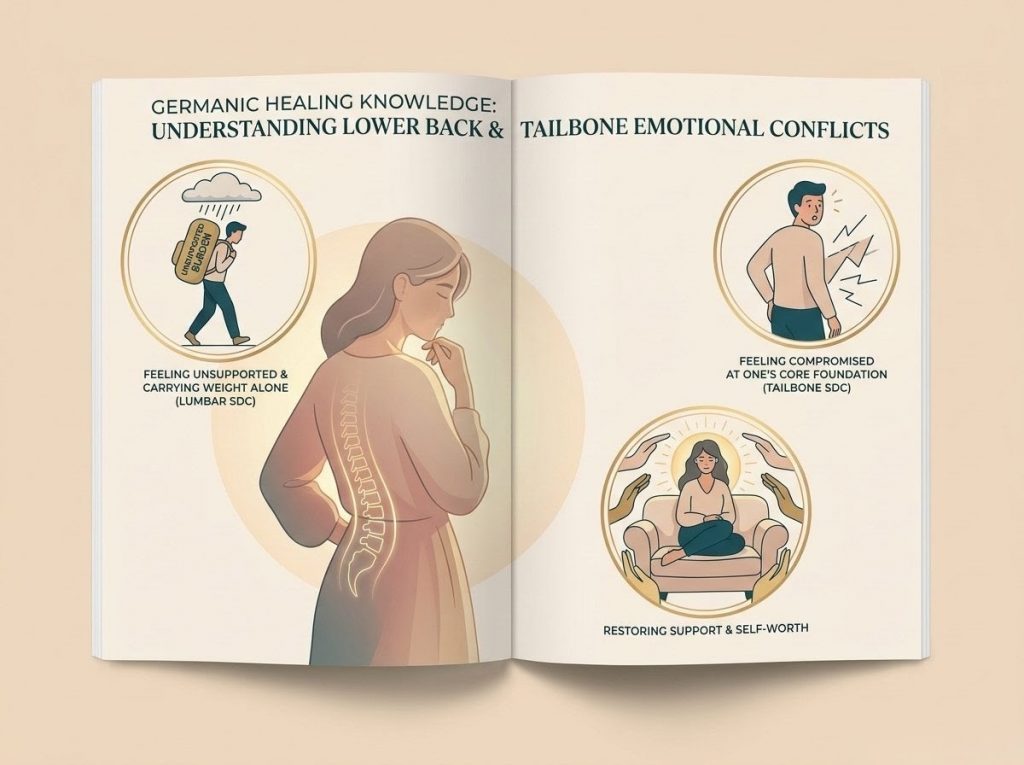
GHK Biological Case Analysis: Anonymous Case
Symptom Focus: Lower Back Pain (Lumbar / Sacral Spine) & Tailbone (Coccyx) Pain
Tissue Layer: New Mesoderm (Cerebral Medulla / Brain White Matter)
Governing Laws: Dr. med. Ryke Geerd Hamer’s 5 Biological Laws of Nature
🧠 1. Biological Conflict Decoding
In Germanic Healing Knowledge (GHK), bones, cartilage, tendons, and striated muscles originate embryologically from the New Mesoderm and are controlled by the Cerebral Medulla. Every New Mesoderm tissue program is driven by a specific flavor of a Self-Devaluation Conflict (SDC)—a sudden shock where a person feels inadequate, unsupported, compromised, or unable to carry a situation.
🦴 Lower Back & Sacrum (Lumbar Spine)
Biological Conflict Theme: Central / Lumbar Self-Devaluation Conflict (SDC).
Core Emotional Experience: Feeling unsupported (financially, emotionally, structurally, or by family/partners), feeling weighed down by a heavy burden, or feeling “unable to hold up or carry the weight of a situation.”
🦴 Tailbone (Coccyx)
Biological Conflict Theme: Specific Pelvic / Seated Self-Devaluation Conflict.
Core Emotional Experience: Feeling “struck from behind,” humiliated or compromised regarding one’s core stability or position, or feeling blindsided in a foundational personal situation.
🖐️ Biological Handedness & Lateralization
If the person is Right-Handed: Right-sided spinal/pelvic pain involves the Partner Domain (husband, father, siblings, business partners, close associates). Left-sided pain involves the Mother / Child Domain.
Central Lower Back & Coccyx: Represents a core, overall feeling of lacking structural foundation or feeling compromised at one’s center.
🔄 2. The Two-Phase Biological Pattern
1. Conflict-Active Phase (ca-Phase)
Upon experiencing the shock of feeling unsupported or burdened, micro-cell reduction (osteolysis / decalcification) occurs in the lumbar vertebrae, sacrum, or coccyx.
Symptom: Typically painless or accompanied by mild cold stiffness without active inflammation.
2. Healing Phase (pcl-Phase & Re-calcification)
Once the person resolves the conflict—feeling supported again, stepping out of the burden, or reclaiming self-worth—the body immediately begins bone repair.
Osteoblasts deposit mineral tissue to fill the voids. The surrounding bone lining (periosteum) stretches, causing tissue swelling, localized inflammation, and acute pain (lumbago, sciatica, or coccydynia).
3. Epileptoid Crisis (EC) & Strengthening
At the midpoint of healing, a temporary peak occurs (often experienced as a sharp muscle spasm or acute twinge).
As healing completes, the bone fully hardens, leaving the lumbar vertebrae and coccyx denser and stronger than before (callus formation).
🌿 3. The “Doing Nothing” Approach & Relapse Prevention
Avoid the “Fear Trap”
When back pain strikes, conventional fear makes people worry that their spine is “damaged” or “broken.” This fear triggers secondary self-devaluation and Kidney Collecting Tubule activation (water retention), which increases swelling and pain.
Active Non-Interference
- Rest the physical spine during active periosteal stretching.
- Reassure the person that her body is not broken—it is actively rebuilding bone density.
- Eliminate “conflict tracks” (situations or conversations that make her feel unsupported or burdened again).
📋 GHK Biological Summary Matrix
| Anatomical Region | Germ Layer & Brain Relay | Biological Conflict Theme | Phase & Healing Expression |
|---|---|---|---|
| Lower Back (Lumbar / Sacrum) | New Mesoderm (Cerebral Medulla) | Central / Lumbar SDC: Feeling unsupported; unable to carry a heavy burden. | Healing Phase (Pcl-Phase): Bone re-calcification, periosteal swelling, acute pressure pain. |
| Tailbone (Coccyx) | New Mesoderm (Cerebral Medulla) | Seated / Pelvic SDC: Feeling “struck from behind” or humiliated in core position. | Healing Phase (Pcl-Phase): Coccyx re-calcification and localized inflammation (coccydynia). |