In Dr. Hamer’s Germanic Healing Knowledge (GHK) / New Medicine, pain in the left thigh of a right-handed woman is interpreted as a mesodermal tissue program controlled by the cerebral white matter (Großhirn-Marklager).
1. The Biological Conflict: Physical / Performance Self-Devaluation
- Tissue Affected: The leg bones (femur/thigh), joints, and surrounding musculature originate from the mesoderm and are governed by the cerebral white matter.
- Conflict Theme: Initiated by a Self-Devaluation Conflict (Selbstwerteinbruch-Konflikt) related to physical capability, movement, performance, or endurance—specifically the feeling of “I can’t manage this,” “I can’t perform,” “I can’t escape/run,” or “I failed to hold my ground”.
2. Handedness & Lateralization (Left Side = Mother / Child)
- The Handedness Rule: In a right-handed woman, the right side of the body represents partners (husband, father, brother, colleague, rival, or friend) [54, 108, 118, 139, 150–152].
- Left Side Significance: The left side strictly represents the Mother/Child relationship (her own mother, her child, or someone she cares for in a maternal/protective dynamic).
- GHK Synthesis: For a right-handed woman, pain in the left thigh indicates that the self-devaluation conflict (“I couldn’t manage,” “I failed physically/capably”) was experienced specifically in relation to her child or her mother.
3. Why the Thigh Hurts: The Two-Phase Rhythm
In GHK, bone and muscular pain does not occur during active conflict stress, but during the healing phase after the conflict has been resolved:
1. Conflict-Active Phase
ca-Phase
- While the self-devaluation conflict is active (sympathicotonia), the thigh bone undergoes localized decalcification (osteolysis) or muscle tissue loss.
- This phase is usually painless, though the bone temporarily loses structural density.
2. Healing Phase — The Source of Pain
pcl-Phase
- Once the conflict is resolved (Conflictolyse), the body enters vagotonia to repair and recalcify the bone.
- Repair requires fluid and edema to carry bone-building cells into the tissue. This fluid swells the inner bone and inflates the outer lining (periosteum), creating intense periosteal stretch pain (Periost-Spannungsschmerz), heat, and localized swelling in the left thigh.
3. Biological Purpose (“Groupe de Luxe”)
- Once recalcification finishes, the bone is rebuilt denser, thicker, and mechanically stronger than it was before the conflict occurred.
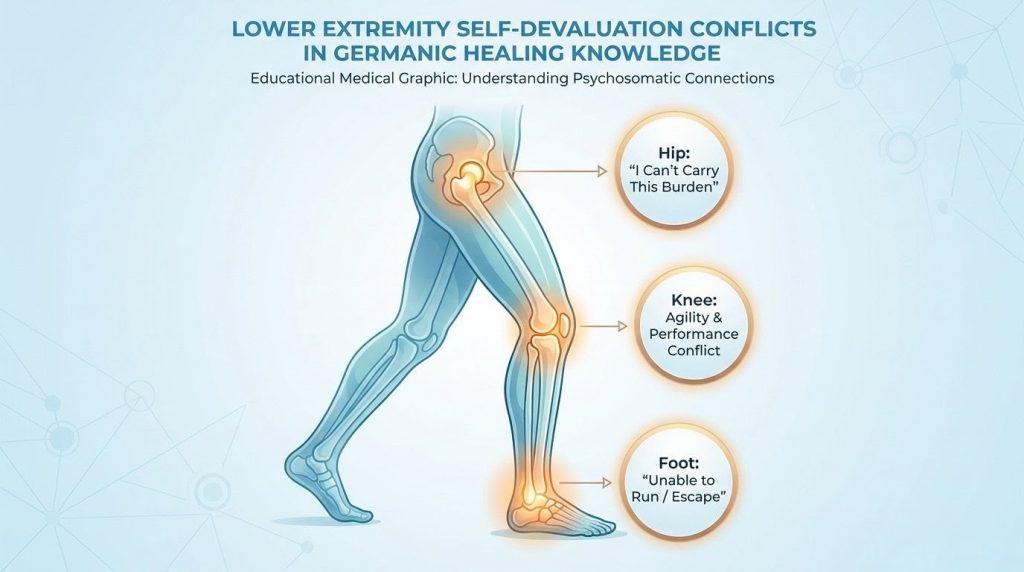
Overview of Lower Extremity Conflicts in GHK: All bones, joints, and skeletal muscles originate from the mesoderm and are controlled by the cerebral white matter (Großhirn-Marklager). Each anatomical segment of the leg corresponds to a specific shade of physical or performance-related self-devaluation.
1. Hip & Femoral Neck (Schenkelhals / Hüftkopf)
- Conflict Theme: “Das schaffe ich nicht!” (“I can’t manage this!” / “I cannot carry or endure this burden”).
Conflict-Active Phase
ca-Phase
- Bone decalcification (osteolysis) of the femoral neck or hip socket.
Healing Phase
pcl-Phase
- Periosteal stretch pain (Periost-Spannungsschmerz), swelling, hip joint effusion (acute hip rheumatism), and risk of spontaneous fracture if burdened before full recalcification.
2. Knee Joint & Shin Head (Knie / Tibiakopf)
- Conflict Theme: Unsportlichkeits-Selbstwerteinbruch (“Unathletic / Performance Self-Devaluation”). Feeling agile-deficient, physically too slow, failing in a sport or physical task, or being forced to yield, bend, or submit.
Conflict-Active Phase
ca-Phase
- Osteolysis of the knee joint bones (tibia head/femoral condyle).
Healing Phase
pcl-Phase
- Acute knee rheumatism (Gelenkrheumatismus), severe joint swelling, heat, pain, and temporary fluid collection.
3. Lower Leg, Ankle & Foot (Unterschenkel / Sprunggelenk / Fuß)
- Conflict Theme: Self-devaluation regarding running, escaping, dancing, kicking away an obstacle, or standing one’s ground (“I couldn’t run away,” “I lost my footing,” “I couldn’t kick him off”).
Conflict-Active Phase
ca-Phase
- Osteolysis of the fibula, tibia shaft, or tarsal/foot bones.
Healing Phase
pcl-Phase
- Localized recalcification swelling, ankle/foot pain, and temporary mobility restriction.