What is an Eye Cyst?
The most common “eye cyst” on the eyelid is a chalazion (meibomian cyst)—a firm lump that develops when a meibomian gland becomes blocked.
According to Learning GNM, a chalazion is not considered an isolated event. It is interpreted as part of a biological program involving the eyelid glands, particularly when healing is prolonged by repeated conflict relapses. (Learning GNM)
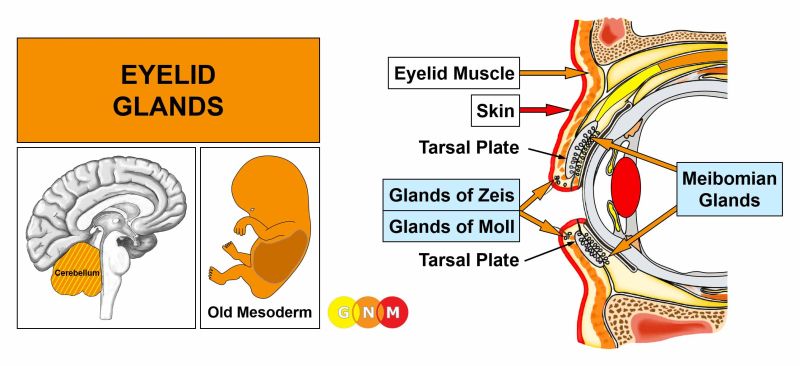
Biological Conflict
According to Learning GNM, the eyelid glands are associated with an attack conflict.
Examples include:
- Feeling attacked or assaulted.
- An unexpected blow or injury near the eye.
- Dust, chemicals, or an object entering the eye and being experienced as an “attack.”
- A symbolic attack directed toward one’s vision or face.
Dust, sand, or other particles (or a bug) hitting the eye can be registered as an attack conflict. In a figurative sense, the “attack” could be triggered by an insulting look (the “evil eye”) or a look of reproach. The conflict also relates to feeling disfigured, soiled or “dirty” concerning the eyelids. A “yucky” touch or kiss on the eye(s) might activate the conflict. Buying into the theory that touching the eyes after contact with a person who has a cold causes an “eye infection” only creates a predisposition for the conflict.
The biological purpose of the gland-cell increase during the conflict-active phase is described as reinforcing the eyelid to better protect the eye from future attacks. (Learning GNM)
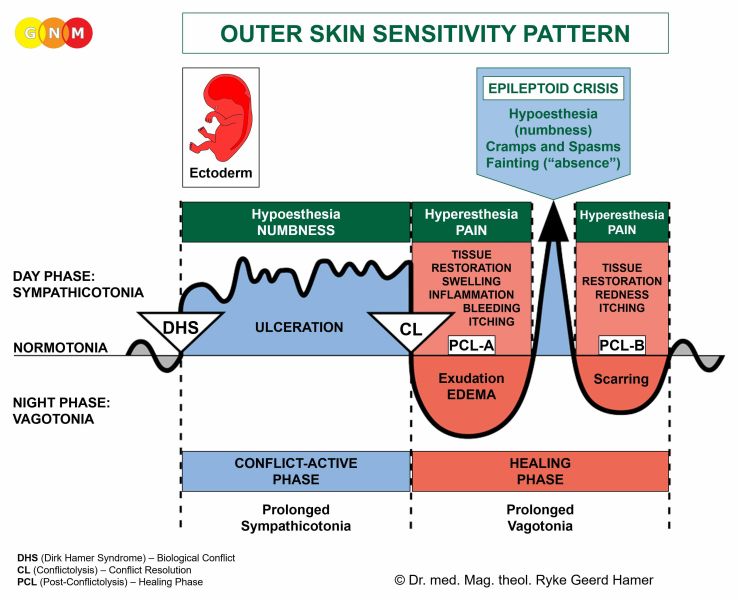
Conflict-Active Phase
Following the DHS (Dirk Hamer Syndrome), Learning GNM states:
- Cells in the eyelid glands proliferate.
- The longer the conflict remains active, the larger the glandular growth may become.
- This swelling may be diagnosed conventionally as an eyelid tumor or gland enlargement.
According to GHK, this increase in cells serves the biological purpose of strengthening the eyelid’s protection. (Learning GNM)
Healing Phase
After the conflict is resolved:
- Fungi or bacteria (when available) remove the additional gland cells.
- The eyelid becomes swollen, red, tender, and may contain pus.
- This stage is commonly recognized as a stye (hordeolum). (Learning GNM)
Why Does a Chalazion Form?
Learning GNM explains that:
- If the meibomian gland becomes blocked and inflamed, a chalazion develops.
- A chalazion is considered a granuloma that usually forms inside the upper eyelid.
- It is described as a sign of a hanging healing, meaning healing repeatedly interrupted by conflict relapses.
- Feeling embarrassed or disfigured because of the eyelid lump can itself reactivate the conflict and prolong healing. (Learning GNM)
Encapsulated Cyst Formation
Learning GNM further states that if the required microbes are not available during healing:
- The extra cells are not completely removed.
- The remaining tissue becomes encapsulated by connective tissue.
- This is interpreted as the formation of a persistent cyst-like lump. (Learning GNM)
Laterality in GHK
Learning GNM notes that:
- Whether the right or left eyelid is affected depends on:
- the person’s handedness,
- whether the conflict relates to a mother/child or a partner relationship.
- A localized attack conflict affects the eye associated with that particular experience. (Learning GNM)
Questions During GHK Case Taking
- When did the eyelid lump first appear?
- Was there a recent event that felt like an “attack” involving the eye or face?
- Was there dust, a foreign body, chemical irritation, or trauma to the eye?
- Has the lump repeatedly improved and returned?
- Has the appearance of the eyelid caused embarrassment or self-consciousness?
- Is the cyst on the right or left eye, and what significant relationship does that side represent according to handedness?
GHK Therapy Approach
Within the GHK framework, the focus is on:
- Identifying the original attack conflict.
- Recognizing any recurring conflict tracks that interrupt healing.
- Resolving ongoing emotional triggers.
- Reducing fear and concern about the appearance of the eyelid if that has become a new source of distress.
Key Insight
According to Learning GNM, a chalazion (eyelid cyst) reflects a prolonged or repeatedly interrupted healing process following an attack conflict involving the eyelid. Frequent conflict relapses are believed to prevent complete healing, allowing the blocked gland to persist as a cyst-like lesion. (Learning GNM)Y